Rajasthan CM: 3.34 Lakh Farmers in 26 Districts Get Daytime Power
Synopsis
The Chief Minister's Office of Rajasthan announced that over 3.34 lakh farmers across 26 districts are now receiving daytime electricity for agriculture, a milestone under CM Bhajanlal Sharma's rural development agenda and the feeder-separation infrastructure built under national schemes.
Key Takeaways
More than 3 lakh 34 thousand farmers across 26 districts of Rajasthan are now receiving daytime electricity for agricultural use.
The announcement was made by the Chief Minister's Office of Rajasthan on August 19, 2026 , crediting CM Bhajanlal Sharma .
Daytime agricultural power supply reduces nighttime irrigation risks, electricity theft, and crop losses from unmonitored watering.
The shift is enabled by dedicated agricultural feeder separation, a model supported nationally by the Deen Dayal Upadhyaya Gram Jyoti Yojana (2015).
Expansion to remaining Rajasthan districts will determine the full impact on farmer incomes and the state's power distribution network.
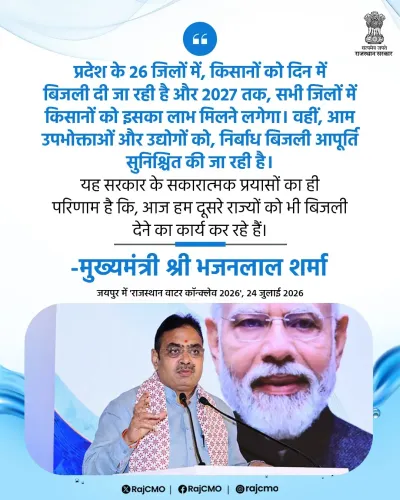
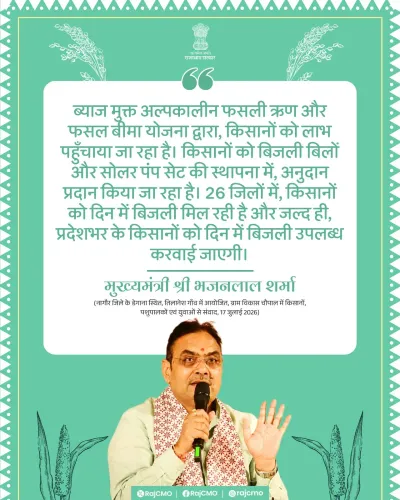
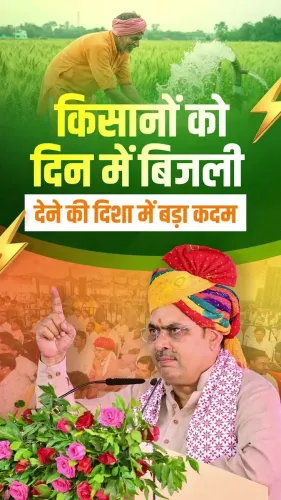
Daytime electricity for farming — a demand that has echoed across Rajasthan's fields for decades — is now a reality for more than 3 lakh 34 thousand farmers across 26 districts of the state. The Chief Minister's Office of Rajasthan announced on Wednesday, August 19, 2026, that agricultural power supply has been successfully shifted to daylight hours, crediting the initiative to Chief Minister Bhajanlal Sharma.
What daytime power means for Rajasthan's farmers
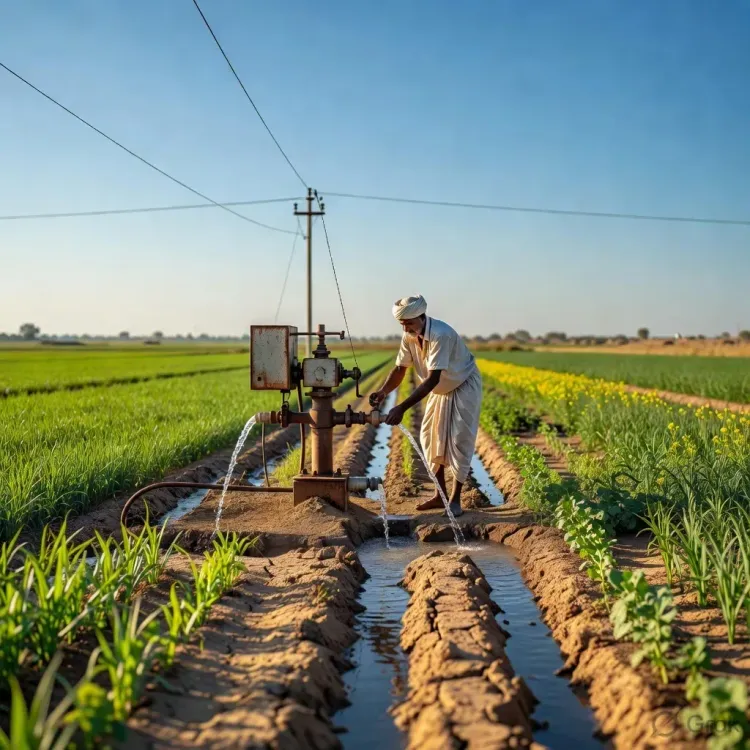
For generations, farmers in Rajasthan ran their irrigation pump sets through the night — a dangerous, exhausting, and often theft-prone arrangement forced by grid constraints. Shifting supply to daytime hours changes the equation entirely. Farmers can now monitor their irrigation, reduce crop losses from over- or under-watering, and work their fields safely under sunlight.
Rajasthan's agriculture is heavily dependent on electric pump sets for groundwater irrigation, making reliable, timed power supply a direct lever on yields and farmer incomes. The post, tagged with the hashtag #आपणो_अग्रणी_राजस्थान ('Our Leading Rajasthan'), frames the initiative as part of the BJP government's broader rural development push under CM Bhajanlal Sharma, who took office in December 2023.
The feeder-separation backbone behind the shift
The structural enabler for such daytime agricultural supply is the separation of dedicated agricultural feeders from domestic and industrial lines — a model championed nationally under the Deen Dayal Upadhyaya Gram Jyoti Yojana, launched in 2015. Separate feeders allow distribution companies to schedule agricultural power independently, without disrupting household supply or bowing to peak-hour industrial demand.
Rajasthan has been among the states where feeder separation has been a long-running infrastructure project. Getting 26 districts onto a coordinated daytime schedule represents a significant operational milestone for the state's power distribution network.
A pattern playing out across Indian states
Rajasthan is not alone in this push. States from Gujarat to Andhra Pradesh have piloted dedicated daytime agricultural feeders, with measurable gains in farm productivity and reductions in electricity theft — a chronic drain on distribution companies' finances. The difference here is scale: 3.34 lakh farmers brought onto a single coordinated schedule across more than two dozen districts is a number that signals system-wide implementation, not a pilot.
The remaining districts of Rajasthan — and the pace at which they are brought into the daytime supply fold — will be the real test of whether this becomes a state-defining infrastructure achievement or stalls at the current footprint.
Point of View
Tangible rural deliverable ahead of the next electoral cycle — a smart play in a state where farmer welfare has historically swung elections. Covering 26 districts and 3.34 lakh beneficiaries gives the BJP a concrete, enumerable achievement to campaign on, distinct from the broader but harder-to-quantify gains of feeder-separation infrastructure. The initiative also aligns with the Centre's long-standing push to make state power distribution companies financially viable by reducing theft and cross-subsidisation pressure — meaning this is both local politics and national policy convergence in one announcement. The real scrutiny will come when independent assessments measure actual supply hours delivered versus those promised.
NationPress
20 Aug 2026
Frequently Asked Questions
Which districts in Rajasthan are getting daytime electricity for farmers?
The Rajasthan government has announced daytime agricultural power supply across 26 districts , though the specific district names were not listed in the official announcement.
How many farmers in Rajasthan are benefiting from daytime power supply?
More than 3 lakh 34 thousand (334,000) farmers are currently receiving daytime electricity for agricultural use, according to the Chief Minister's Office of Rajasthan.
What is the Deen Dayal Upadhyaya Gram Jyoti Yojana and how does it relate to this?
The Deen Dayal Upadhyaya Gram Jyoti Yojana , launched in 2015 , funded the separation of agricultural feeders from domestic power lines across Indian states including Rajasthan, making it technically possible to schedule dedicated daytime supply for farmers.
Why is daytime electricity important for farmers in Rajasthan?
Daytime power allows farmers to operate irrigation pump sets safely, monitor water usage, and avoid the dangers and inefficiencies of nighttime farming — directly improving crop management and reducing electricity theft.
What is 'Aapno Agrani Rajasthan'?
Aapno Agrani Rajasthan ('Our Leading Rajasthan') is a hashtag used by the Rajasthan government under CM Bhajanlal Sharma to brand its development and governance initiatives.