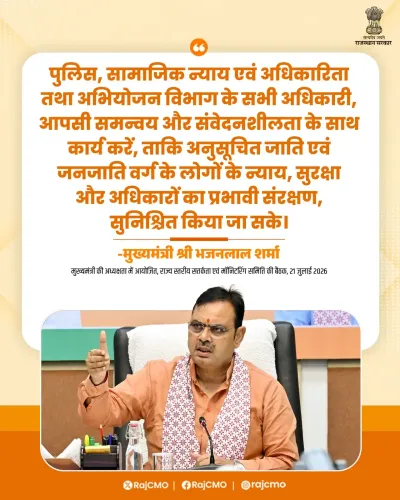
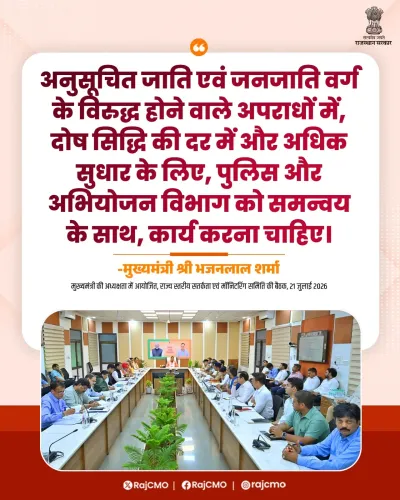
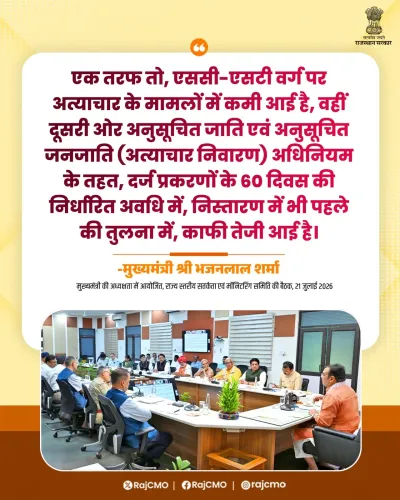
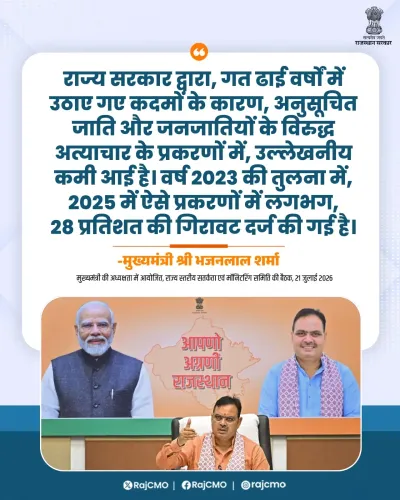
Rajasthan CM Bhajanlal calls for strict action against SC/ST crimes
Synopsis
The Chief Minister's Office of Rajasthan on 22 July 2026 called for strict enforcement of laws against crimes targeting SC/ST communities and urged recognition of individuals who foster social harmony, under CM Bhajanlal Sharma's 'Aapno Agrani Rajasthan' agenda.
Key Takeaways
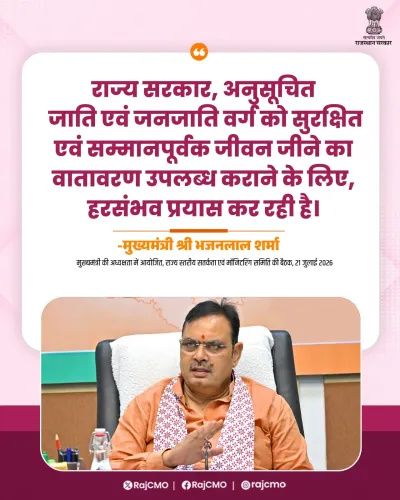
The Chief Minister's Office of Rajasthan issued a public directive on 22 July 2026 calling for strict action against perpetrators of crimes targeting SC/ST communities .
The statement also urged that individuals contributing to social harmony be actively encouraged and recognised.
The directive is framed under the #आपणो_अग्रणी_राजस्थान ('Our Leading Rajasthan') campaign of CM Bhajanlal Sharma .
The legal backbone for enforcement is the SC/ST (Prevention of Atrocities) Act, 1989 , amended in 2015 and 2018 .
State police, district magistrates, and special courts are the primary institutions responsible for implementing the directive.
NCRB annual atrocity data and state budget allocations for special courts will be key indicators of follow-through.
The Chief Minister's Office of Rajasthan on Wednesday, 22 July 2026 directed that perpetrators of crimes against Scheduled Caste and Scheduled Tribe communities be dealt with strictly, while urging that those who contribute to social harmony be encouraged and recognised. The directive, addressed to Chief Minister Bhajanlal Sharma, was accompanied by the hashtag #आपणो_अग्रणी_राजस्थान ('Our Leading Rajasthan'), the government's ongoing brand for its development agenda.
Context
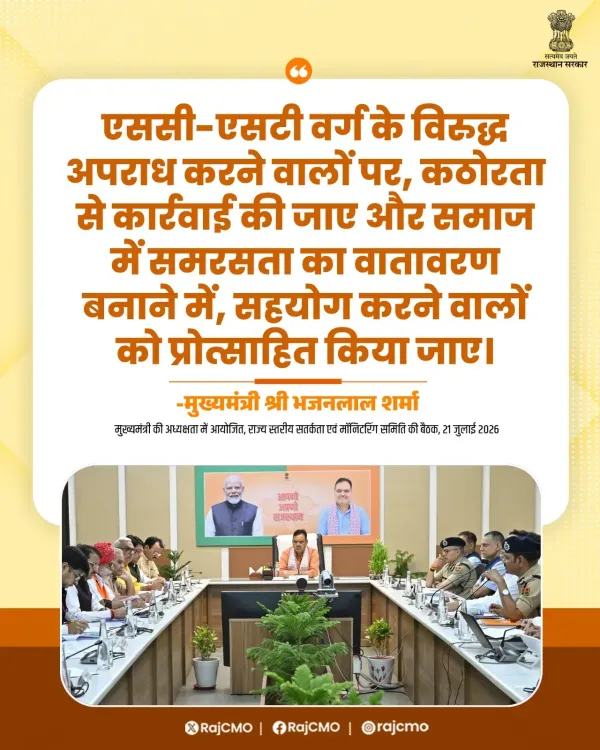
The post, in Hindi, states: 'एससी-एसटी वर्ग के विरुद्ध अपराध करने वालों पर, कठोरता से कार्रवाई की जाए और समाज में समरसता का वातावरण बनाने में, सहयोग करने वालों को प्रोत्साहित किया जाए' — translated: 'Those who commit crimes against SC/ST communities must be dealt with strictly, and those who help create an atmosphere of harmony in society must be encouraged.' The statement signals the administration's dual-track approach: punitive action against offenders alongside positive reinforcement for community peacebuilders.
Rajasthan has a substantial Scheduled Caste and Scheduled Tribe population, making enforcement of anti-atrocity laws a recurring governance priority for successive state administrations. Chief Minister Bhajanlal Sharma, who took office in December 2023, has positioned his government's outreach under the 'Aapno Agrani Rajasthan' ('Our Leading Rajasthan') banner, which encompasses social justice alongside economic development goals.
Policy Backdrop
The legal framework underpinning this directive is the Scheduled Castes and the Scheduled Tribes (Prevention of Atrocities) Act, enacted by Parliament in 1989 and significantly strengthened through amendments in 2015 and 2018. The Act prescribes stringent punishments for a wide range of caste-based offences, mandates special courts for speedy trials, and provides for victim relief and rehabilitation.
State governments bear primary responsibility for enforcement, including directing police action, constituting special investigation teams, and ensuring timely filing of charge sheets. Indian state administrations — including those in Rajasthan — routinely pair messaging on strict legal action under the Act with broader appeals for social cohesion, particularly in the wake of reported incidents of caste tension.
Stakeholders and Impact
The most direct beneficiaries of robust enforcement are members of Scheduled Caste and Scheduled Tribe communities, who are legally entitled to protection, timely justice, and compensation under the Act. State police, district magistrates, and special courts are the key institutional actors responsible for translating the directive into ground-level action.
Civil society organisations working on Dalit and Adivasi rights have long argued that the gap between policy statements and on-ground enforcement remains wide. The CMO's public communication signals political will at the top, but accountability mechanisms — including monitoring of charge-sheet rates and conviction data — determine whether the intent translates into outcomes for affected communities.
What's Next
Analysts and rights groups will watch for follow-through in the form of administrative circulars to district police superintendents, allocations for special courts, and victim compensation disbursements. The annual crime data published by the National Crime Records Bureau (NCRB) on atrocities against SC/ST communities will serve as a key benchmark for evaluating enforcement trends in Rajasthan. Any state budget announcements targeting fast-track courts or expanded victim support infrastructure will be closely tracked as indicators of how far this public directive translates into structural change.
Point of View
Particularly as a signal of political sensitivity toward large SC/ST voter blocs. For CM Bhajanlal Sharma, who is still consolidating his administration's identity after taking charge in December 2023, such public communications serve a dual purpose — demonstrating law-and-order resolve while projecting an inclusive social vision under the 'Aapno Agrani Rajasthan' brand. The real test, as rights advocates consistently point out, lies not in the statement but in charge-sheet rates, special court functioning, and victim compensation disbursal — metrics that will emerge in future NCRB reports. Until those data points are available, the directive is best read as a governance signal rather than a measurable policy shift.
NationPress
22 Jul 2026
Frequently Asked Questions
What did the Rajasthan CMO say about SC/ST crimes on 22 July 2026?
The Chief Minister's Office of Rajasthan directed on 22 July 2026 that those committing crimes against SC/ST communities must face strict legal action, and that individuals fostering social harmony should be encouraged and recognised.
What is the SC/ST Prevention of Atrocities Act?
The Scheduled Castes and the Scheduled Tribes (Prevention of Atrocities) Act, 1989, is a central law that prescribes stringent punishments for caste-based crimes, mandates special courts for speedy trials, and provides victim relief. It was amended in 2015 and 2018 to strengthen its provisions.
Who is Bhajanlal Sharma and what is his role in Rajasthan?
Bhajanlal Sharma is a BJP politician who has served as Chief Minister of Rajasthan since December 2023. The CMO's directive was addressed to him as part of his administration's governance communications.
What is 'Aapno Agrani Rajasthan'?
'Aapno Agrani Rajasthan' — meaning 'Our Leading Rajasthan' — is the Bhajanlal Sharma government's campaign brand, used to frame its development and social justice agenda across public communications.
How is SC/ST crime enforcement monitored in India?
The National Crime Records Bureau (NCRB) publishes annual data on crimes against SC/ST communities, covering registration rates, charge-sheet filing, and convictions. State-level performance on special courts and victim compensation is also tracked by the Union Ministry of Social Justice and Empowerment.