Rajasthan CM Bhajanlal flags Western Freight Corridor as economic pillar
Synopsis
The Chief Minister's Office of Rajasthan on 18 July 2026 highlighted the 1,504-km Western Dedicated Freight Corridor as a vital pillar of the state's economic progress, linking CM Bhajan Lal Sharma to the centrally built freight rail project that traverses hundreds of kilometres of Rajasthan.
Key Takeaways
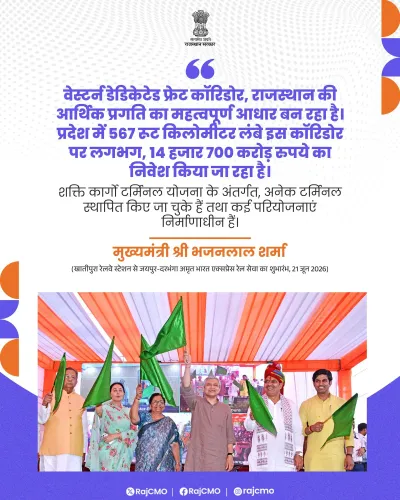
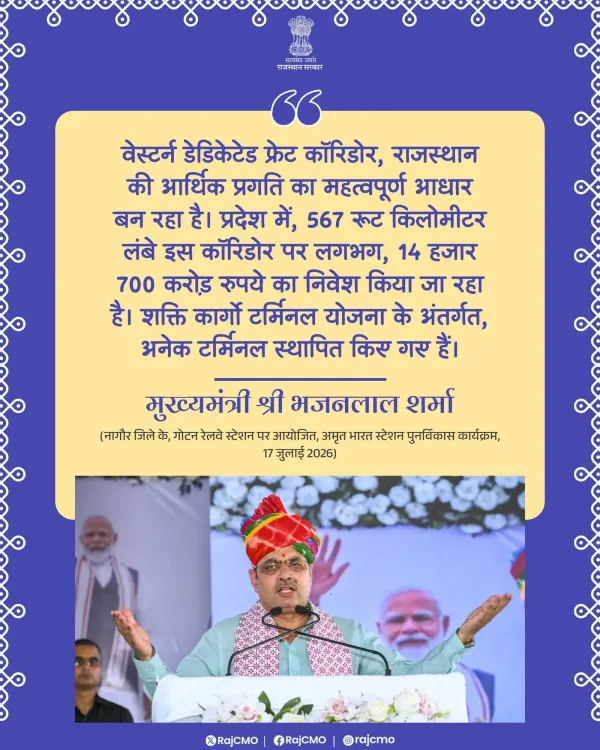
The Rajasthan CMO on 18 July 2026 described the Western Dedicated Freight Corridor as 'an important foundation of Rajasthan's economic progress.' The post tagged Chief Minister Bhajan Lal Sharma and used the state branding hashtag #आपणो_अग्रणी_राजस्थान ('Our Leading Rajasthan').
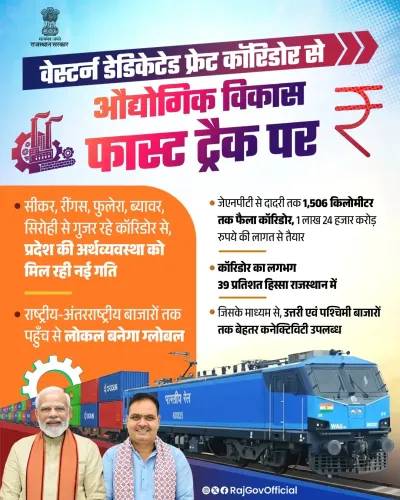
The WDFC spans 1,504 km from Dadri, UP to JNPT near Mumbai , passing through several hundred kilometres of Rajasthan .
The corridor was approved in 2006 and is operated by DFCCIL under the Ministry of Railways ; it is also aligned with PM Gati Shakti .
Key beneficiaries include Rajasthan's mining sector , logistics operators, and manufacturers who gain faster, cheaper freight access to ports.
The Chief Minister's Office of Rajasthan on Saturday, 18 July 2026, highlighted the Western Dedicated Freight Corridor as a critical driver of the state's economic progress, tagging Chief Minister Bhajan Lal Sharma in the post under the campaign hashtag #आपणो_अग्रणी_राजस्थान ('Our Leading Rajasthan').
Context
The post, shared from the official @RajCMO account, states that the Western Dedicated Freight Corridor 'राजस्थान की आर्थिक प्रगति का महत्वपूर्ण आधार बन रहा है' — 'is becoming an important foundation of Rajasthan's economic progress.' The message is brief but pointed, framing a central-government infrastructure project as a vehicle for state-level economic advancement under the Sharma administration. The hashtag aligns with the Rajasthan government's broader branding effort to project the state as a frontrunner in development.Policy Backdrop
The Western Dedicated Freight Corridor (WDFC) is a 1,504-km dedicated rail freight line stretching from Dadri in Uttar Pradesh to Jawaharlal Nehru Port Trust (JNPT) near Mumbai, passing through several hundred kilometres of Rajasthan. It was conceived in the Union Railway Budget of 2005-06 and received Cabinet approval in 2006, with the Dedicated Freight Corridor Corporation of India (DFCCIL) — a special purpose vehicle under the Ministry of Railways — incorporated the same year to build and operate the network. The corridor is designed to carry heavy freight at higher speeds and lower costs by separating freight trains from passenger traffic, a long-standing bottleneck on Indian Railways. The WDFC is also a key component of the national PM Gati Shakti multimodal connectivity framework, which seeks to integrate rail, road, port, and logistics infrastructure across India.Stakeholders and Impact
Rajasthan is among the states with the most to gain from the WDFC, given its significant mining and industrial traffic. The corridor enables faster and cheaper movement of bulk commodities — including minerals, cement, and agricultural produce — from the state's hinterland to ports and consumption centres. Logistics operators and manufacturers in the state stand to benefit from reduced transit times and lower freight costs, while the improved connectivity is expected to attract fresh industrial investment. The state government's decision to publicly associate Chief Minister Bhajan Lal Sharma with the corridor signals an intent to claim political credit for the infrastructure dividend flowing from a centrally built and funded project.What's Next
Attention will now turn to full commissioning of the remaining WDFC sections within Rajasthan and any state-level announcements on industrial parks, logistics hubs, or last-mile connectivity projects designed to leverage the new freight line. If the Sharma government follows through on positioning the corridor as an economic anchor, complementary state investments in road connectivity and warehousing infrastructure along the WDFC alignment are likely to follow. The corridor's operational performance will ultimately determine how much of the promised economic uplift translates into measurable gains for Rajasthan's industries and workers.Point of View
Converting a Railways-funded asset into a state-level political dividend. This pattern — state governments amplifying central schemes under their own branding — has become a standard playbook across BJP-ruled states, particularly in the run-up to electoral cycles. The hashtag 'Our Leading Rajasthan' suggests the government is actively building a development narrative around the WDFC as part of a wider communication strategy. Whether the messaging translates into tangible policy follow-through — such as industrial parks or logistics hubs along the corridor — will be the real test of intent.
NationPress
18 Jul 2026
Frequently Asked Questions
What is the Western Dedicated Freight Corridor and how does it pass through Rajasthan?
The Western Dedicated Freight Corridor is a 1,504-km dedicated rail freight line from Dadri in Uttar Pradesh to JNPT near Mumbai, passing through several hundred kilometres of Rajasthan. It is built to carry heavy freight at higher speeds and lower costs than the regular rail network.
Who is Bhajan Lal Sharma and what is his role in Rajasthan's infrastructure push?
Bhajan Lal Sharma is the Chief Minister of Rajasthan, having taken office in December 2023 as a Bharatiya Janata Party leader. His office has been actively associating him with infrastructure projects like the WDFC to build a development narrative for the state.
What is DFCCIL and who funds the Western Dedicated Freight Corridor?
DFCCIL, or the Dedicated Freight Corridor Corporation of India, is a special purpose vehicle under India's Ministry of Railways incorporated in 2006 to build and operate the country's dedicated freight corridors. The Western corridor is a centrally funded and managed project.
How does the Western Dedicated Freight Corridor benefit Rajasthan's economy?
The corridor enables faster and cheaper movement of bulk commodities such as minerals, cement, and agricultural produce from Rajasthan's hinterland to ports and markets. Logistics operators, manufacturers, and the mining sector are among the primary beneficiaries.
What is PM Gati Shakti and how is the WDFC connected to it?
PM Gati Shakti is a national multimodal connectivity framework that integrates rail, road, port, and logistics infrastructure across India. The Western Dedicated Freight Corridor is a key component of this initiative, designed to reduce logistics costs and improve supply-chain efficiency.