Rajasthan CM Directs Mission-Mode Push on Health Infrastructure

Synopsis
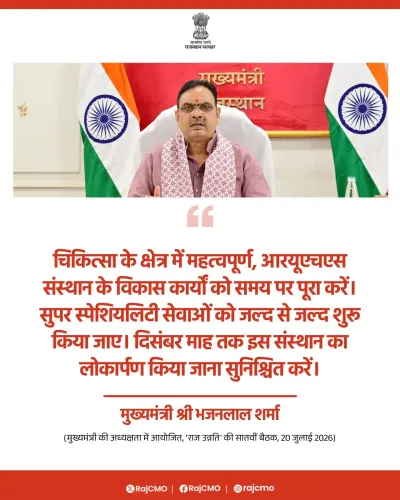
The Chief Minister's Office of Rajasthan on 19 August 2026 directed CM Bhajan Lal Sharma to complete all pending works under the Mukhyamantri Ayushman Arogya Swasthya Avsanrachna Mission in mission mode, signalling a hard push on health infrastructure delivery across the state.
Key Takeaways
The Rajasthan CMO on 19 August 2026 issued a mission-mode directive for pending health infrastructure works.
The directive is addressed to Chief Minister Bhajan Lal Sharma of the BJP-led Rajasthan government.
The Mukhyamantri Ayushman Arogya Swasthya Avsanrachna Mission targets strengthening of district hospitals and health facilities across Rajasthan.
The state mission complements the central Ayushman Bharat programme launched in 2018 .
Mission-mode execution means time-bound, CMO-monitored completion with direct accountability for district officials.
Progress reports from the Rajasthan health department on fund utilisation and facility upgrades will be the key indicator of follow-through.
Rajasthan's health infrastructure buildout has a new deadline pressure. The Chief Minister's Office of Rajasthan on Wednesday, 19 August 2026 issued a pointed directive: all remaining work under the Mukhyamantri Ayushman Arogya Swasthya Avsanrachna Mission must be completed in mission mode — no more delays, no more pending files.
The post, addressed directly to Chief Minister Bhajan Lal Sharma (@BhajanlalBjp), carried the hashtag #आपणो_अग्रणी_राजस्थान — 'Our Leading Rajasthan' — signalling the administration's intent to frame health delivery as a marker of governance performance. The message is terse and unambiguous: finish what is started.
What the Mukhyamantri Ayushman Arogya Mission covers
The Mukhyamantri Ayushman Arogya Swasthya Avsanrachna Mission is a Rajasthan state initiative designed to strengthen physical health infrastructure — district hospitals, primary health centres, and associated medical facilities — across the state. It sits alongside the central government's Ayushman Bharat programme, launched in 2018, which provides the national framework for both health insurance and infrastructure expansion. Rajasthan's state mission layers additional capital works and facility upgrades on top of that central architecture.
Since the BJP government took office in Rajasthan in December 2023, the administration has repeatedly emphasised accelerated execution of infrastructure projects initiated or inherited at the state level. Mission-mode timelines — where pending works are tracked against hard deadlines with centralised oversight — have become a standard governance tool for this government when progress on large schemes stalls.
Why 'mission mode' is the operative phrase
The choice of language matters. 'Mission mode' in Indian administrative parlance is not a metaphor — it signals a shift to time-bound, top-monitored execution with direct accountability to the Chief Minister's Office. When a CMO publicly invokes it, district officials and health department heads understand that progress reports will be scrutinised and delays will be visible at the top. For Rajasthan's residents — particularly those in rural and semi-urban areas who depend on district-level public health facilities — faster completion of these projects translates directly into functional hospitals, equipped wards, and accessible care.
The state health department's official progress reports on facility upgrades and fund utilisation under the mission will be the next concrete measure of whether this directive moves from announcement to action.
Point of View
Direct address to the Chief Minister on a pending infrastructure mission is a calibrated governance signal — it creates visible accountability and puts district-level health officials on notice ahead of any performance review cycle. For the Bhajan Lal Sharma administration, completing tangible health infrastructure works is both a policy priority and a political asset, given that public health delivery was a central campaign issue in the 2023 Rajasthan election. The invocation of mission mode also reflects a broader BJP state-government pattern of using top-down, deadline-driven frameworks to demonstrate administrative momentum. Whether the directive translates into measurable progress will depend on fund disbursement timelines and contractor capacity on the ground.
NationPress
19 Aug 2026
Frequently Asked Questions
What is the Mukhyamantri Ayushman Arogya Swasthya Avsanrachna Mission in Rajasthan?
It is a Rajasthan state scheme focused on strengthening physical health infrastructure — including district hospitals and primary health centres — across the state, complementing the central Ayushman Bharat programme launched in 2018.
What does 'mission mode' mean in the context of the Rajasthan health directive?
'Mission mode' in Indian administration means time-bound, centrally monitored execution with direct accountability to the Chief Minister's Office, ensuring pending works are completed against hard deadlines.
Who is Bhajan Lal Sharma?
Bhajan Lal Sharma is a Bharatiya Janata Party leader who has served as Chief Minister of Rajasthan since December 2023.
How is the Rajasthan state mission related to Ayushman Bharat?
Ayushman Bharat is the central government's national health programme launched in 2018; the Rajasthan state mission builds on that framework by targeting additional capital works and facility upgrades at the state level.
What will show whether the Rajasthan health infrastructure directive has been acted upon?
Official progress reports from the Rajasthan health department on facility upgrades and fund utilisation under the Mukhyamantri Ayushman Arogya Swasthya Avsanrachna Mission will be the key measure of implementation.