Rajasthan CM Office: 2.19 Cr PMFBY Policies, Rs 9,534 Cr Claims Paid
Synopsis
Rajasthan's Chief Minister's Office announced on 2 August 2026 that 2.19 crore policies have been issued and Rs 9,534 crore in claims disbursed under PMFBY, framing the figures as a key welfare milestone under CM Bhajan Lal Sharma's BJP government.
Key Takeaways
2.19 crore PMFBY policies have been issued in Rajasthan under the current government.
Farmers have received Rs 9,534 crore in crop insurance claim disbursements.
The announcement was made by the Chief Minister's Office of Rajasthan on 2 August 2026 , tagged to CM Bhajan Lal Sharma .
PMFBY , launched in 2016, is a central-state partnership replacing older crop insurance schemes.
Rajasthan's rain-fed, arid farming belt makes crop insurance coverage especially critical for rural livelihoods.
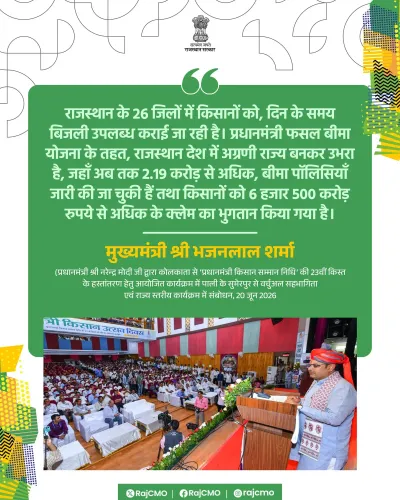
Crop insurance is only as good as the cheque that actually reaches the farmer — and Rajasthan's Chief Minister's Office is putting a number to that promise. On Sunday, 2 August 2026, the CMO announced that under the Pradhan Mantri Fasal Bima Yojana (PMFBY), the state has issued 2.19 crore policies and disbursed claims worth Rs 9,534 crore to farmers.
The post, tagged to Chief Minister Bhajan Lal Sharma and carrying the hashtag #आपणो_अग्रणी_राजस्थान ('Our Pioneering Rajasthan'), frames the figures as a marker of welfare delivery under the BJP government that took office in December 2023.
What PMFBY actually does — and why Rajasthan's scale matters
PMFBY, launched nationally in 2016, replaced the older National Agricultural Insurance Scheme and Modified NAIS with a single, simplified framework: farmers pay a capped premium, and the central and state governments split the remaining cost. When crops fail — due to drought, flood, pest, or unseasonal rain — enrolled farmers are entitled to compensation pegged to yield-loss assessments.
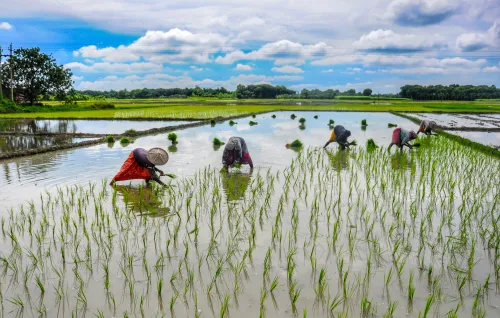
Rajasthan's geography makes this especially consequential. The state is home to one of India's largest arid and semi-arid farming belts, where rain-fed agriculture means a single bad monsoon can wipe out a season's income. A policy count of 2.19 crore and a payout of nearly Rs 9,534 crore represent the scheme working at scale in precisely the kind of vulnerable landscape it was designed for.
How states use PMFBY data as a welfare scorecard
Across India, state governments periodically publicise cumulative PMFBY figures — policies issued, premiums collected, claims settled — as a measure of agricultural governance. The practice reflects a broader accountability dynamic: PMFBY is a central-state partnership, so both Delhi and state capitals share credit (and blame) for its reach.
For the Bhajan Lal Sharma administration, anchoring the announcement to the CMO's official handle and tagging the Chief Minister directly signals that farm welfare is being positioned as a signature deliverable. Rajasthan's rural electorate, which swings elections, is watching both the headline number and the ground-level experience of actually receiving a claim.
The real test of any crop insurance announcement is not the policy count but the claim settlement ratio — how many of those 2.19 crore policyholders who filed claims actually received money, and how fast. That granular data is what farmers, and eventually voters, will weigh.
Point of View
Rs 9,534 crore in claims) is politically significant in a state where agrarian distress has historically driven electoral outcomes. However, the announcement's credibility will ultimately rest on ground-level claim settlement ratios and turnaround times, which are not disclosed here. As PMFBY faces ongoing scrutiny nationally over delayed payouts and coverage gaps, Rajasthan's figures will need granular follow-through to translate into durable political capital.
NationPress
2 Aug 2026
Frequently Asked Questions
What is PMFBY and how does it help Rajasthan farmers?
PMFBY (Pradhan Mantri Fasal Bima Yojana) is a central government crop insurance scheme launched in 2016. It covers farmers against yield losses from natural calamities, with the central and state governments sharing the bulk of the premium. In Rajasthan, 2.19 crore policies have been issued and Rs 9,534 crore in claims disbursed.
How much has Rajasthan paid out under PMFBY?
According to the Chief Minister's Office of Rajasthan, claims worth Rs 9,534 crore have been disbursed to farmers under PMFBY.
Who is Bhajan Lal Sharma and what is his role in PMFBY?
Bhajan Lal Sharma is the BJP Chief Minister of Rajasthan since December 2023. The CMO's announcement on PMFBY was tagged to him, positioning farm welfare as a key deliverable of his administration.
When was PMFBY launched and what did it replace?
PMFBY was launched in 2016 by the central government. It replaced the older National Agricultural Insurance Scheme (NAIS) and Modified NAIS with a simpler, unified crop insurance framework.
Why is crop insurance especially important for Rajasthan?
Rajasthan has one of India's largest arid and semi-arid farming belts, where rain-fed agriculture leaves farmers highly vulnerable to drought and unseasonal weather. Crop insurance provides a critical financial safety net for this rural population.