Rajasthan CMO: 4-Lane Elevated Spur to Link Kota with Delhi-Mumbai Expressway
Synopsis
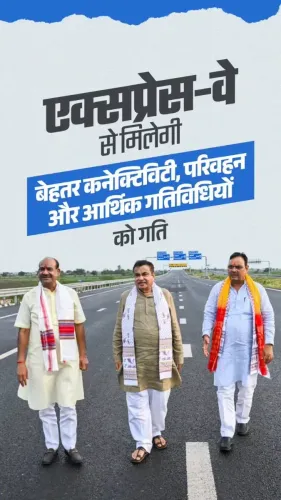
The Chief Minister's Office of Rajasthan has announced that a DPR is being prepared for a 4-lane elevated spur road from Kota DCM Road to Ummedganj, designed to seamlessly connect Kota city with the Delhi-Mumbai Expressway under the Bharatmala Pariyojana framework.
Key Takeaways
The Rajasthan CMO announced on 9 July 2026 that a DPR is being prepared for a 4-lane elevated spur road from Kota (DCM) Road to Ummedganj .
The spur aims to provide smooth connectivity between Kota city and the Delhi-Mumbai Expressway , a 1,350-km, 8-lane national corridor.
The project is part of Rajasthan's broader effort to integrate district hubs with the Bharatmala Pariyojana expressway network.
The announcement was tagged to Chief Minister Bhajanlal Sharma , signalling direct political ownership of the infrastructure push.
Key next steps include DPR completion, NHAI or state PWD funding sanction, tendering, and land acquisition.
Beneficiaries include Kota commuters, freight transporters, and urban developers in southeastern Rajasthan.
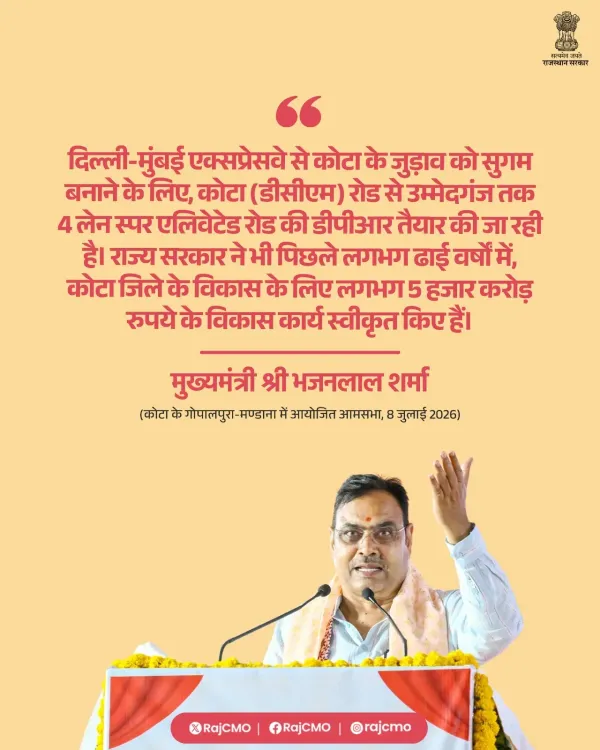
The Chief Minister's Office of Rajasthan announced on Thursday, 9 July 2026 that a Detailed Project Report (DPR) is being prepared for a 4-lane elevated spur road connecting Kota (DCM) Road to Ummedganj, aimed at integrating Kota with the Delhi-Mumbai Expressway. The announcement, made via the official CMO handle, tagged Chief Minister Bhajanlal Sharma and carried the hashtag #आपणो_अग्रणी_राजस्थान ('Our Leading Rajasthan').
Context
The post states: 'दिल्ली-मुंबई एक्सप्रेसवे से कोटा के जुड़ाव को सुगम बनाने के लिए, कोटा (डीसीएम) रोड से उम्मेदगंज तक 4 लेन स्पर एलिवेटेड रोड की डीपीआर तैयार की जा रही है।' ('To facilitate Kota's connectivity with the Delhi-Mumbai Expressway, a DPR for a 4-lane spur elevated road from Kota DCM Road to Ummedganj is being prepared.')
Kota is southeastern Rajasthan's most significant industrial, educational coaching, and rail hub. Despite its strategic importance, the city currently lacks a direct, high-speed link to the Delhi-Mumbai Expressway, the 1,350-km, 8-lane access-controlled corridor under the Bharatmala Pariyojana that passes through Rajasthan.
Policy Backdrop
The Delhi-Mumbai Expressway, a flagship project under Bharatmala Pariyojana — launched in 2015 — is designed to drastically cut travel time between India's capital and its financial capital. Rajasthan hosts a significant stretch of this corridor, and the state has been preparing spur links and elevated connectors to bring district headquarters and industrial clusters within reach of the main alignment.
The proposed spur from Kota (DCM) Road to Ummedganj follows this broader pattern. Rajasthan's highway development programme has previously prioritised elevated corridors in the Kota, Udaipur, and Jaipur regions to reduce travel time and support logistics. The effort also aligns with the central government's PM Gati Shakti framework for multimodal connectivity.
Stakeholders and Impact
The proposed elevated spur is expected to benefit Kota's large commuter population, freight transporters, and urban developers who have long sought faster access to the national expressway network. An elevated alignment would reduce congestion at grade-level intersections and enable seamless freight movement to and from Kota's industrial zones.
The National Highways Authority of India (NHAI), which is executing the Delhi-Mumbai Expressway and coordinating state spur links, is expected to play a central role in reviewing and sanctioning the DPR once it is submitted by state authorities.
What's Next
The immediate next step is the completion and formal submission of the DPR, which will define the road's exact alignment, engineering specifications, and cost estimates. Following DPR approval, the project will move to tendering, land acquisition, and funding sanction — either through NHAI or the state's Public Works Department.
If the DPR clears regulatory and financial scrutiny swiftly, the Kota spur could become one of the more visible infrastructure milestones of CM Bhajanlal Sharma's tenure, reinforcing the state's push to position itself as a logistics and industrial corridor under the Bharatmala umbrella.
Point of View
Infrastructure visibility in cities like Kota — a city with an outsized national profile due to its coaching industry — carries political weight beyond the engineering merit. The DPR stage, however, is early; the real test will be the speed of funding sanction and land acquisition, historically the two choke-points that delay such spur projects by years. If executed efficiently, the spur could also reinforce Rajasthan's pitch to investors under the PM Gati Shakti framework, making Kota's industrial zones more attractive to logistics-dependent manufacturing.
NationPress
9 Jul 2026
Frequently Asked Questions
What is the proposed 4-lane elevated spur road in Kota?
It is a planned elevated road that will connect Kota (DCM) Road to Ummedganj , designed to give Kota city direct, high-speed access to the Delhi-Mumbai Expressway . The Rajasthan government is currently preparing a Detailed Project Report (DPR) for the project.
Why is Kota being connected to the Delhi-Mumbai Expressway?
Kota is a major industrial, educational, and rail hub in southeastern Rajasthan but currently lacks a direct link to the expressway. The spur road will improve freight movement, reduce travel time, and support economic growth in the region.
What is the Delhi-Mumbai Expressway?
The Delhi-Mumbai Expressway is an 8-lane, 1,350-km access-controlled national highway built under the Bharatmala Pariyojana . It is designed to cut travel time between Delhi and Mumbai and passes through several Rajasthan districts.
What is a DPR and what happens after it is prepared?
A Detailed Project Report (DPR) outlines a project's engineering design, alignment, cost estimates, and implementation plan. Once completed and approved, the Kota spur DPR will move to tendering, land acquisition, and funding sanction by NHAI or the state PWD.
Who announced the Kota elevated spur road project?
The announcement was made by the Chief Minister's Office of Rajasthan on 9 July 2026 via its official social media handle, tagging Chief Minister Bhajanlal Sharma .