Rajasthan CMO backs Bharat Taxi cooperative, driver-ownership model
Synopsis
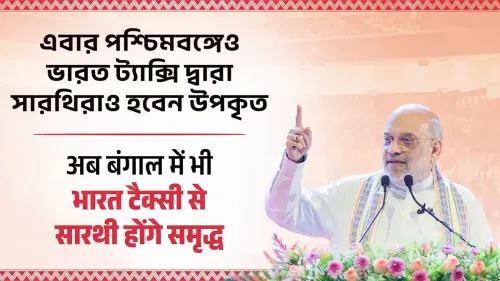
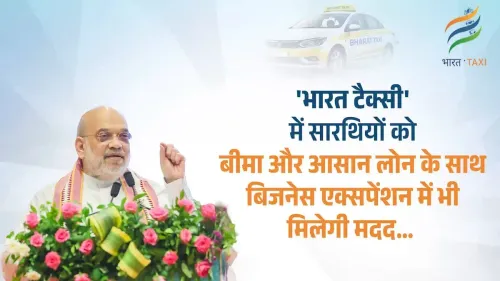
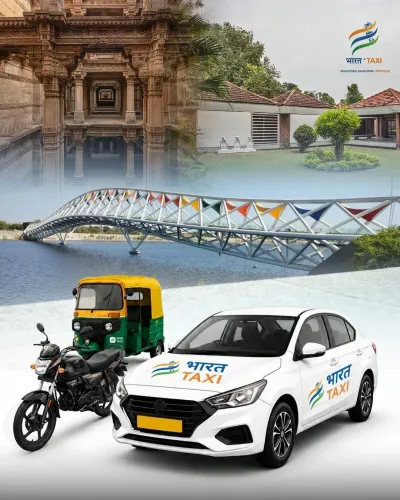
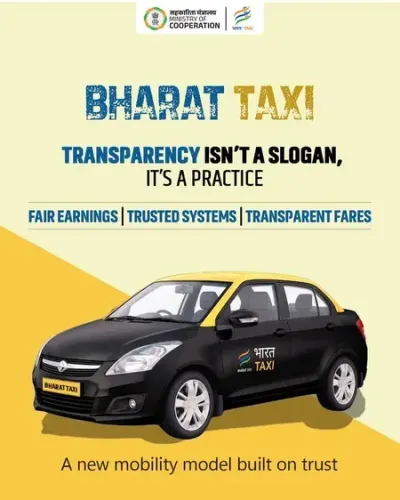
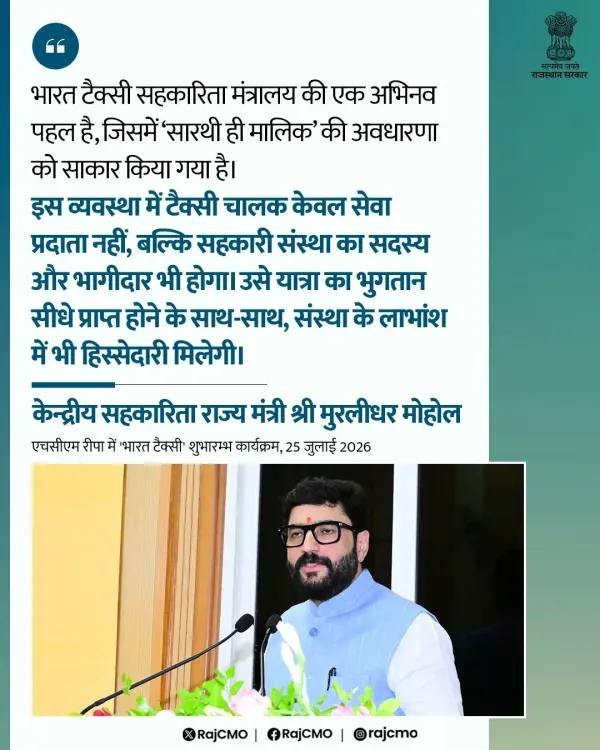
The Rajasthan Chief Minister's Office has backed Bharat Taxi Sahakarita, a Ministry of Cooperation initiative built on the 'Sarthi hi Malik' principle, which places taxi drivers as owners of their cooperative enterprise rather than gig workers under a platform intermediary.
Key Takeaways
The Rajasthan CMO on 26 July 2026 publicly endorsed Bharat Taxi Sahakarita , an initiative of the Ministry of Cooperation .
The scheme is built on the concept of 'Sarthi hi Malik' — the driver is the owner — giving taxi operators direct ownership stakes.
The Ministry of Cooperation was established in July 2021 to expand India's cooperative economy beyond agriculture and dairy into sectors like urban transport.
The post tagged the Union cooperation ministry's handle, indicating Centre-state coordination on the initiative.
The hashtag #AapnoAgrani_Rajasthan frames the endorsement within the state's broader development agenda.
State-level rollout details — registration, licensing integration, and financial support for driver cooperatives — remain to be announced.
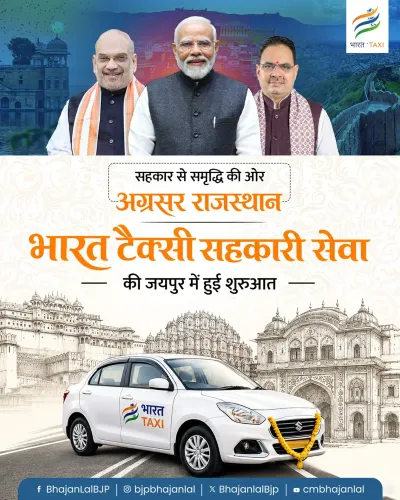
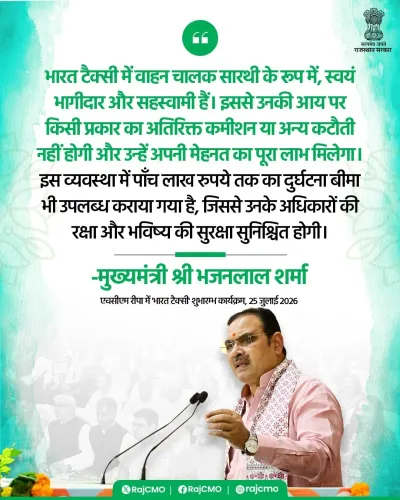
The Chief Minister's Office of Rajasthan on Sunday, 26 July 2026 highlighted Bharat Taxi Sahakarita as an innovative initiative under the Ministry of Cooperation, emphasising the concept of 'Sarthi hi Malik' ('the driver is the owner') as its defining principle. The post, addressed to Union Minister Mridula Mohol and tagged with the campaign hashtag #AapnoAgrani_Rajasthan, signals the state government's alignment with a cooperative-based model for urban transport.
Context
The post describes Bharat Taxi Sahakarita as an initiative of the Ministry of Cooperation that operationalises the idea of driver-owned taxi services. The phrase 'Sarthi hi Malik' — meaning the driver is the owner — encapsulates a model where taxi operators hold ownership stakes in the cooperative rather than working as gig workers for a platform intermediary. The Rajasthan CMO's endorsement places the state among early advocates of this approach.
Policy Backdrop
The Ministry of Cooperation was established by the Central government in July 2021 to deepen and diversify India's cooperative economy beyond its traditional strongholds of agriculture and dairy. Extending cooperative structures to urban transport represents a significant broadening of that mandate. Globally and domestically, driver-owned cooperative models have been proposed as a counter to platform-economy arrangements that critics argue concentrate earnings at the intermediary level.
India's informal and gig transport workforce — estimated in the crores — has long operated without formal ownership rights or collective bargaining structures. A cooperative taxi framework, if scaled, would formalise these workers' economic participation and provide them a share in enterprise assets and revenues.
Stakeholders and Impact
The primary beneficiaries of a cooperative taxi model are taxi and cab drivers who currently work under aggregator platforms or as independent operators with limited financial security. Under the 'Sarthi hi Malik' principle, drivers would collectively own the enterprise, potentially improving income stability, access to credit, and social protections. Rajasthan, with a large semi-urban and rural transport workforce, stands to see significant ground-level impact if the model is rolled out at scale within the state.
The tagging of @mohol_murlidhar — associated with the Union cooperation portfolio — suggests active coordination between the state government and the Centre on implementation. The hashtag #AapnoAgrani_Rajasthan ('Our Leading Rajasthan') frames this as part of the state's broader development narrative.
What's Next
Attention will now turn to state-level implementation details: registration mechanisms for driver cooperatives, integration with existing transport licensing frameworks, and financial support structures such as subsidised loans or equity-sharing arrangements. Parliamentary and regulatory steps at the Centre to formally back driver-owned transport cooperatives will be closely watched. If Rajasthan moves ahead with a structured rollout, it could serve as a replicable model for other states seeking to formalise gig-economy transport workers within the cooperative framework.
Point of View
Signalling that the state sees political and economic value in championing worker-ownership models for the gig economy. The 'Sarthi hi Malik' framing is rhetorically powerful — it directly addresses the grievance of platform dependency that has animated taxi-driver protests across Indian cities. By tagging the Union cooperation ministry, Rajasthan is also positioning itself as a proactive partner in a Central policy push, which could translate into preferential access to scheme funds or pilot status. If the cooperative model gains traction, it may pressure ride-hailing aggregators to renegotiate terms with driver partners at scale.
NationPress
25 Oct 2026
Frequently Asked Questions
What is Bharat Taxi Sahakarita?
Bharat Taxi Sahakarita is an initiative under India's Ministry of Cooperation that aims to organise taxi drivers into cooperatives where the drivers themselves are the owners, operating under the principle of 'Sarthi hi Malik' (the driver is the owner).
What does 'Sarthi hi Malik' mean?
'Sarthi hi Malik' is a Hindi phrase meaning 'the driver is the owner.' It describes the cooperative ownership model where taxi drivers hold ownership stakes in their enterprise rather than working as gig workers for an external platform.
What is India's Ministry of Cooperation and when was it set up?
The Ministry of Cooperation is a Central government ministry established in July 2021 to strengthen and expand India's cooperative sector across multiple economic activities, including agriculture, dairy, and increasingly urban services.
How does a cooperative taxi model benefit drivers?
Under a cooperative model, drivers collectively own the enterprise, which can improve income stability, reduce dependence on intermediary platforms, provide access to institutional credit, and offer a share in enterprise revenues and assets.
What is #AapnoAgrani_Rajasthan?
#AapnoAgrani_Rajasthan translates to 'Our Leading Rajasthan' and is a campaign hashtag used by the Rajasthan government to highlight development and governance initiatives that position the state as a progressive leader.