Rajasthan CMO Echoes Modi's 'Nagrik Devo Bhava' Governance Vision

Synopsis
The Chief Minister's Office of Rajasthan declared on 30 September 2026 that PM Narendra Modi's every policy is anchored in the resolve of 'Nagrik Devo Bhava' — the citizen is divine — tagging CM Bhajanlal Sharma and invoking the state's pioneering identity.
Key Takeaways
The Rajasthan CMO posted on 30 September 2026 attributing the philosophy of Nagrik Devo Bhava to PM Narendra Modi 's governance approach.
The Sanskrit-derived phrase frames the citizen as divine — the moral centre of every state welfare policy.
Chief Minister Bhajanlal Sharma was tagged, signalling alignment between the state BJP leadership and central government ideology.
The hashtag #आपणो_अग्रणी_राजस्थान (Our Pioneering Rajasthan) reinforces the state's self-positioning as a model BJP-governed state.
Rajasthan has been BJP-ruled since December 2023 , consistently framing local scheme delivery as an extension of Modi's national vision.
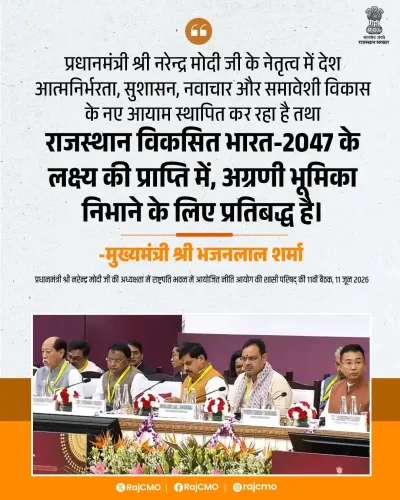
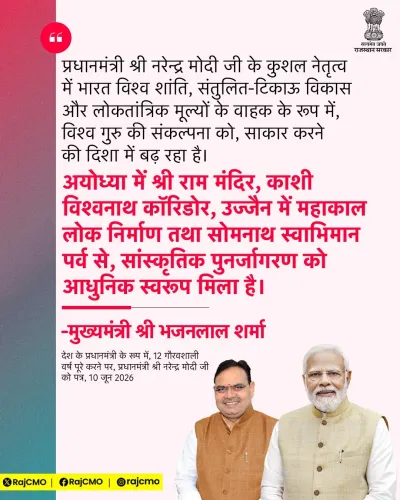
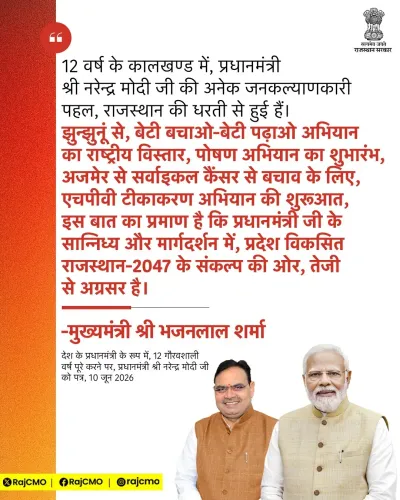
A philosophy borrowed from ancient Sanskrit — नागरिक देवो भव (the citizen is divine) — is now the stated north star of every welfare policy flowing from New Delhi to Jaipur, according to the Chief Minister's Office of Rajasthan. On Wednesday, 30 September 2026, the official CMO handle invoked Prime Minister Narendra Modi's governance ethos, framing it as a citizen-first compact that underlies every central scheme.
The post, tagging Chief Minister Bhajanlal Sharma and carrying the hashtag #आपणो_अग्रणी_राजस्थान (Our Pioneering Rajasthan), states: 'Every policy and public-welfare scheme of Prime Minister Shri Narendra Modi Ji has at its centre the resolve of Nagrik Devo Bhava.' The phrase is an adaptation of the classical Sanskrit Atithi Devo Bhava — 'the guest is God' — recast here to elevate the ordinary citizen to that same status of reverence in the eyes of the state.
BJP's Ideological Thread from Delhi to Jaipur
Rajasthan returned to BJP rule in December 2023, with Bhajanlal Sharma taking oath as Chief Minister. Since then, the state government has positioned itself as an active implementer of central flagship schemes — from PM Awas Yojana to Ayushman Bharat — framing local delivery as an extension of Modi's national vision rather than a standalone state agenda.
The CMO's post fits that pattern precisely. By anchoring Rajasthan's governance identity to Modi's philosophy, the BJP-led administration signals ideological continuity upward to New Delhi while projecting a citizen-welfare image downward to voters. The hashtag 'Aapno Agrani Rajasthan' — Our Pioneering Rajasthan — reinforces a brand of state pride fused with central alignment.
What 'Nagrik Devo Bhava' Signals as a Governing Slogan
Slogans in Indian governance are rarely decorative. When a Chief Minister's Office formally attributes a philosophical resolve to the Prime Minister across all his policies, it is a deliberate act of political messaging — one that frames the centre's welfare architecture as morally grounded, not merely transactional. The citizen, in this framing, is not a beneficiary to be managed but a sovereign to be served.
Whether that resolve translates into measurable outcomes — scheme saturation rates, grievance redressal timelines, last-mile delivery in Rajasthan's vast rural belt — is the question that will define the slogan's shelf life beyond the social-media cycle.
Point of View
This kind of coordinated messaging across state handles is a force-multiplier ahead of any electoral cycle. The real test, however, is whether the 'Nagrik Devo Bhava' framing survives contact with Rajasthan's ground realities: scheme delivery gaps, rural infrastructure deficits, and a vast geography that has historically challenged last-mile governance. Slogans that outlast their social-media moment are the ones backed by verifiable outcomes.
NationPress
30 Sept 2026
Frequently Asked Questions
What does 'Nagrik Devo Bhava' mean?
'Nagrik Devo Bhava' is an adaptation of the classical Sanskrit phrase 'Atithi Devo Bhava' (the guest is God), recast to mean 'the citizen is divine' — positioning every Indian citizen as the moral centre of government policy.
Why did the Rajasthan CMO post about PM Modi's governance philosophy?
The Rajasthan CMO posted to express ideological alignment between the BJP-led state government and the central leadership, framing PM Modi's welfare policies as citizen-first in nature.
Who is the Chief Minister of Rajasthan in 2026?
Bhajanlal Sharma is the Chief Minister of Rajasthan, having taken office in December 2023 after the BJP won the state assembly elections.
What is the hashtag Aapno Agrani Rajasthan about?
#आपणो_अग्रणी_राजस्थान , meaning 'Our Pioneering Rajasthan,' is a branding hashtag used by the Rajasthan government to project the state as a leading example of BJP governance and welfare delivery.
What central welfare schemes is Rajasthan implementing?
Rajasthan under the BJP government has been implementing central flagship schemes including PM Awas Yojana and Ayushman Bharat, positioning their rollout as aligned with PM Modi's citizen-welfare vision.