Rajasthan CMO hails Modi's DBT push on 11 Years of Digital India
Synopsis
The Chief Minister's Office of Rajasthan marked 11 Years of Digital India by crediting PM Narendra Modi with using Direct Benefit Transfer to route welfare scheme benefits directly into beneficiaries' bank accounts, coinciding with the National Conference on e-Governance 2026.
Key Takeaways
The Chief Minister's Office of Rajasthan posted on 2 July 2026 praising PM Narendra Modi's DBT-driven governance model.
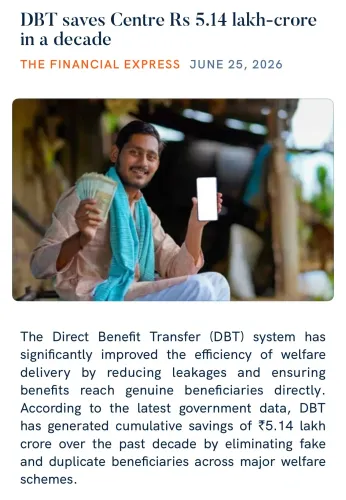
Direct Benefit Transfer (DBT) , formally launched in 2013 and expanded post- 2014 , routes welfare payments directly into Aadhaar-seeded bank accounts.
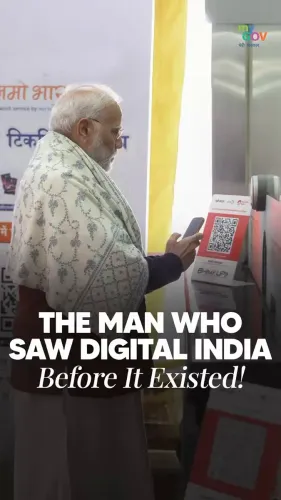
The post coincides with 11 years of the Digital India programme , which was launched on 1 July 2015 .
The JAM trinity — Jan Dhan, Aadhaar, and Mobile — underpins the DBT infrastructure that eliminates intermediary leakages.
The #NCeG2026 tag links the message to the National Conference on e-Governance 2026 , a key platform for reviewing digital-governance progress.
Rajasthan under CM Bhajanlal Sharma has positioned itself as aligned with the central government's digital-welfare delivery framework.
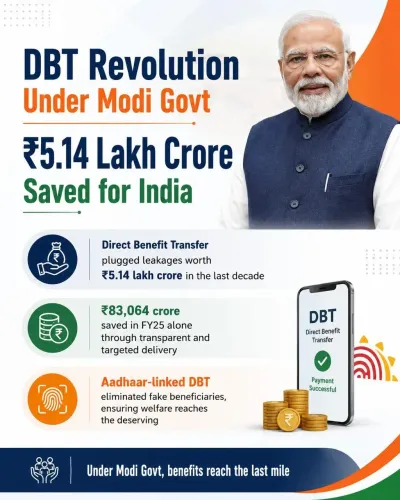
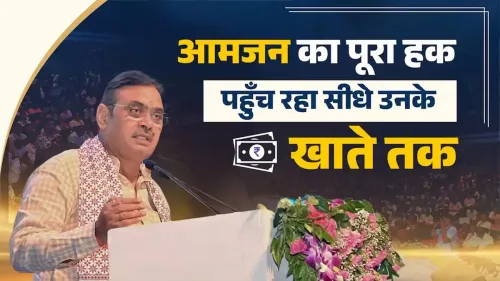
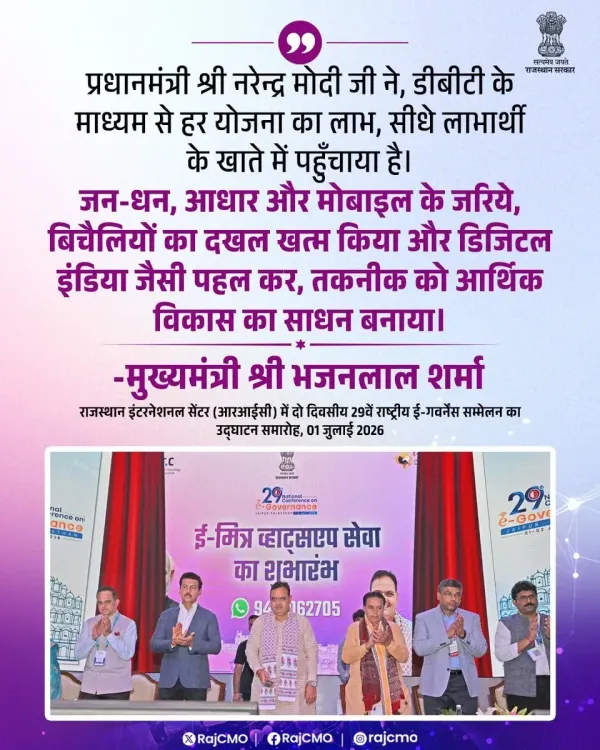
The Chief Minister's Office of Rajasthan on Thursday, 2 July 2026 posted a tribute to Prime Minister Narendra Modi, crediting him with ensuring that the benefits of every government scheme reach beneficiaries directly in their bank accounts through the Direct Benefit Transfer (DBT) mechanism, coinciding with the #11YearsOfDigitalIndia milestone and the National Conference on e-Governance 2026 (NCeG2026).
Context
The post, shared from the official @RajCMO handle and tagging Chief Minister Bhajanlal Sharma (@BhajanlalBjp), states in Hindi: 'Pradhan Mantri Shri Narendra Modi ji ne, DBT ke madhyam se har yojana ka labh, seedhe labhaarthi ke khate mein pahunchaya hai' — meaning, 'Prime Minister Narendra Modi has, through DBT, delivered the benefit of every scheme directly into the beneficiary's account.' The message aligns with the broader national conversation marking 11 years of the Digital India programme, which was launched on 1 July 2015.
Policy Backdrop
Direct Benefit Transfer was formally introduced in 2013 and underwent a significant expansion after 2014 under the JAM trinity — Jan Dhan bank accounts, Aadhaar biometric identity, and Mobile connectivity — designed to eliminate intermediary leakages in welfare delivery. The Digital India programme, launched by PM Modi on 1 July 2015, provided the broader digital infrastructure backbone — from rural broadband to e-governance portals — that made large-scale DBT feasible across hundreds of central and state schemes.
Since 2014, the central government has steadily encouraged state governments to integrate their own welfare schemes with central DBT platforms, aiming for uniform, verifiable, last-mile transfers into Aadhaar-seeded bank accounts. Rajasthan, under Chief Minister Bhajanlal Sharma, has aligned itself with this national digital-governance framework.
Stakeholders and Impact
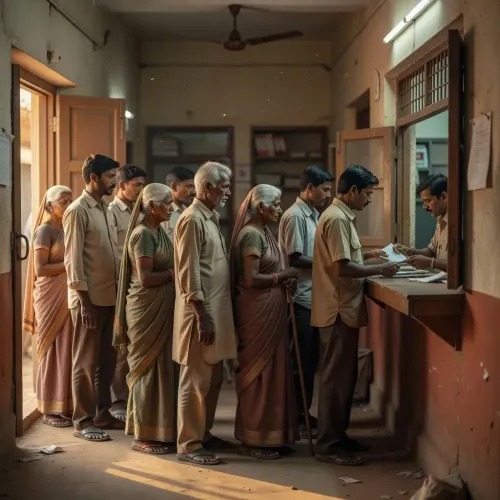
The primary beneficiaries of DBT are millions of welfare recipients across Rajasthan and the rest of India who receive subsidies, pensions, scholarships, and other entitlements directly into their accounts — bypassing the intermediary chains that historically siphoned off a share of public funds. State governments benefit from reduced administrative overhead and improved audit trails, while the central government gains a unified dashboard to track scheme delivery.
The post's tagging of #NCeG2026 signals that the National Conference on e-Governance 2026 serves as the immediate backdrop, a platform where central and state officials review progress on digital-governance initiatives and chart next steps for deeper integration.
What's Next
Attention will now turn to the proceedings and outcomes of NCeG2026, where announcements on expanded DBT coverage, new state-scheme integrations, and updated digital-infrastructure targets are expected. For Rajasthan specifically, any new state-level DBT linkages or e-governance commitments emerging from the conference will be closely watched by both beneficiaries and policy observers tracking the state's alignment with the central digital-governance agenda.
Point of View
The message serves a dual purpose: endorsing the Modi government's welfare-delivery record and signalling Rajasthan's institutional commitment to the same digital-governance framework. This pattern of state-level amplification of central schemes has become a consistent feature of BJP-ruled administrations, reflecting a unified communication strategy across government tiers. The forward reference to NCeG2026 also hints at possible Rajasthan-specific announcements on e-governance integration in the near term.
NationPress
1 Oct 2026
Frequently Asked Questions
What is Direct Benefit Transfer (DBT) in India?
Direct Benefit Transfer is a central government mechanism that routes subsidies, pensions, scholarships, and other welfare payments directly into the Aadhaar-seeded bank accounts of beneficiaries, eliminating intermediaries and reducing leakages. It was formally launched in 2013 and significantly expanded after 2014 using the JAM trinity.
When was Digital India launched and what does it do?
Digital India was launched by PM Narendra Modi on 1 July 2015 to build digital infrastructure, promote e-governance, and enable financial inclusion across India. It provides the backbone — from rural broadband to digital identity systems — that makes large-scale DBT delivery possible.
What is the JAM trinity and how does it relate to DBT?
The JAM trinity stands for Jan Dhan bank accounts, Aadhaar biometric identity, and Mobile connectivity. Promoted from 2014 onwards, it forms the infrastructure layer that enables Direct Benefit Transfer to reach beneficiaries efficiently and in a verifiable manner.
Why did the Rajasthan CMO's office post about DBT and Digital India?
The Rajasthan Chief Minister's Office posted on 2 July 2026 to mark 11 years of the Digital India programme and to credit PM Narendra Modi's governance model of using DBT to deliver scheme benefits directly to citizens, coinciding with the National Conference on e-Governance 2026.