Rajasthan CMO cites PM Modi's push for tribal area development
Synopsis
The Rajasthan Chief Minister's Office posted on 27 September 2026 that CM Bhajanlal Sharma's government has taken multiple steps for tribal area development, citing Prime Minister Narendra Modi's national welfare vision as inspiration, under the 'Aapno Agraṇī Rajasthan' campaign.
Key Takeaways
The Rajasthan CMO posted on 27 September 2026 attributing tribal development steps in the state to PM Narendra Modi's inspiration.
CM Bhajanlal Sharma of the BJP leads the Rajasthan government that is implementing these measures.
Key tribal districts targeted include Banswara, Dungarpur and Udaipur — all Fifth Schedule areas.
The policy draws on the Vanbandhu Kalyan Yojana (2014) and the Tribal Sub-Plan framework dating to 1974–79.
No specific scheme names, rupee allocations or district targets were cited in the post — details are expected in the next assembly session or annual plan.
The post used the campaign hashtag #आपणो_अग्रणी_राजस्थान ('Our Leading Rajasthan'), signalling a broader state branding push.
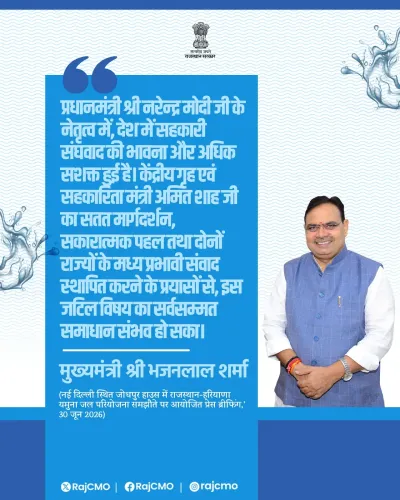
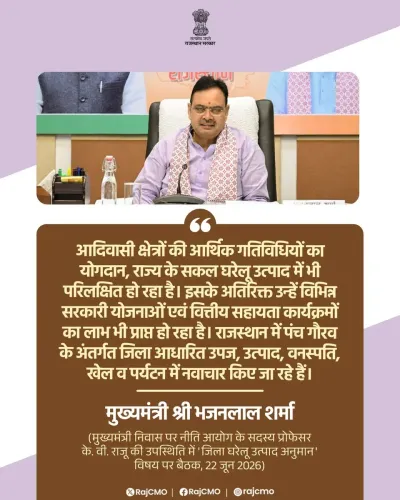
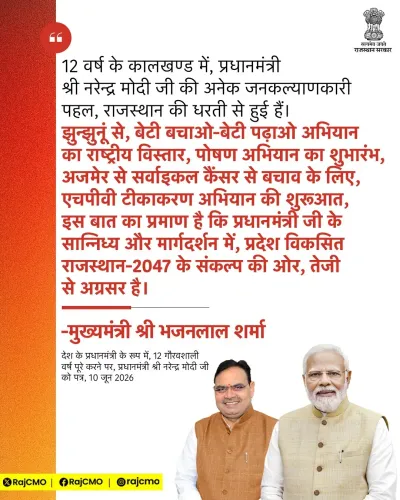
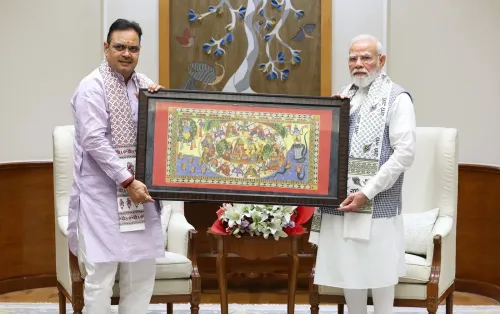
Tribal welfare is back at the centre of Rajasthan's political conversation. The Chief Minister's Office of Rajasthan posted on X on Sunday, 27 September 2026, crediting Prime Minister Narendra Modi's inspiration for a series of steps the state government has taken to develop tribal regions — a signal that Chief Minister Bhajanlal Sharma's administration is aligning itself firmly with the Centre's tribal welfare agenda.
The post, tagged with the campaign hashtag #आपणो_अग्रणी_राजस्थान ('Our Leading Rajasthan'), read: 'प्रधानमंत्री जी की प्रेरणा से राज्य में भी, जनजाति क्षेत्र के विकास के लिए अनेक कदम उठाए गए हैं' — 'Inspired by the Prime Minister, several steps have been taken in the state as well for the development of tribal areas.' The phrasing is deliberate: it frames state action as an extension of national vision, not a stand-alone initiative.Rajasthan's tribal belt and what is at stake
The stakes are real. Rajasthan has a substantial Scheduled Tribe population concentrated in the southern districts of Banswara, Dungarpur and Udaipur — all Fifth Schedule areas where constitutional provisions require the state to prioritise development spending. These corridors have historically lagged on health, education and road connectivity benchmarks, making them perennial pressure points for any state government.
The policy architecture the state is drawing on has deep roots. India's Tribal Sub-Plan, introduced during the Fifth Five Year Plan (1974–79), mandated that funds flow proportionally into tribal sub-districts. Four decades later, the Vanbandhu Kalyan Yojana, launched by the Government of India in 2014, gave that older framework a sharper socio-economic edge — targeting livelihoods, housing and basic services in one integrated push. Rajasthan's current posture slots into that lineage.
State-Centre coordination as the governing template
Since 2014, successive NDA-aligned state governments have increasingly mirrored Central schemes rather than building parallel state architectures — a pattern that reduces duplication but also ties state credit to the national brand. Rajasthan under CM Bhajanlal Sharma appears to be following this template explicitly: the CMO's post names the Prime Minister first, and the state government second.
That sequencing matters politically. With tribal constituencies spread across seats that can swing assembly outcomes in southern Rajasthan, demonstrating visible, Modi-backed delivery on welfare is both a governance imperative and an electoral calculation.
What to watch in Rajasthan's next budget cycle
The post is light on specifics — no scheme names, no rupee figures, no district-level targets are named. The real measure of intent will come when Rajasthan's next annual plan or assembly session reveals whether the rhetoric is backed by ring-fenced budget allocations for tribal districts. Analysts and tribal rights groups will be watching for line-item commitments rather than umbrella claims.
The campaign slogan — 'Our Leading Rajasthan' — sets a high bar. Whether the tribal belt gets to feel it is the question that will define this government's report card in southern Rajasthan.
Point of View
Where constituencies in Banswara and Dungarpur are genuinely competitive. The explicit invocation of national inspiration also signals that Rajasthan will likely expand Central scheme coverage rather than launch standalone state programmes — a fiscally convenient but politically calculated choice. Until specific budget lines are disclosed, however, the post reads more as intent signalling than concrete policy announcement.
NationPress
27 Sept 2026
Frequently Asked Questions
What steps has the Rajasthan government taken for tribal development?
The Rajasthan CMO announced on 27 September 2026 that several steps have been taken for tribal area development inspired by PM Modi, but did not specify individual schemes or budget allocations in the post. Details are expected in the next assembly session or annual plan.
Which tribal districts in Rajasthan are being targeted for development?
Rajasthan's Scheduled Tribe populations are concentrated in southern districts such as Banswara, Dungarpur and Udaipur , all of which are Fifth Schedule areas requiring prioritised state spending.
What is the Vanbandhu Kalyan Yojana and how does it relate to Rajasthan?
The Vanbandhu Kalyan Yojana was launched by the Government of India in 2014 to improve socio-economic conditions of tribal populations through integrated livelihood, housing and services support. Rajasthan's state welfare steps align with this Central framework.
Who is Chief Minister of Rajasthan in 2026?
Bhajanlal Sharma of the BJP is the Chief Minister of Rajasthan and is tagged in the CMO's post on tribal development.
What is the #AapnoAgraniRajasthan campaign?
#आपणो_अग्रणी_राजस्थान translates to 'Our Leading Rajasthan' and is a state government branding campaign used by the Rajasthan CMO to highlight developmental milestones and governance achievements.