Rajasthan CMO defends VB G Ram Ji Yojana as cooperative federalism model
Synopsis
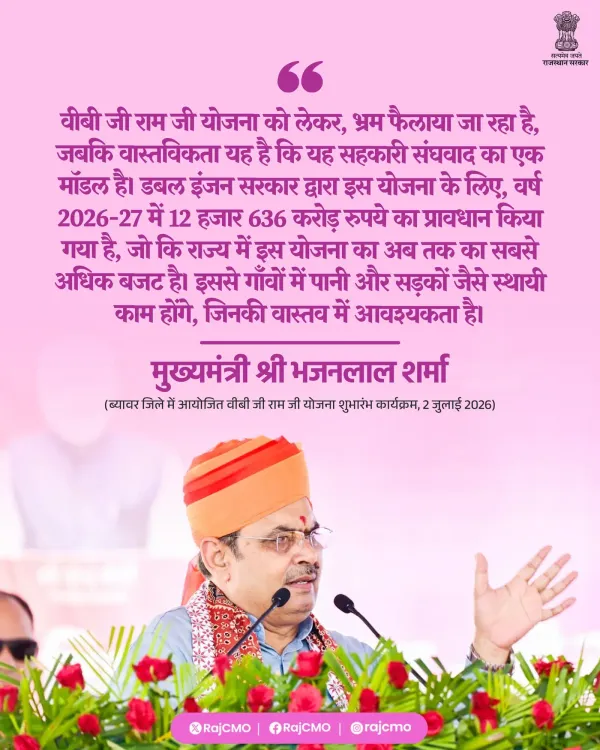
The Chief Minister's Office of Rajasthan on July 3, 2026 rejected what it termed deliberate misinformation about the VB G Ram Ji Yojana, framing the scheme as a model of cooperative federalism between the state and the Centre, with CM Bhajan Lal Sharma directly tagged in the post.
Key Takeaways
The Chief Minister's Office of Rajasthan posted on July 3, 2026 defending the VB G Ram Ji Yojana against alleged misinformation.
The CMO described the scheme as 'a model of cooperative federalism' between the state and the Union government.
Chief Minister Bhajan Lal Sharma was directly tagged, signalling his personal association with the clarification.
The post was published under the hashtag #आपणो_अग्रणी_राजस्थान ('Our Leading Rajasthan'), part of a broader state branding campaign.
BJP-led state governments have frequently used the cooperative federalism framework to defend schemes against political criticism.
Observers expect follow-up official communications such as scheme guidelines or joint Centre-state review meetings.
The Chief Minister's Office of Rajasthan on Friday, July 3, 2026, pushed back against what it called deliberate misinformation surrounding the VB G Ram Ji Yojana, asserting that the scheme represents a model of cooperative federalism between the state and the Centre. The post, attributed to the office of Chief Minister Bhajan Lal Sharma, was shared on X under the hashtag #आपणो_अग्रणी_राजस्थान (meaning 'Our Leading Rajasthan').
Context
The CMO's post states directly: 'VB G Ram Ji Yojana ko lekar bhram failaya ja raha hai, jabki vastavikata yeh hai ki yeh sahkari sanghvad ka ek model hai' — translating to: 'Confusion is being spread about the VB G Ram Ji Yojana, whereas the reality is that it is a model of cooperative federalism.' The statement is a pointed rebuttal, signalling that the scheme has come under public or political scrutiny. By framing the scheme through the lens of cooperative federalism, the government is positioning it as a joint Centre-state initiative rather than a unilateral state programme.
Chief Minister Bhajan Lal Sharma, who was sworn in as the head of Rajasthan's BJP government in December 2023, was directly tagged in the post, indicating his personal association with the scheme's defence.
Policy Backdrop
Cooperative federalism — the principle of structured collaboration between the Union government and state governments — became a central pillar of governance discourse in India after the NITI Aayog replaced the Planning Commission in 2015. The NITI Aayog was explicitly created to foster a 'Team India' approach, encouraging states to participate in national development as equal partners rather than passive recipients of central directives.
BJP-led state governments have consistently invoked this framework when defending welfare and development schemes, particularly when opposition parties or critics allege that schemes are poorly designed, duplicative of central programmes, or inadequately funded. Invoking cooperative federalism serves a dual purpose: it lends institutional credibility to the scheme and deflects criticism by underscoring Centre-state alignment.
Stakeholders and Impact
The primary stakeholders of the VB G Ram Ji Yojana are the citizens of Rajasthan, who stand to benefit from — or be affected by — the scheme's implementation. The state government's decision to issue a public clarification suggests that misinformation, whether circulated on social media or through political channels, has reached a scale that warrants an official response.
For the Rajasthan government, the credibility of its welfare delivery architecture is at stake. A scheme perceived as poorly explained or contested can erode public trust, reduce uptake among intended beneficiaries, and hand political opponents a ready narrative ahead of future electoral cycles. The CMO's intervention is therefore both administrative and political in nature.
What's Next
Official clarifications of this nature are typically followed by detailed scheme guidelines being made public, press briefings by the concerned ministry, or joint Centre-state review meetings to demonstrate coordinated implementation. Observers will watch whether the Rajasthan government issues a formal fact-sheet or FAQ document on the VB G Ram Ji Yojana to counter the reported misinformation at the ground level. The use of the hashtag #आपणो_अग्रणी_राजस्थान also suggests this is part of a broader communications campaign to project Rajasthan as a development-forward state under the current administration.
Point of View
The government attempts to insulate the scheme from criticism while aligning itself with the broader national governance philosophy championed since 2015. The direct tagging of Chief Minister Bhajan Lal Sharma signals that this is not a routine administrative clarification but a deliberate political communication. The episode underscores a growing trend of state governments using official social media handles as rapid-response channels to shape public perception of contested welfare programmes.
NationPress
3 Jul 2026
Frequently Asked Questions
What is the VB G Ram Ji Yojana in Rajasthan?
The VB G Ram Ji Yojana is a scheme of the Rajasthan government that the Chief Minister's Office described on July 3, 2026 as a model of cooperative federalism between the state and the Centre. Specific details of the scheme's benefits and eligibility have not been officially elaborated in the CMO's post.
Why is the Rajasthan government defending the VB G Ram Ji Yojana?
The Rajasthan CMO stated that 'confusion is being spread' about the scheme, indicating it has faced public criticism or misinformation. The government issued a clarification to set the record straight and reaffirm the scheme's credentials as a Centre-state collaborative initiative.
What does cooperative federalism mean in the context of Indian governance?
Cooperative federalism refers to structured collaboration between the Union government and state governments to jointly design and implement policies. In India, it gained prominence after the NITI Aayog was established in 2015 to replace the Planning Commission and foster a 'Team India' approach to development.
Who is Bhajan Lal Sharma?
Bhajan Lal Sharma is the Chief Minister of Rajasthan, sworn in December 2023 as the leader of the BJP government in the state. He was directly tagged by the CMO in the July 3, 2026 post defending the VB G Ram Ji Yojana.
What is the hashtag #आपणो_अग्रणी_राजस्थान about?
The hashtag translates to 'Our Leading Rajasthan' in English and is used by the Rajasthan government as part of a broader communications and branding campaign to project the state as a development-oriented, progressive administration under Chief Minister Bhajan Lal Sharma.