Rajasthan CMO directs regular monitoring of 1,962 mobile vet units
Synopsis
The Chief Minister's Office of Rajasthan on 15 July 2026 directed regular monitoring of 1,962 mobile veterinary units, tagging CM Bhajan Lal Sharma. The move aims to ensure operational efficiency of field clinics serving livestock farmers across the state's remote and rural areas.
Key Takeaways
The Chief Minister's Office of Rajasthan issued a public directive on 15 July 2026 calling for regular monitoring of mobile veterinary units.
The directive specifically covers 1,962 mobile veterinary units operating across the state.
Chief Minister Bhajan Lal Sharma was directly tagged, indicating the instruction carries top-level administrative weight.
The post was shared under the #आपणो_अग्रणी_राजस्थान ('Our Leading Rajasthan') campaign hashtag.
Mobile veterinary units serve livestock farmers in remote areas where fixed veterinary clinics are limited or absent.
Follow-up action is expected from the Rajasthan Animal Husbandry Department on monitoring formats and reporting systems.
The Chief Minister's Office of Rajasthan on Wednesday, 15 July 2026 directed that the operation of 1,962 mobile veterinary units be subject to regular, systematic monitoring, tagging Chief Minister Bhajan Lal Sharma in the directive shared under the hashtag #आपणो_अग्रणी_राजस्थान ('Our Leading Rajasthan').
Context
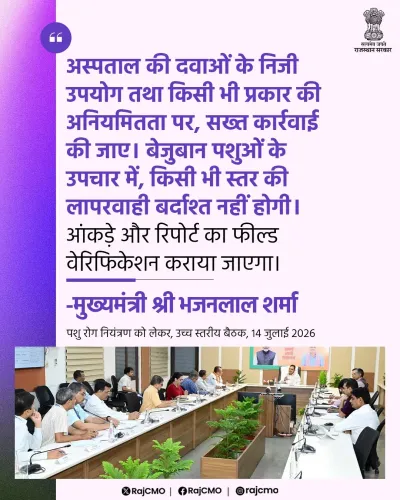
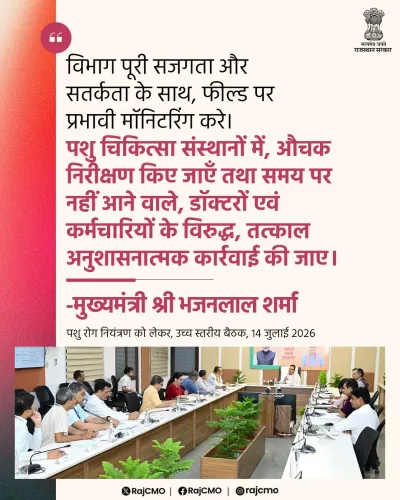
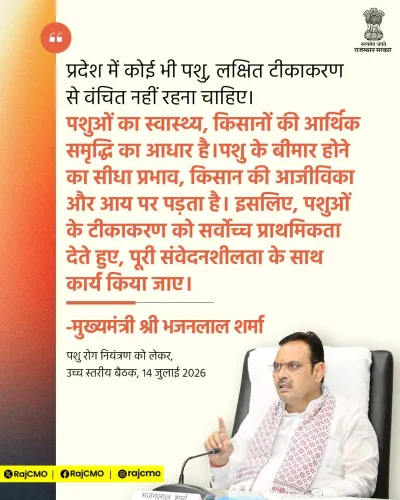
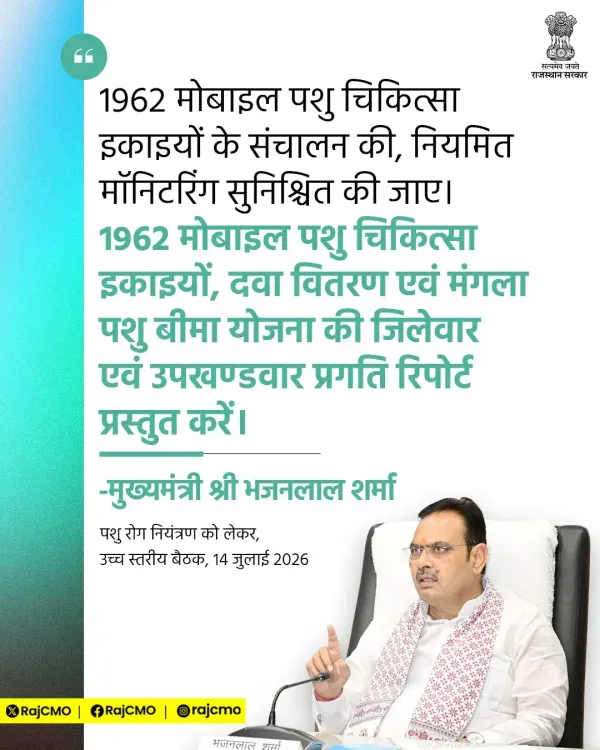
The post, issued from the official @RajCMO handle, calls for ensuring consistent oversight of the mobile veterinary fleet: '1962 मोबाइल पशु चिकित्सा इकाइयों के संचालन की, नियमित मॉनिटरिंग सुनिश्चित की जाए' — 'Regular monitoring of the operation of 1,962 mobile veterinary units must be ensured.' The directive is addressed directly to Chief Minister Bhajan Lal Sharma, signalling that the instruction flows from the highest administrative level of the state government.
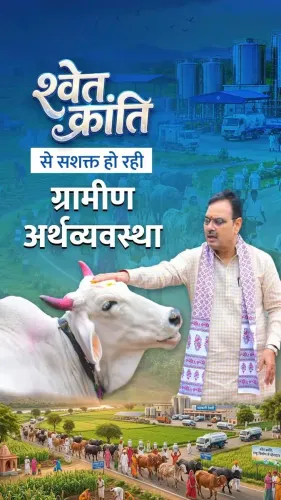
Mobile veterinary units are field-deployable clinics that carry medicines, diagnostic equipment, and trained personnel to livestock owners in remote villages, reducing the need for farmers to transport sick animals to fixed clinics.
Policy Backdrop
Rajasthan has one of India's largest livestock populations, with cattle, camels, sheep, and goats forming a critical pillar of the rural economy, especially in the arid western districts. The Rajasthan Animal Husbandry Department has periodically expanded mobile veterinary outreach to bridge service gaps in areas where permanent clinics are either absent or under-staffed.
The emphasis on regular monitoring reflects a standard administrative push to ensure that field units remain operationally active rather than lying idle after initial deployment — a recurring challenge in large-scale government schemes. The #आपणो_अग्रणी_राजस्थान campaign frames such governance actions within the BJP-led state government's broader development narrative since Chief Minister Sharma assumed office in December 2023.
Stakeholders and Impact
The primary beneficiaries of a well-monitored mobile veterinary network are livestock farmers and rural animal owners across Rajasthan's districts, particularly in tribal and remote areas where veterinary infrastructure is thin. Timely treatment of livestock diseases directly protects farm incomes and supports the state's dairy output.
For the Rajasthan Animal Husbandry Department, the directive implies an obligation to put in place measurable performance metrics — whether through physical inspection, digital reporting, or geo-tagged attendance logs — to demonstrate that each of the 1,962 units is conducting regular field visits.
What's Next
Observers will watch for follow-up administrative orders specifying the monitoring format, reporting frequency, and accountability chain for unit supervisors. Integration with digital dashboards or mobile-based attendance systems would be consistent with the state government's broader push toward technology-enabled governance.
If the monitoring directive translates into verifiable field activity, it could strengthen Rajasthan's livestock economy and serve as a model for other large states seeking to operationalise mobile veterinary fleets at scale.
Point of View
The CMO places accountability squarely on the state's top executive and creates a public record of the instruction. For the Bhajan Lal Sharma administration, such posts serve a dual purpose: demonstrating administrative seriousness on rural welfare while feeding the 'Our Leading Rajasthan' brand ahead of future electoral cycles. The specific figure of 1,962 units, if operationally verified, would represent one of the larger mobile veterinary deployments among Indian states, giving the government a concrete achievement to highlight. The real test will be whether monitoring translates into measurable outcomes — reduced livestock mortality, faster disease response — or remains an administrative formality.
NationPress
15 Jul 2026
Frequently Asked Questions
What are mobile veterinary units in Rajasthan?
Mobile veterinary units are government-deployed field clinics equipped with medicines and diagnostic tools that travel to remote villages in Rajasthan to treat livestock, reducing the need for farmers to transport sick animals to fixed clinics.
How many mobile veterinary units does Rajasthan have?
According to the Chief Minister's Office directive issued on 15 July 2026, Rajasthan operates 1,962 mobile veterinary units across the state.
Who is responsible for veterinary services in Rajasthan?
The Rajasthan Animal Husbandry Department is the state body responsible for livestock health, veterinary services, and related schemes, including the operation of mobile veterinary units.
What is the #आपणो_अग्रणी_राजस्थान hashtag about?
#आपणो_अग्रणी_राजस्थान translates to 'Our Leading Rajasthan' and is a campaign hashtag used by the Bhajan Lal Sharma government to frame its governance and development initiatives.
Why is regular monitoring of mobile vet units important?
Regular monitoring ensures that field units remain operationally active and reach livestock farmers in remote areas, directly protecting rural incomes and supporting Rajasthan's dairy and livestock economy.