Rajasthan CMO: GYAN Model Drives ST Welfare Push
Synopsis
The Chief Minister's Office of Rajasthan says the Bhajanlal Sharma government is working on economic empowerment, social security, and holistic upliftment of Scheduled Tribe communities, explicitly anchoring its approach to PM Modi's GYAN welfare model covering the poor, youth, farmers, and women.
Key Takeaways
The Rajasthan CMO posted on August 3, 2026 that the state is pursuing tribal welfare through PM Modi's GYAN model .
GYAN stands for Garib, Yuva, Annadata, Nari — poor, youth, farmers, and women.
Chief Minister Bhajanlal Sharma is the named head of the BJP government implementing these measures.
The Vanbandhu Kalyan Yojana (2014) and the Forest Rights Act (2006) form the national policy backbone for tribal development in India.
Rajasthan has significant Scheduled Tribe populations in districts including Udaipur, Banswara, and Dungarpur .
The post used the hashtag #आपणो_अग्रणी_राजस्थान , a branding phrase for the current state government.
Tribal communities across Rajasthan are at the centre of a renewed state-level welfare drive — one the government is framing explicitly around Prime Minister Narendra Modi's GYAN model, the four-pillar framework that groups national welfare priorities under Garib, Yuva, Annadata aur Nari (poor, youth, farmers, and women).
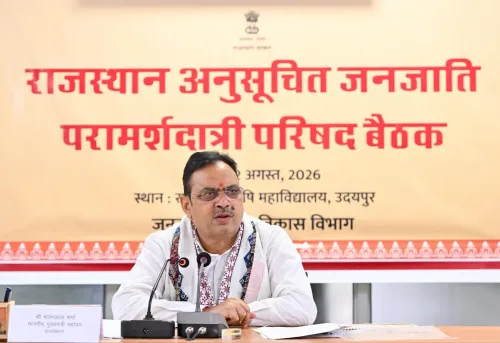
The Chief Minister's Office of Rajasthan posted on Monday, August 3, 2026, stating that the state government, under Chief Minister Bhajanlal Sharma, is working toward 'economic empowerment, social security, and holistic upliftment' of Scheduled Tribe communities in the state — anchoring that commitment to the GYAN model's central logic.
What the GYAN Model means for Scheduled Tribes
The GYAN framework — shorthand for Garib (poor), Yuva (youth), Annadata (farmer), and Nari (woman) — was articulated by PM Modi as a targeting lens for welfare delivery. Scheduled Tribe populations, who often sit at the intersection of poverty, agrarian livelihoods, and social vulnerability, are a natural focal group for all four categories simultaneously. By invoking GYAN explicitly, the Rajasthan government signals that its tribal welfare programmes are being aligned with the Centre's overarching beneficiary framework rather than operating in isolation.
Rajasthan's tribal welfare backdrop
Rajasthan is home to a significant Scheduled Tribe population concentrated in districts such as Udaipur, Banswara, and Dungarpur. At the national level, the Vanbandhu Kalyan Yojana, launched by the Government of India in 2014, set a template for holistic tribal area development — covering infrastructure, livelihoods, and social security. The Forest Rights Act of 2006 had earlier established a legal foundation for securing land and resource rights for tribal and forest-dwelling communities. State-level implementation of these frameworks has varied, and Rajasthan's current government is positioning itself as an active executor of that central vision.
The post also tagged @BhajanlalBjp and carried the hashtag #आपणो_अग्रणी_राजस्थान ('Our Leading Rajasthan'), a recurring branding phrase used by the Bhajanlal Sharma government to signal a development-forward identity for the state.
Watch for state budget allocations and scheme implementation disclosures in Rajasthan legislative sessions for the concrete numbers behind this commitment.
Point of View
Allowing the Bhajanlal Sharma government to present tribal outreach as part of a coherent national vision rather than a standalone state initiative. This mirrors a broader pattern among BJP-governed states of adopting PM Modi's branding vocabulary to reinforce ideological continuity with New Delhi. For Scheduled Tribe communities, the real test will be whether this rhetorical alignment translates into measurable budget outlays and scheme saturation in Rajasthan's tribal belt. The post, notably light on specifics, suggests the current communication is about positioning — the policy substance will need to follow.
NationPress
3 Aug 2026
Frequently Asked Questions
What is the GYAN model mentioned by Rajasthan CMO?
The GYAN model is PM Narendra Modi's welfare framework that groups beneficiaries into four categories: Garib (poor), Yuva (youth), Annadata (farmer), and Nari (woman), guiding targeted government schemes across these groups.
What is Rajasthan doing for Scheduled Tribes under the GYAN model?
The Rajasthan government under CM Bhajanlal Sharma has stated it is working on economic empowerment, social security, and holistic upliftment of Scheduled Tribe communities using the GYAN model as its guiding framework.
What is the Vanbandhu Kalyan Yojana?
The Vanbandhu Kalyan Yojana is a Government of India scheme launched in 2014 aimed at the holistic development of tribal areas, covering infrastructure, livelihoods, and social security for tribal communities.
Who is Bhajanlal Sharma?
Bhajanlal Sharma is the Chief Minister of Rajasthan from the BJP, leading the state government that is currently implementing tribal welfare and development programmes.
Which districts in Rajasthan have large Scheduled Tribe populations?
Rajasthan's Scheduled Tribe populations are significantly concentrated in districts such as Udaipur, Banswara, and Dungarpur in the southern part of the state.