Rajasthan CMO hails Yamuna water pact as historic milestone
Synopsis
The Chief Minister's Office of Rajasthan on 5 July 2026 hailed a newly concluded Yamuna water agreement — facilitated by PM Narendra Modi — as a historic milestone for the state, signalling a potential shift in its water entitlement under the three-decade-old interstate sharing framework.
Key Takeaways
The Rajasthan CMO officially described the Yamuna water agreement as a 'golden chapter' in the state's water history on 5 July 2026 .
The agreement is credited to the guidance of Prime Minister Narendra Modi , with CM Bhajanlal Sharma tagged in the announcement.
Rajasthan's Yamuna water entitlement has been governed by the 1994 MoU and overseen by the Upper Yamuna River Board since 1995.
Exact allocation figures, implementation timelines and formal responses from co-basin states Haryana and Delhi are yet to be made public.
Eastern Rajasthan's farming communities are the primary stakeholders expected to benefit from any enhanced water share.
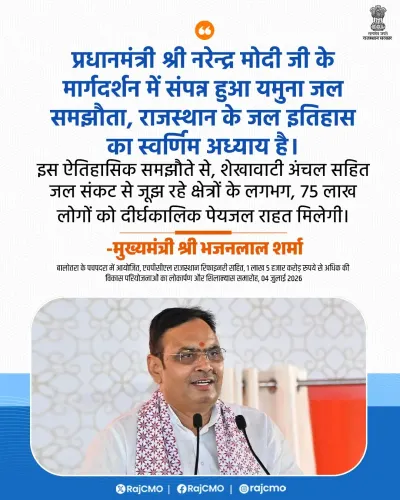
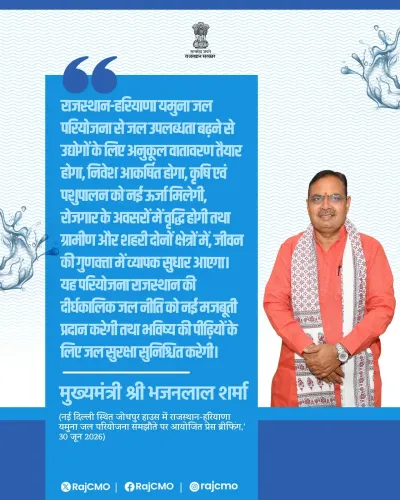
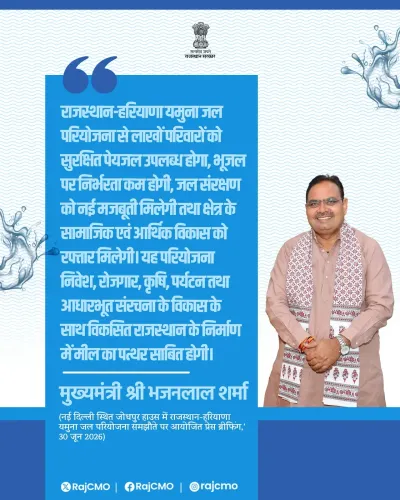
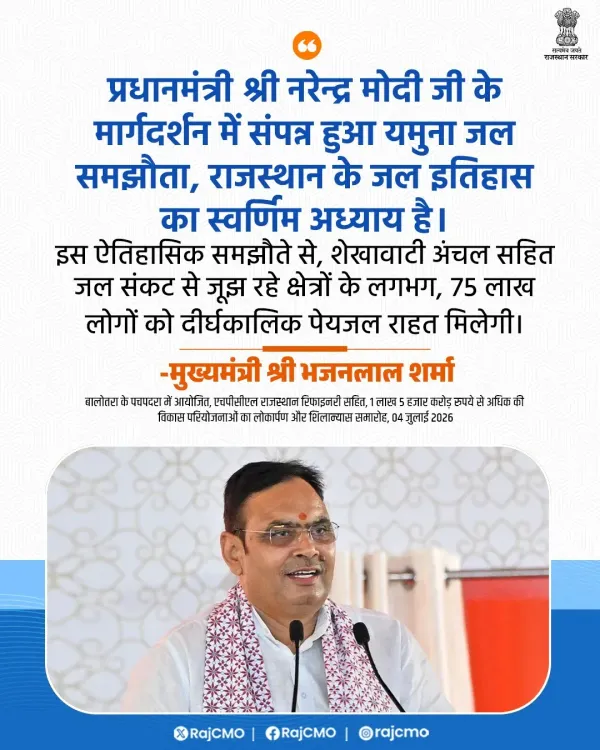
The Chief Minister's Office of Rajasthan on Sunday, 5 July 2026, declared the Yamuna water agreement — concluded under the guidance of Prime Minister Narendra Modi — a 'golden chapter' in the state's water history, publicly crediting the central government's leadership for the breakthrough.
The post, attributed to the official Rajasthan CMO handle and tagging Chief Minister Bhajanlal Sharma, stated in Hindi: 'Yamuna jal samjhauta, Rajasthan ke jal itihas ka swarnim adhyay hai' — ('The Yamuna water agreement is a golden chapter in Rajasthan's water history'). The hashtags #आपणो_अग्रणी_राजस्थान (Our Pioneering Rajasthan) and #PMModi4ViksitRajasthan (PM Modi for a Developed Rajasthan) framed the announcement within the state government's development narrative.
Context
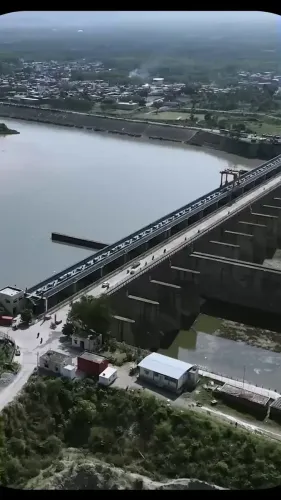
The Yamuna river is a critical water source for the semi-arid state of Rajasthan, which has historically received a limited share of its waters. Interstate water-sharing in India is governed through a combination of central memoranda, tribunal awards and statutory boards, with the central government frequently acting as facilitator among competing states.
Rajasthan's water needs are acute: the state encompasses a large portion of the Thar Desert and depends heavily on canal systems and river allocations for both irrigation and drinking water, particularly in its eastern districts.
Policy Backdrop
The Yamuna water-sharing framework has its roots in the 1994 Memorandum of Understanding, which assigned fixed shares to Rajasthan, Haryana, Uttar Pradesh, Himachal Pradesh and Delhi. The Upper Yamuna River Board, constituted in 1995, was tasked with overseeing implementation of that MoU and resolving seasonal allocation disputes among partner states.
Any revision to Rajasthan's allocation under the Yamuna framework would represent a significant shift in a three-decade-old arrangement, requiring alignment among multiple state governments and the central authority. India's broader track record on interstate river disputes — including the Cauvery, Mahadayi and Ravi-Beas basins — shows that such agreements typically emerge after prolonged negotiations and central facilitation.
Stakeholders and Impact
Rajasthan's farming communities, especially in the state's eastern districts that lie within or near the Yamuna basin catchment zone, stand to benefit most directly from any enhanced water allocation. Improved water availability could support expanded irrigation coverage and reduce dependence on groundwater in a region already facing depletion pressures.
The announcement also carries political weight: the Bhajanlal Sharma government, in office since December 2023, has positioned water security as a flagship concern, and aligning this achievement with Prime Minister Modi's leadership reinforces the BJP's governance narrative ahead of future electoral cycles.
What's Next
Key details that will determine the agreement's real-world impact remain to be made public — including the exact volume of additional allocation secured for Rajasthan, any amendments to Upper Yamuna River Board regulations, and formal responses from co-basin states Haryana and Delhi. Publication of the agreement's text and a formal implementation timeline will be closely watched by water-policy observers and farmer groups alike.
If the pact translates into measurable additional flows into Rajasthan's canal network, it could mark the most consequential revision to the state's Yamuna entitlement since the original 1994 MoU — setting a template for how the central government approaches other long-pending interstate water disputes.
Point of View
Reinforcing party cohesion and electoral credit-claiming. The announcement's vagueness on specifics, however, suggests the government is leading with political optics while technical details are still being finalised. If verified, an upward revision to Rajasthan's Yamuna share would be the most significant interstate water development for the state in three decades, carrying real consequences for irrigation and drinking water in the east. Observers will watch whether co-basin states, particularly Haryana and Delhi under different political configurations, publicly endorse or contest the pact's terms.
NationPress
5 Jul 2026
Frequently Asked Questions
What is the Yamuna water agreement for Rajasthan?
It is an interstate water-sharing pact on the Yamuna river that the Rajasthan government says has been concluded under PM Narendra Modi's guidance, potentially revising the state's water entitlement beyond what was fixed in the 1994 Memorandum of Understanding.
How much additional Yamuna water will Rajasthan get?
The exact volume of additional allocation has not been officially disclosed yet; the Rajasthan CMO's announcement did not specify quantities, and those details are expected to be published separately.
What was Rajasthan's previous Yamuna water share?
Under the 1994 MoU on Yamuna waters, Rajasthan was assigned a fixed share alongside Haryana, Uttar Pradesh, Himachal Pradesh and Delhi, administered by the Upper Yamuna River Board since 1995.
Who is Bhajanlal Sharma and what is his role in this agreement?
Bhajanlal Sharma is the Chief Minister of Rajasthan, in office since December 2023. He was tagged in the CMO's announcement, indicating his government is taking credit for securing the agreement.
Which districts of Rajasthan will benefit from the Yamuna water deal?
Eastern Rajasthan's districts, which lie closest to the Yamuna basin catchment zone, are expected to be the primary beneficiaries for both irrigation and drinking-water supply.