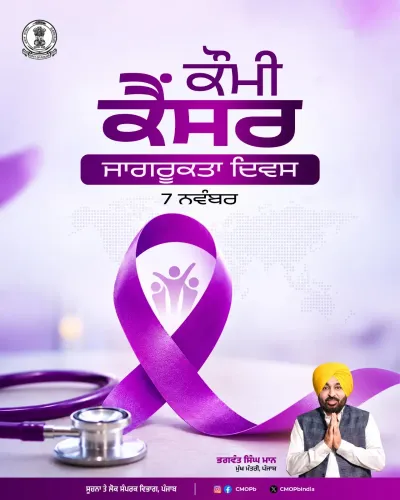
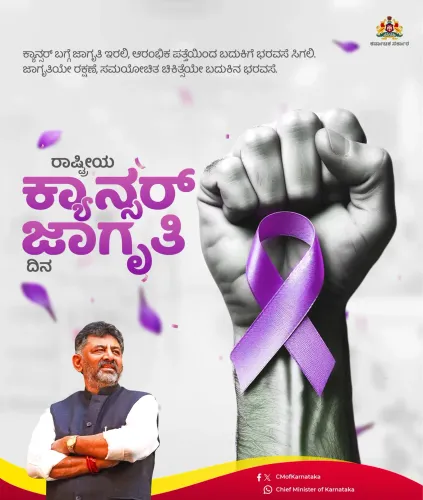
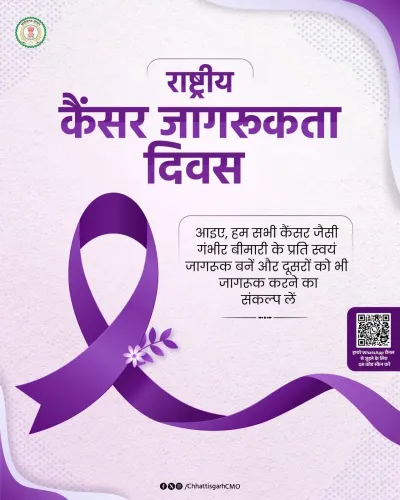
Rajasthan CMO marks National Cancer Awareness Day with health pledge
Synopsis
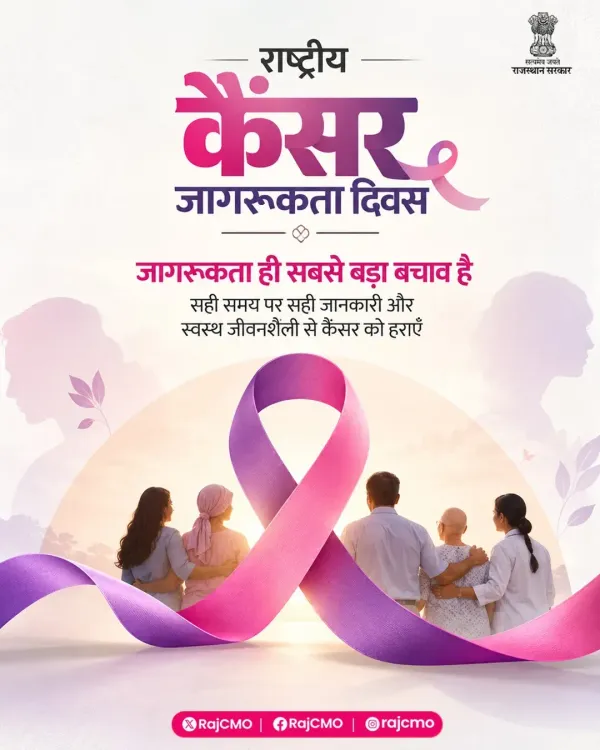
On National Cancer Awareness Day — 7 November — the Rajasthan Chief Minister's Office pledged to make cancer symptom awareness and timely treatment accessible to every citizen, reaffirming the state's commitment to public health under central schemes like NPCDCS.
Key Takeaways
The Chief Minister's Office of Rajasthan posted a cancer awareness message on 7 November 2026 , National Cancer Awareness Day.
The post declared that 'timely information and awareness are the greatest weapons' against serious diseases like cancer.
National Cancer Awareness Day is observed annually on 7 November , coinciding with Marie Curie's birth anniversary.
The state government reaffirmed its commitment to providing 'better and accessible healthcare' to every Rajasthan citizen.
The post aligns with the Union government's NPCDCS scheme (launched 2010) , which integrates cancer screening into primary healthcare across Indian states.
Future state budget allocations for cancer infrastructure and integration with Ayushman Bharat will determine the depth of the pledge.
On a day that doubles as the birth anniversary of Marie Curie, the scientist who gave the world its first framework for understanding radiation and its medical potential, the Chief Minister's Office of Rajasthan used National Cancer Awareness Day, 7 November 2026, to issue a pointed call to action — urging every section of society to arm itself with timely knowledge against one of India's most consequential public-health challenges.
The post, shared in Hindi, declared: 'सही समय पर सही जानकारी और जागरूकता ही सबसे बड़ा हथियार है' — 'timely information and awareness are the greatest weapons' against a disease as serious as cancer. It called on citizens to collectively pledge awareness of symptoms and the importance of early treatment, while reaffirming the state government's 'complete commitment' to delivering better and more accessible healthcare to every resident of Rajasthan.
Why 7 November — and why it matters for India
National Cancer Awareness Day has been observed across India every 7 November to honour Marie Curie's birthday and to anchor public attention on cancer prevention and early detection. The timing is deliberate: non-communicable diseases, including cancer, now account for a growing share of India's disease burden, and public-health experts consistently flag late diagnosis as the single biggest driver of poor outcomes. Early detection, the evidence shows, can dramatically improve survival rates across common cancers — cervical, breast, oral, and colorectal among them.
The central scheme behind state-level awareness drives
Rajasthan's commitment does not exist in a vacuum. Since 2010, the Union government's National Programme for Prevention and Control of Cancer, Diabetes, Cardiovascular Diseases and Stroke (NPCDCS) has provided the structural spine for state-level cancer awareness, screening, and treatment integration into primary healthcare. Under NPCDCS, states including Rajasthan are expected to embed cancer screening into district hospitals and community health centres — making awareness messaging a precursor to actionable, ground-level intervention rather than a standalone communication exercise.
What the pledge signals for Rajasthan's health agenda
The CMO's framing — centred on accessibility and reaching 'every citizen' — signals continued alignment with the broader national push to bring cancer care closer to the population that needs it most: rural, semi-urban, and economically vulnerable communities who historically reach tertiary facilities only at advanced stages. The state's integration with central schemes such as Ayushman Bharat and future budget allocations for cancer-care infrastructure will be the real test of that commitment in the months ahead.
Awareness, as the post itself argues, is the first step. What follows the pledge is what will count.
Point of View
Geographically dispersed state. With NPCDCS providing structural backing since 2010, the real policy gap has never been intent; it has been last-mile execution and budget prioritisation. As Ayushman Bharat deepens its reach, how Rajasthan allocates its own health infrastructure spending in the upcoming state budget will reveal whether this pledge is a conversation-starter or a commitment with teeth.
NationPress
7 Nov 2026
Frequently Asked Questions
When is National Cancer Awareness Day observed in India?
National Cancer Awareness Day is observed every year on 7 November in India, coinciding with the birth anniversary of scientist Marie Curie .
What did the Rajasthan CMO say on National Cancer Awareness Day 2026?
The Chief Minister's Office of Rajasthan posted that 'timely information and awareness are the greatest weapons' against cancer, calling on citizens to pledge awareness of symptoms and early treatment, and reaffirming the state government's commitment to accessible healthcare.
What is NPCDCS and how does it relate to Rajasthan?
NPCDCS — the National Programme for Prevention and Control of Cancer, Diabetes, Cardiovascular Diseases and Stroke — is a central government scheme launched in 2010 that integrates cancer awareness, screening, and treatment into primary healthcare across Indian states including Rajasthan.
Why is early cancer detection important in India?
Public health experts consistently identify late diagnosis as the primary driver of poor cancer outcomes in India. Early detection across common cancers — including cervical, breast, and oral — can significantly improve survival rates.
What can citizens do on National Cancer Awareness Day?
Citizens can educate themselves and others about cancer symptoms, encourage timely medical check-ups, and support community outreach efforts that promote early screening and access to treatment facilities.