CM Bhajanlal Directs Depts to Plant 10 Cr Trees This Monsoon
Synopsis
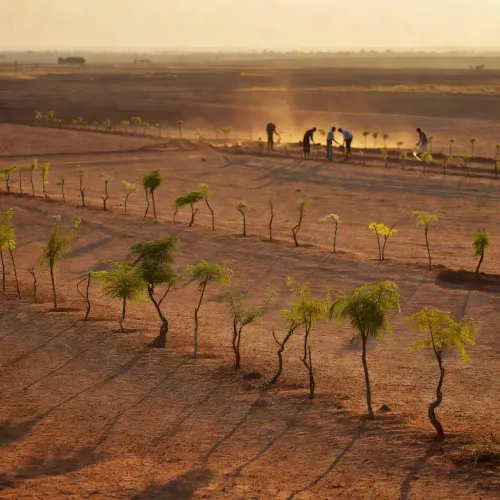
The Rajasthan CMO has directed all state departments to work in coordination under Mission Hariyalo Rajasthan to plant 10 crore saplings in the upcoming monsoon season, reinforcing the state's push to expand green cover in one of India's most arid regions.
Key Takeaways
The Chief Minister's Office of Rajasthan issued a directive on 20 June 2026 under Mission Hariyalo Rajasthan .
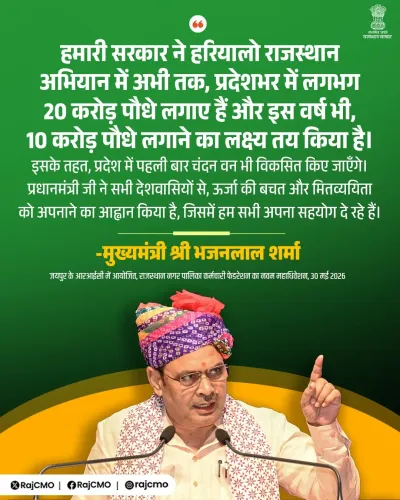
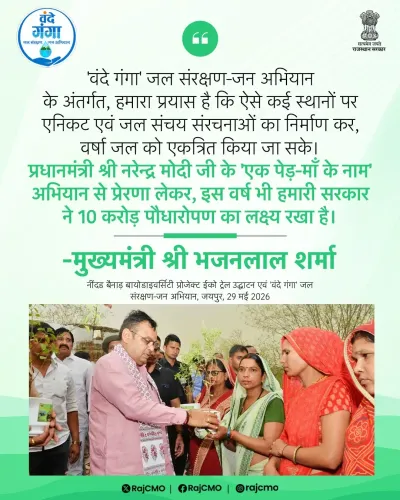
The target is to plant 10 crore (100 million) saplings during the upcoming monsoon season.
All concerned state departments have been asked to work in coordination to fulfil the target.
Rajasthan has historically low forest and tree cover of around 4.8 percent , far below the national goal of 33 percent.
The drive aligns with India's Paris Agreement commitments and is supported by national funds including CAMPA and the Green India Mission .
Post-monsoon survival rates and official plantation counts will be key indicators of the campaign's actual ecological impact.
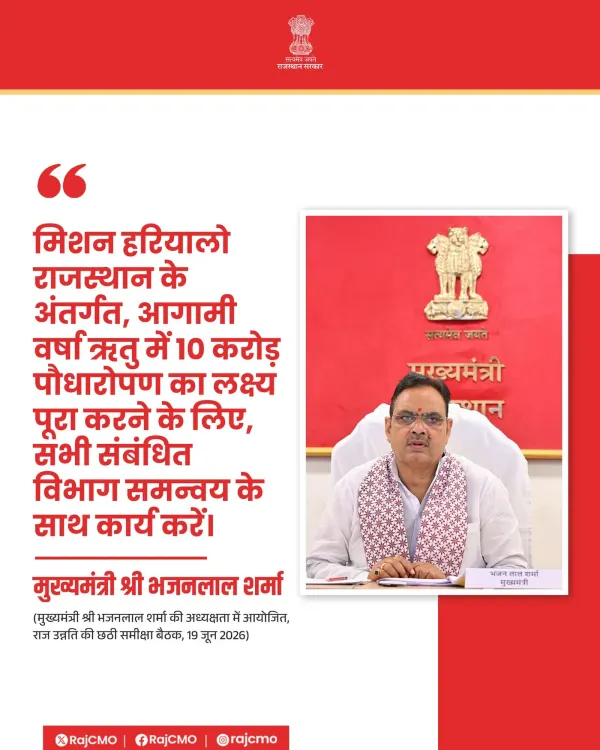
The Chief Minister's Office of Rajasthan on Saturday, 20 June 2026 directed all concerned state departments to work in coordination to achieve a target of planting 10 crore saplings during the upcoming monsoon season under Mission Hariyalo Rajasthan, the state's flagship afforestation initiative.
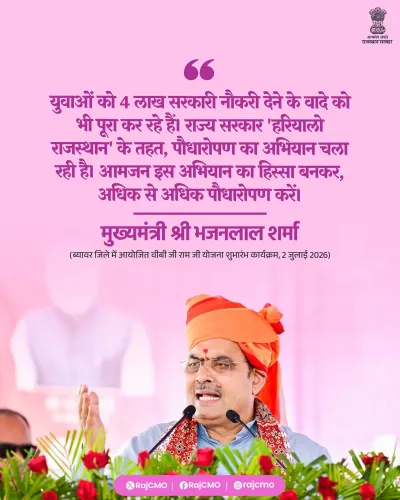
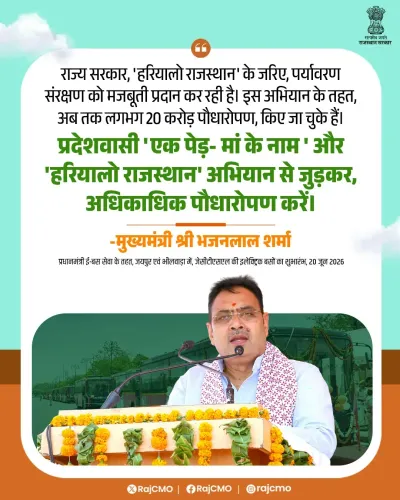
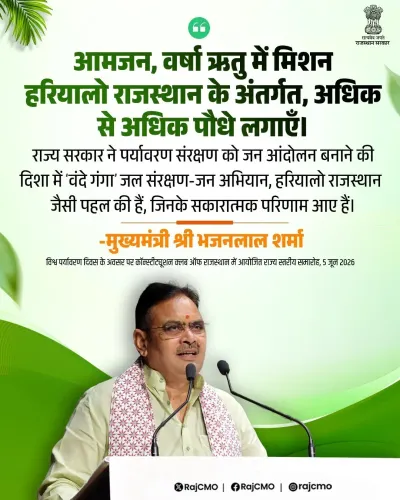
The post, attributed to Chief Minister Bhajanlal Sharma via the official CMO handle, stated in Hindi: 'मिशन हरियालो राजस्थान के अंतर्गत, आगामी वर्षा ऋतु में 10 करोड़ पौधारोपण का लक्ष्य पूरा करने के लिए, सभी संबंधित विभाग समन्वय के साथ कार्य करें' — ('Under Mission Hariyalo Rajasthan, all concerned departments should work in coordination to fulfil the target of planting 10 crore saplings in the upcoming rainy season.')
Context
Rajasthan is India's largest state by area and one of its most ecologically stressed, with forest and tree cover historically hovering around 4.8 percent — far below the national aspiration of 33 percent. Large swaths of the state fall within arid and semi-arid zones, making sustained afforestation both a climate-resilience imperative and a long-standing policy challenge. The monsoon window, typically July to September, is the primary planting season when soil moisture supports sapling survival.
Policy Backdrop
Mission Hariyalo Rajasthan is the Bhajanlal government's coordinated afforestation drive, designed to align multiple departments — including the Rajasthan Forest Department, agriculture, rural development, and panchayati raj — behind a single seasonal plantation target. Rajasthan has run annual Van Mahotsav plantation drives since the 1950s, and the state has received funding through national channels such as the Compensatory Afforestation Fund Management and Planning Authority (CAMPA) and the Green India Mission, launched in 2014. The current directive signals a push to institutionalise cross-departmental accountability ahead of the 2026 monsoon.
Large-scale seasonal plantation campaigns are a recurring feature across Indian states. Madhya Pradesh and Maharashtra have run comparable drives in recent years, reflecting India's commitments under the Paris Agreement to create an additional carbon sink of 2.5 to 3 billion tonnes of CO2 equivalent through increased forest and tree cover by 2030.
Stakeholders and Impact
The directive has direct implications for the Rajasthan Forest Department, which is the primary executing agency, as well as agriculture officials and rural communities who are typically mobilised as ground-level participants in plantation drives. Successful execution of the 10 crore target would require nursery preparedness, logistical coordination across 33 districts, and community engagement to ensure sapling survival beyond the planting event itself. Survival rates — not just planting numbers — are increasingly the metric that determines the ecological value of such campaigns.
For rural households, afforestation drives can generate short-term employment under schemes such as MGNREGS and contribute to long-term benefits including soil stabilisation, groundwater recharge, and reduced desertification in vulnerable western districts.
What's Next
The government is expected to release post-monsoon progress reports on saplings planted, survival rates, and species-wise distribution. Observers will watch whether supplementary budget allocations or additional CAMPA fund releases are announced for 2026-27 to back the drive. The 10 crore target will also serve as a benchmark for the Bhajanlal administration's environmental record ahead of future electoral cycles, making independent verification of outcomes particularly significant.
Point of View
The 10 crore figure is as much a governance optic as an ecological goal, allowing the government to claim a concrete deliverable in a state where environmental credentials are increasingly electorally relevant. The emphasis on 'coordination' across departments implicitly acknowledges a recurring weakness of India's plantation drives: siloed execution that inflates planting numbers while sapling survival remains poor. Whether Mission Hariyalo Rajasthan breaks that pattern will depend on post-monsoon audit rigour, not the ambition of the target.
NationPress
19 Sept 2026
Frequently Asked Questions
What is Mission Hariyalo Rajasthan?
Mission Hariyalo Rajasthan is the Bhajanlal Sharma government's flagship afforestation initiative, which coordinates multiple state departments to achieve large-scale tree plantation targets, particularly during the monsoon season, to improve Rajasthan's historically low forest and tree cover.
What is the plantation target set by the Rajasthan government for 2026?
The Rajasthan Chief Minister's Office has set a target of planting 10 crore (100 million) saplings during the upcoming monsoon season of 2026 under Mission Hariyalo Rajasthan.
What is Rajasthan's current forest cover percentage?
Rajasthan's forest and tree cover has historically been around 4.8 percent, well below India's national aspiration of 33 percent green cover. The state's large arid and semi-arid zones make sustained afforestation a significant challenge.
Which departments are responsible for the plantation drive in Rajasthan?
The Rajasthan Forest Department is the primary executing agency, but the CMO directive calls for all concerned departments — including agriculture, rural development, and panchayati raj — to work in coordination to meet the 10 crore target.
How is Rajasthan's plantation drive funded?
Rajasthan's afforestation drives are funded through a combination of state budget allocations and national funds such as the Compensatory Afforestation Fund Management and Planning Authority (CAMPA) and the Green India Mission, launched in 2014.