Rajasthan CMO calls for world-class infra in Abu Raj
Synopsis
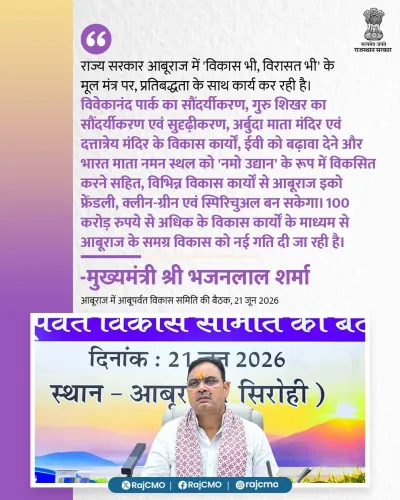
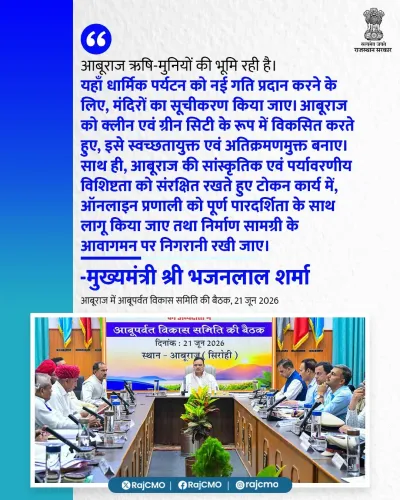
The Rajasthan CMO has called for world-class urban development, roads, parking and mobility infrastructure in Abu Raj, tagging CM Bhajan Lal Sharma under the 'Our Leading Rajasthan' campaign — signalling a major push for the Mount Abu gateway region.
Key Takeaways
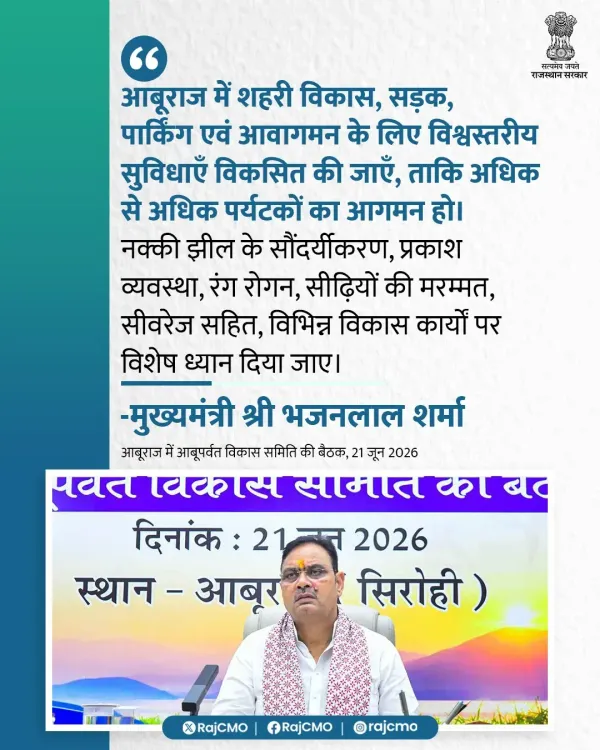
The Chief Minister's Office of Rajasthan posted on 21 June 2026 directing world-class infrastructure for Abu Raj .
The directive covers urban development, roads, parking and mobility — four interconnected infrastructure domains.
Chief Minister Bhajan Lal Sharma was tagged directly, signalling executive-level priority.
The post was made under the campaign hashtag #आपणो_अग्रणी_राजस्थान ('Our Leading Rajasthan').
Abu Raj refers to the Abu Road–Mount Abu corridor in Sirohi district , Rajasthan's key hill-station gateway.
Formal project reports, tenders and budget allocations are the next milestones to watch.
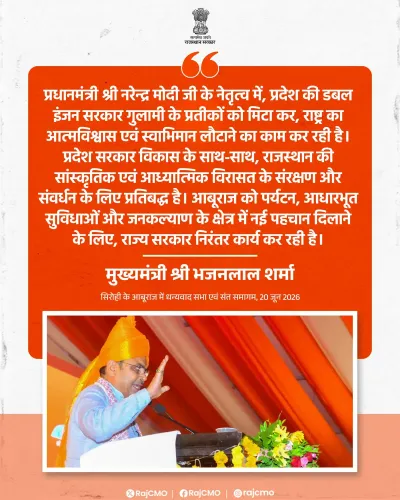
The Chief Minister's Office of Rajasthan on Sunday, 21 June 2026 directed that world-class facilities for urban development, roads, parking, and mobility be developed in Abu Raj, tagging Chief Minister Bhajan Lal Sharma in the official post.
Context
The post, shared under the hashtag #आपणो_अग्रणी_राजस्थान ('Our Leading Rajasthan'), calls for Abu Raj — a reference to the Abu Road and Mount Abu region in Sirohi district of southern Rajasthan — to receive infrastructure upgrades meeting global standards. The directive covers four interconnected domains: urban development, road networks, parking facilities, and overall movement of people and goods. By tagging Chief Minister Bhajan Lal Sharma directly, the CMO signalled that the push carries executive-level attention.
Policy Backdrop
Rajasthan has historically participated in central government urban renewal programmes, including the Atal Mission for Rejuvenation and Urban Transformation (AMRUT), launched in 2015, which channelled funds into urban roads, mobility corridors and parking infrastructure across Indian cities and towns. Since the BJP government under Bhajan Lal Sharma assumed office in December 2023, urban infrastructure upgrades have featured prominently in the administration's public communications as a marker of its development agenda. The Abu Road–Mount Abu corridor holds particular strategic value: it is a gateway to Mount Abu, Rajasthan's only hill station, drawing significant tourist traffic and requiring commensurate civic infrastructure.
State governments across India routinely use official social media channels to signal intent ahead of formal project approvals. Such announcements typically precede detailed project reports, departmental tenders, and budget line-item allocations in subsequent fiscal cycles. The CMO's post fits this established pattern, suggesting that planning or pre-feasibility work for Abu Raj may already be under way.
Stakeholders and Impact
Urban residents and daily commuters in the Abu Road town and the Mount Abu hill station stand to benefit most directly from improved roads, organised parking, and better last-mile connectivity. The region's tourism economy — a significant contributor to Sirohi district's revenues — is equally at stake, as congestion and inadequate parking have long been cited as friction points for visitors. Traders, hotel operators and local transport providers would see downstream gains if the infrastructure overhaul materialises on the timeline implied by the announcement.
Broader civic benefits could include reduced vehicular congestion on the narrow approach roads to Mount Abu, improved emergency-vehicle access, and better pedestrian infrastructure — outcomes aligned with the state's stated goal of making Rajasthan a leading destination for both tourism and investment.
What's Next
Observers should watch the Rajasthan Urban Development Department for formal project notifications, tender documents, and budget allocations that will convert this directive into measurable commitments. State budget documents for the upcoming fiscal cycle and announcements from the Urban Improvement Trust or local bodies covering the Sirohi region will be the clearest indicators of pace and scale. If the project is routed through a central scheme such as AMRUT 2.0, a joint state-centre funding announcement could follow. The CMO's public tagging of Chief Minister Sharma adds political accountability to the directive, making a formal follow-up response more likely in the near term.
Point of View
The CMO creates a visible accountability loop that raises the political cost of inaction. The Mount Abu corridor is a logical early focus — its tourism revenue and chronic congestion make it both a high-impact and high-visibility target. If followed by concrete budget allocations, the move could strengthen the government's narrative ahead of future electoral cycles; if it stalls at the announcement stage, it risks reinforcing perceptions of governance-by-tweet.
NationPress
20 Sept 2026
Frequently Asked Questions
What is Abu Raj in Rajasthan?
'Abu Raj' refers to the Abu Road and Mount Abu region in Sirohi district of southern Rajasthan. Mount Abu is the state's only hill station and a major tourist destination, while Abu Road serves as its main rail and road gateway.
What infrastructure is planned for Abu Raj?
The Rajasthan CMO has called for world-class facilities covering urban development, road networks, parking infrastructure and overall mobility — though formal project details, tenders and budget allocations are yet to be announced.
Who is Bhajan Lal Sharma?
Bhajan Lal Sharma is the Chief Minister of Rajasthan representing the BJP. He has been in office since December 2023, following the party's victory in the Rajasthan assembly elections.
What is the 'Aapno Agrani Rajasthan' campaign?
'Aapno Agrani Rajasthan' — meaning 'Our Leading Rajasthan' — is a hashtag campaign used by the Rajasthan government and BJP to brand the state's development initiatives and position Rajasthan as a front-runner in governance and infrastructure.
What central schemes support urban infrastructure in Rajasthan?
Rajasthan has participated in the Atal Mission for Rejuvenation and Urban Transformation (AMRUT), a central government programme launched in 2015 to fund urban roads, mobility and parking projects. The state may also route new projects through AMRUT 2.0 or other central schemes.