Rajasthan CMO calls for temple listing at Mount Abu
Synopsis
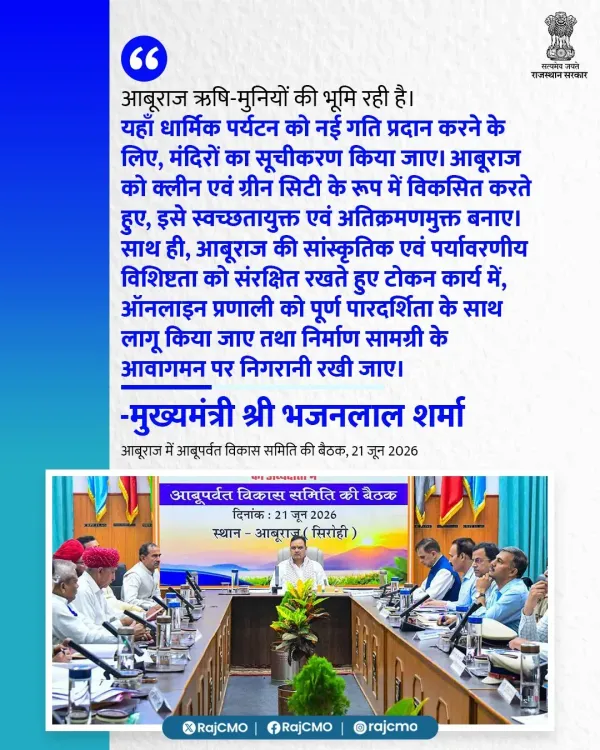
The Rajasthan CMO on 21 June 2026 called for a formal cataloguing of temples at Mount Abu to boost religious tourism, invoking the hill station's ancient rishi heritage and tagging CM Bhajanlal Sharma in the directive.
Key Takeaways
The Chief Minister's Office of Rajasthan posted on 21 June 2026 directing that temples at Mount Abu be catalogued to promote religious tourism.
Mount Abu in Sirohi district is home to the Dilwara Temples (11th-13th century), the Brahma Kumaris headquarters, and is steeped in ancient rishi traditions.
The post tagged Chief Minister Bhajanlal Sharma , signalling direct executive-level attention to the proposal.
The move mirrors temple-cataloguing drives in Uttar Pradesh and Madhya Pradesh that link heritage documentation with infrastructure investment.
Follow-up action is expected from the Rajasthan Tourism Department on enumeration timelines and pilgrim amenity budgets.
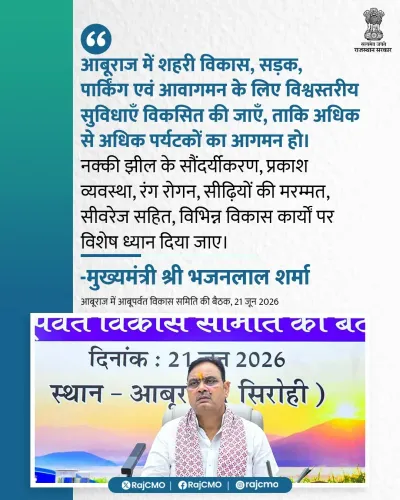
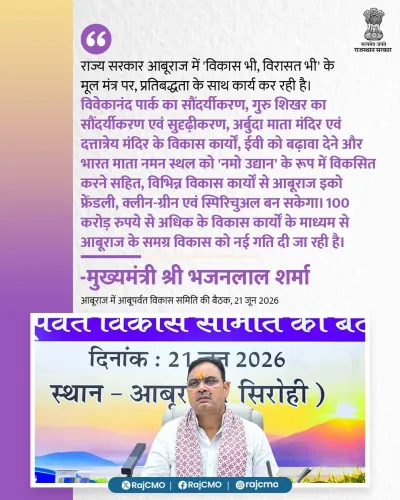
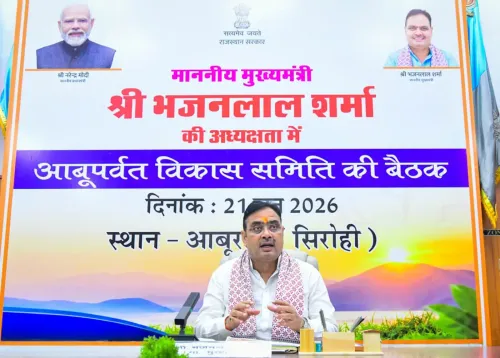
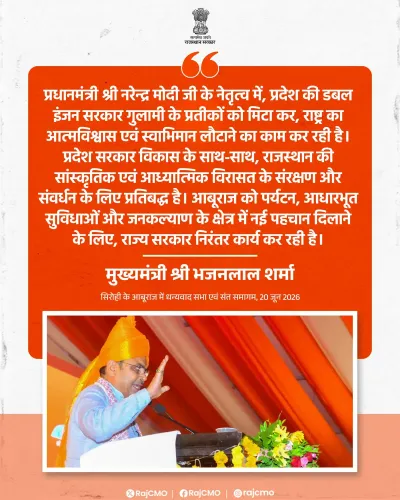
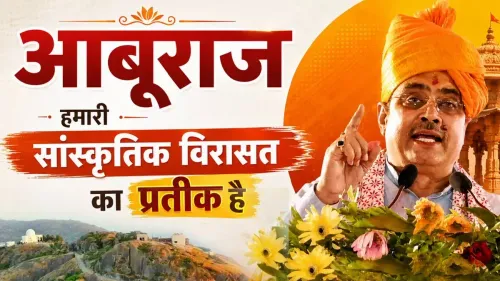
The Chief Minister's Office of Rajasthan on Sunday, 21 June 2026, directed that temples at Mount Abu be catalogued to give fresh momentum to religious tourism at the hill station, tagging Chief Minister Bhajanlal Sharma in the post.
The post, shared on X, stated: 'Aabu raj rishi-muniyon ki bhoomi rahi hai. Yahan dharmik paryatan ko nayi gati pradaan karne ke liye, mandiron ka suchikaran kiya jae.' ('Mount Abu has been the land of sages and saints. To give new momentum to religious tourism here, temples should be catalogued.')
Context
Mount Abu, located in Sirohi district of Rajasthan, is the state's only hill station and carries deep religious significance across multiple traditions. It is home to the celebrated Dilwara Temples, a cluster of 11th-to-13th century marble Jain shrines widely regarded as masterpieces of Indian temple architecture. The area is also the global headquarters of the Brahma Kumaris spiritual organisation and is historically associated with ancient rishi traditions referenced in the post's hashtag #AapnoAgraniRajasthan ('Our Pioneering Rajasthan').
The directive to list temples is framed as a precondition for structured promotion — mapping existing religious assets before channelling tourism infrastructure investment toward them.
Policy Backdrop
Rajasthan's tourism policy documents since the early 2010s have consistently identified Mount Abu as a priority node in the state's religious and heritage tourism circuit. The current BJP government, which took office in December 2023 under Chief Minister Bhajanlal Sharma, has signalled an intent to accelerate such initiatives as part of a broader push to develop structured pilgrimage corridors.
Across BJP-governed states, temple cataloguing has emerged as a foundational step in creating religious tourism circuits. Uttar Pradesh and Madhya Pradesh have pursued similar documentation drives, linking heritage enumeration with infrastructure upgrades and pilgrim amenity development. The Rajasthan CMO's call mirrors that pattern at the state level.
Stakeholders and Impact
The proposal, if acted upon, would directly affect religious pilgrims, local hoteliers, guides, and priests associated with Mount Abu's temple ecosystem. A formal listing exercise would establish an official inventory that tourism planners, heritage bodies, and private investors could use to prioritise amenity upgrades and promotional campaigns.
For the Jain community in particular, the Dilwara complex already draws significant footfall, but smaller and lesser-known temples in the Abu region remain outside mainstream tourism promotion. A cataloguing exercise could bring these sites into a more structured visitor framework.
What's Next
The immediate follow-up will rest with the Rajasthan Tourism Department, which would be expected to issue orders on the scope, timeline, and implementing agency for the temple enumeration exercise. Budget allocations for pilgrim amenities at Mount Abu in subsequent departmental plans will serve as a concrete indicator of how seriously the directive is pursued.
The post's tagging of CM Bhajanlal Sharma signals that the Chief Minister's Office expects direct executive engagement, potentially accelerating the timeline for a formal government order.
Point of View
The post frames religious tourism development as both a cultural obligation and a governance priority. This fits neatly into a wider BJP playbook visible in Uttar Pradesh and Madhya Pradesh, where temple enumeration has preceded significant infrastructure and branding investments in pilgrimage circuits. The tagging of CM Bhajanlal Sharma suggests the directive is meant to be read as coming from the highest level, raising accountability for follow-through.
NationPress
20 Sept 2026
Frequently Asked Questions
Why is the Rajasthan government listing temples at Mount Abu?
The Rajasthan CMO stated on 21 June 2026 that a formal temple cataloguing exercise at Mount Abu is needed to give new momentum to religious tourism at the hill station, which has deep historical and spiritual significance.
What famous temples are at Mount Abu in Rajasthan?
Mount Abu is best known for the Dilwara Temples, a group of 11th-to-13th century marble Jain shrines considered among the finest examples of temple architecture in India. The area also has several Hindu temples linked to ancient rishi traditions.
Who is the Chief Minister of Rajasthan in 2026?
Bhajanlal Sharma of the BJP has been serving as Chief Minister of Rajasthan since December 2023, when the party won the state assembly elections.
What is the hashtag AapnoAgraniRajasthan about?
'AapnoAgraniRajasthan' translates to 'Our Pioneering Rajasthan' and is used by the Rajasthan government and BJP to brand the state's development and cultural initiatives under the current administration.
How does Rajasthan's temple listing plan compare to other states?
BJP-governed states such as Uttar Pradesh and Madhya Pradesh have previously conducted similar temple cataloguing drives, using heritage documentation as the first step toward building structured religious tourism circuits with upgraded pilgrim amenities.