CM Bhajanlal Highlights Rajasthan's Lead in Cumin, Isabgol, Mustard

Synopsis
The Chief Minister's Office of Rajasthan on 26 July 2026 declared the state among India's top producers of cumin, isabgol, and mustard, reinforcing CM Bhajanlal Sharma's 'Aapno Agrani Rajasthan' brand and underscoring the state's deep roots in India's spice and oilseed economy.
Key Takeaways
The Rajasthan CMO officially highlighted the state's leading national position in cumin, isabgol, and mustard production on 26 July 2026 .
Chief Minister Bhajanlal Sharma , in office since December 2023 , was credited with the state's agricultural standing.
Rajasthan's agro-climatic conditions — arid and semi-arid soils — make it naturally suited to these drought-tolerant, high-value crops.
The post used the hashtag #AapnoAgrani Rajasthan ('Our Leading Rajasthan'), a recurring government branding phrase.
Key farming communities in districts such as Barmer, Jalor, Jodhpur, Pali, Bharatpur, and Alwar stand to benefit from heightened policy attention.
No specific new schemes or statistics were announced; the post signals intent ahead of potential policy or export-promotion moves.
The Chief Minister's Office of Rajasthan on Sunday, 26 July 2026 highlighted the state's position as one of India's leading producers of cumin, isabgol, and mustard, crediting Chief Minister Bhajanlal Sharma with steering this agricultural standing under the banner Aapno Agrani Rajasthan ('Our Leading Rajasthan').
Context
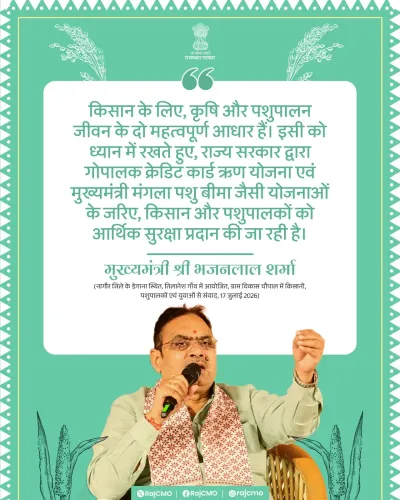
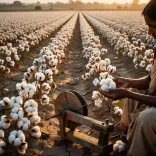
The post, shared from the official CMO handle and tagging @BhajanlalBjp, states: 'Rajasthan jeera, isabgol, sarson sahit anek upaj mein desh ke agrani rajyon mein hai' — 'Rajasthan is among the country's leading states in many crops including cumin, isabgol, and mustard.' The message was accompanied by an image and tagged with the hashtag #AapnoAgrani Rajasthan, a recurring branding phrase used by the current state government to underscore Rajasthan's national stature.
The communication is part of a broader pattern in which state governments use official digital channels to publicise agricultural strengths, particularly ahead of export-promotion drives and investor outreach.
Policy Backdrop
Rajasthan, India's largest state by area, has long held top-tier rankings in the production of cumin (jeera), psyllium husk (isabgol), and mustard (sarson) owing to its distinctive agro-climatic conditions — arid and semi-arid soils that suit these drought-tolerant crops. These three commodities are not only staples of domestic consumption but also significant contributors to India's spice and oilseed export basket.
Chief Minister Bhajanlal Sharma, who took office in December 2023 following the BJP's victory in the state assembly elections, has consistently emphasised rural economic performance and agricultural development in government messaging. Highlighting crop-specific leadership aligns with efforts to attract agri-business investment and strengthen farmer incomes.
Stakeholders and Impact
The primary beneficiaries of Rajasthan's agricultural leadership are its farming communities, particularly smallholders in districts such as Barmer, Jalor, Jodhpur, and Pali, which are traditionally associated with cumin and isabgol cultivation, and the Bharatpur and Alwar belt for mustard. Spice exporters and oilseed processors operating in the state also benefit from the consistent supply volumes that a leading-producer status implies.
For farmers, official recognition of Rajasthan's standing can translate into greater policy attention — including targeted irrigation support, minimum support price announcements, and state-level procurement schemes — though no specific new measures were announced in this post.
What's Next
Observers will watch for the release of updated state and central agricultural production statistics, as well as any crop-specific support measures or export-linkage schemes the Rajasthan government may announce in the coming months. The Aapno Agrani Rajasthan campaign framing suggests the CMO intends to sustain this agricultural narrative through further official communications. How the government converts this messaging into concrete farmer-support policy will be the real measure of the initiative's impact.
Point of View
Associating his tenure with Rajasthan's long-standing crop dominance allows the BJP government to claim ownership of structural advantages that predate it. The 'Aapno Agrani Rajasthan' framing is particularly deliberate: by anchoring pride in measurable economic output rather than political rhetoric, the CMO positions agriculture as a governance achievement. The real test will come when these communications are followed — or not — by concrete policy measures such as expanded irrigation, better market linkages, or higher support prices for cumin and isabgol farmers.
NationPress
25 Oct 2026
Frequently Asked Questions
Is Rajasthan the top producer of cumin in India?
Rajasthan is consistently ranked among India's top cumin-producing states, with its arid agro-climatic conditions in districts like Barmer, Jalor, and Jodhpur being particularly suited to the crop. The Rajasthan CMO reiterated this standing in an official post on 26 July 2026.
What is isabgol and why is Rajasthan known for it?
Isabgol, or psyllium husk, is a drought-tolerant crop used widely as a dietary supplement and in pharmaceuticals. Rajasthan's semi-arid soils make it one of the country's leading producers, and the crop is a significant contributor to India's agricultural exports.
Who is the Chief Minister of Rajasthan in 2026?
Bhajanlal Sharma of the BJP is the Chief Minister of Rajasthan, having taken office in December 2023 following the party's assembly election victory.
What is the 'Aapno Agrani Rajasthan' campaign?
'Aapno Agrani Rajasthan' translates to 'Our Leading Rajasthan' and is a branding phrase used by the current Rajasthan government to highlight the state's top rankings across various sectors, including agriculture.
Which crops make Rajasthan an agricultural leader in India?
Rajasthan is recognised as a leading national producer of cumin (jeera), isabgol (psyllium husk), and mustard (sarson), among other crops, owing to its unique agro-climatic conditions.