Rajasthan CMO urges public to join plantation drive
Synopsis
The Rajasthan CMO on 3 July 2026 called on citizens to join an afforestation campaign and plant maximum saplings, tagging CM Bhajanlal Sharma under the 'Our Leading Rajasthan' banner as the monsoon season begins.
Key Takeaways
The Chief Minister's Office of Rajasthan posted on 3 July 2026 urging citizens to participate in a tree-plantation campaign.
The appeal tags CM Bhajanlal Sharma and uses the hashtag #आपणो_अग्रणी_राजस्थान ('Our Leading Rajasthan').
Rajasthan has large arid and semi-arid zones, making afforestation a long-standing ecological priority for successive state governments.
The drive follows a national tradition of Van Mahotsav monsoon-season plantation, observed in the state since the 1950s .
India's Green India Mission targets raising national forest and tree cover to 33 percent , with Rajasthan aligned since 2015 .
Sapling survival rates and district-level targets will be key metrics to watch over the 2026 monsoon season .
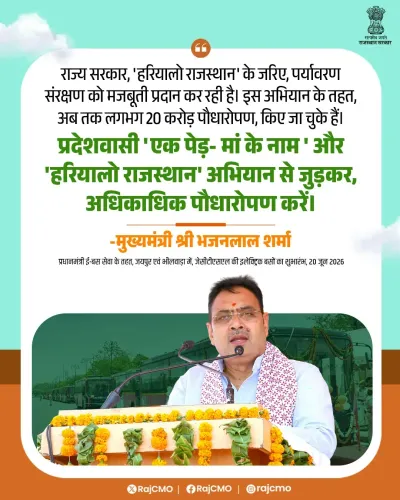
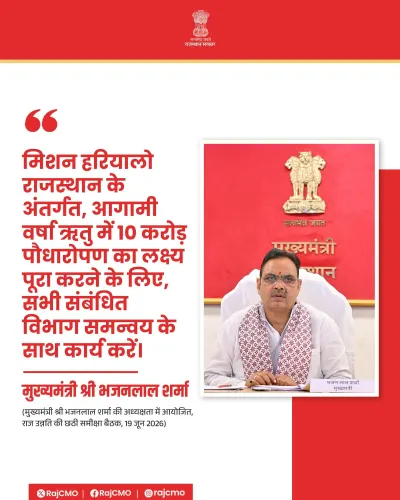
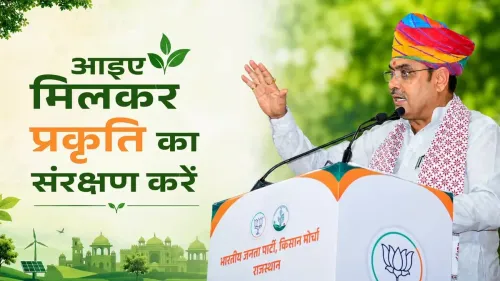
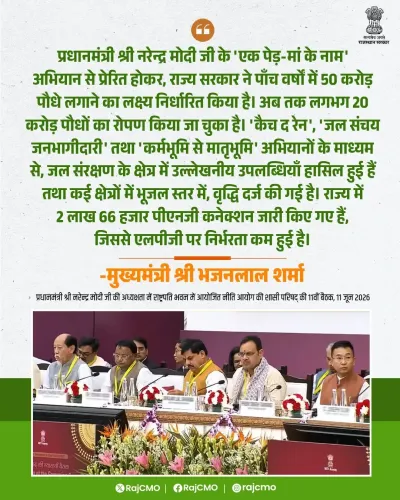
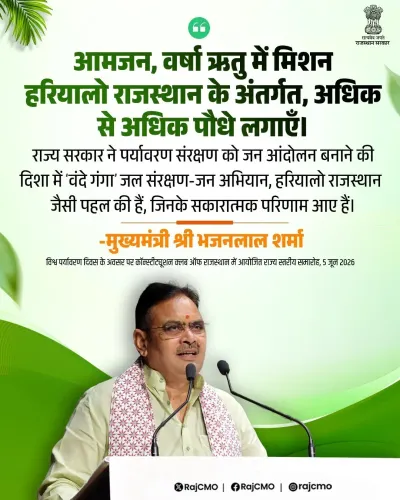
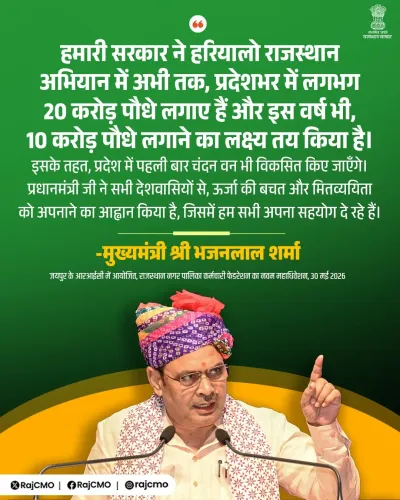
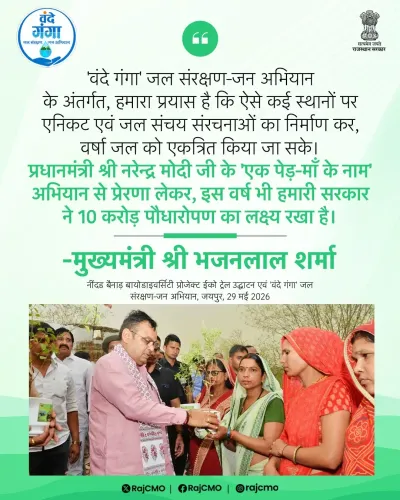
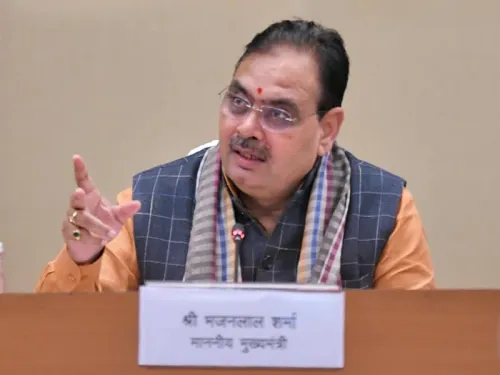
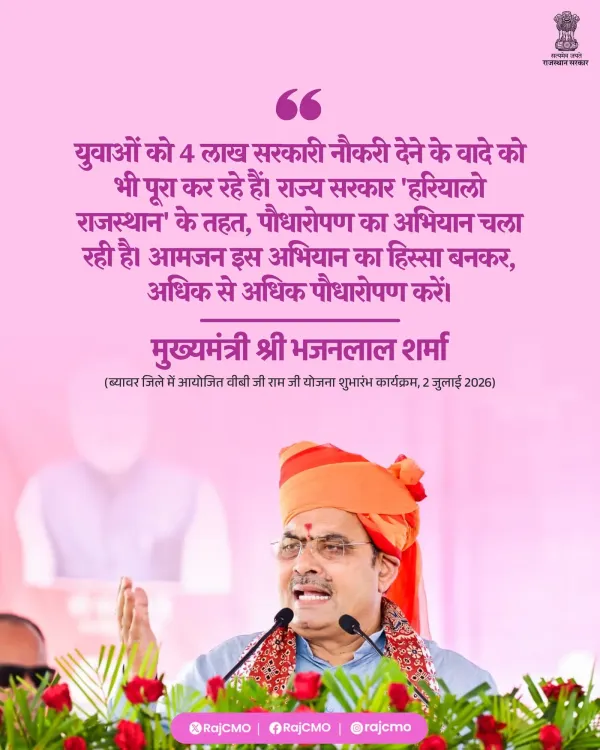
The Chief Minister's Office of Rajasthan on Friday, 3 July 2026, called on the general public to participate in an ongoing afforestation campaign and plant as many saplings as possible, tagging Chief Minister Bhajanlal Sharma in the appeal posted on X under the hashtag #आपणो_अग्रणी_राजस्थान ('Our Leading Rajasthan').
The post, in Hindi, reads: 'Aamjan is abhiyan ka hissa bankar adhik se adhik paudhaaropan karein' — urging ordinary citizens to become part of the campaign and maximise tree-plantation activity.
Context
The appeal comes at the onset of the southwest monsoon season, which typically runs from July to September across Rajasthan. State governments across India traditionally use this window to launch or intensify tree-plantation drives, as soil moisture improves sapling survival rates. Rajasthan, a state with extensive arid and semi-arid zones — particularly in its western districts — has historically faced ecological stress from desertification and low forest cover.
The hashtag #आपणो_अग्रणी_राजस्थान ('Our Leading Rajasthan') signals that the campaign is framed as part of a broader state-development identity under the current BJP-led government, which took office in December 2023.
Policy Backdrop
Rajasthan has observed Van Mahotsav — the national tree-plantation festival — annually since the 1950s, making monsoon afforestation a long-standing state tradition. The state later aligned with the National Afforestation Programme, launched in 2000–02, which sought to regenerate degraded forest lands through Joint Forest Management Committees involving local communities.
In 2015, Rajasthan joined India's commitment under the Green India Mission to raise national forest and tree cover toward the 33 percent target. Indian state governments have also linked plantation drives to international obligations under the Bonn Challenge and the Paris Agreement, framing local campaigns within a global climate-action narrative.
Stakeholders and Impact
The CMO's appeal is directed squarely at aamjan — ordinary citizens — positioning the campaign as a people's movement rather than a purely administrative exercise. Rural communities, who depend on forest resources for livelihoods, and state forest department staff responsible for nursery supply and site preparation are key participants in such drives.
Ecologically, successful plantation in western Rajasthan's arid belt can help stabilise sand dunes, reduce dust storms, and modestly improve groundwater recharge. Community participation is widely regarded as critical to improving sapling survival rates beyond the plantation event itself.
What's Next
Attention will now turn to official reporting on the number of saplings planted and their survival rates through the 2026 monsoon season. Analysts will also watch for any district-level targets announced by the Government of Rajasthan, and whether the drive is linked to employment schemes such as MGNREGA, which has been used in previous years to fund plantation labour in rural areas.
The broader test for any such campaign lies not in the planting count but in long-term green-cover gains — a metric that state forest surveys typically assess over subsequent years.
Point of View
The post serves dual purposes — ecological messaging and political brand-building for a government still in its early years. The campaign fits a broader national pattern of aligning state plantation drives with India's Paris Agreement and Bonn Challenge obligations, lending local action an international legitimacy frame. The real measure of success, however, will be sapling survival data and independent forest-cover assessments rather than planting-day counts.
NationPress
3 Jul 2026
Frequently Asked Questions
What is the Rajasthan tree plantation campaign in July 2026?
The Chief Minister's Office of Rajasthan launched a public afforestation campaign in July 2026, urging citizens to plant as many saplings as possible during the monsoon season to expand the state's green cover.
Who is CM Bhajanlal Sharma?
Bhajanlal Sharma is a BJP leader who has served as Chief Minister of Rajasthan since December 2023, following the party's victory in the state assembly elections.
Why does Rajasthan focus on tree plantation?
Rajasthan has large arid and semi-arid zones, particularly in its western districts, making it vulnerable to desertification and dust storms. Afforestation is a long-standing priority to improve ecological stability and raise forest cover.
What is Van Mahotsav and does Rajasthan observe it?
Van Mahotsav is a national tree-plantation festival observed annually since the 1950s. Rajasthan has participated in it since its inception, using the monsoon season each year to conduct plantation drives.
What is the Green India Mission target for forest cover?
India's Green India Mission aims to increase national forest and tree cover to 33 percent of the country's geographical area. Rajasthan aligned with this target in 2015.