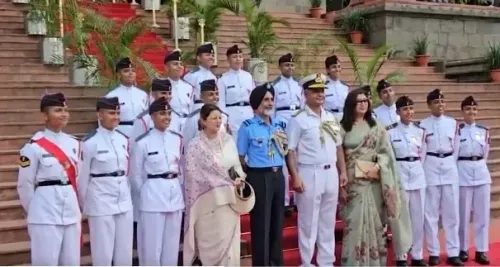
Rajnath Singh Hails First NDA Women Cadets Commissioned

Synopsis
Defence Minister Rajnath Singh on Independence Day eve celebrated the commissioning of India's first NDA-trained women cadets across the Army, Navy and Air Force, and the completion of a 25,500 nautical mile naval expedition by nine women officers — two milestones that mark a structural shift in women's integration into the Indian military.
Key Takeaways
Defence Minister Rajnath Singh on 14 August 2026 celebrated the commissioning of India's first NDA-trained women cadets as officers across the Army, Navy, and Air Force .
Nine women officers of the Indian Navy completed the Samudra Pradakshina expedition covering 25,500 nautical miles .
Women were first admitted to the National Defence Academy in 2021 following a Union government decision, marking a historic shift in officer training.
A 2020 Supreme Court directive had earlier mandated permanent commissions for women officers across most branches of the armed forces.
The milestones continue a decades-long trajectory of expanding women's roles in the Indian military, from non-combat entries in the 1990s to full NDA training today.
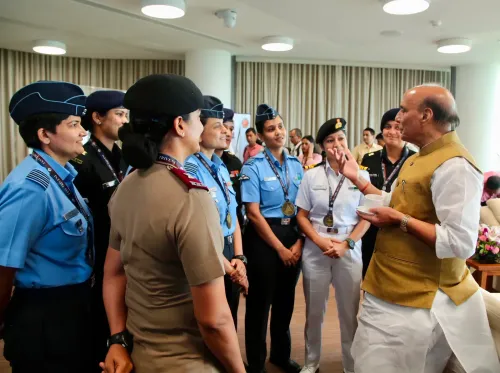
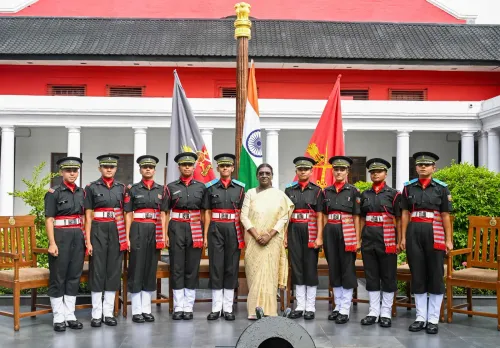
On the eve of Independence Day, Union Defence Minister Rajnath Singh marked a landmark moment in India's military history — the commissioning of the first women cadets trained at the National Defence Academy (NDA) as officers across all three armed services, and the completion of a 25,500 nautical mile ocean voyage by nine women officers of the Indian Navy in the expedition called Samudra Pradakshina.
Posting on 14 August 2026, Singh called the twin milestones 'a new example of the courage and leadership of India's Nari Shakti,' adding that they prove 'new doors are opening for daughters in the defence sector and they are turning every challenge into an opportunity.'
From a 2021 policy decision to a commissioning parade
The road to this moment began in 2021, when the Union government approved the entry of women candidates into the NDA for the first time — a decision that cracked open the most prestigious tri-service training institution in the country. Before that, women officers entered the armed forces through separate academies and on short-service commissions in largely non-combat roles.
A 2020 Supreme Court order had already directed the grant of permanent commission to women officers across most branches of the armed forces, forcing a structural shift that policy alone had been slow to deliver. The NDA admission decision a year later took the integration a step further — placing women in the same foundational training environment as their male peers, from day one.
Samudra Pradakshina: 25,500 nautical miles, nine officers
Alongside the commissioning, Singh highlighted the Samudra Pradakshina — a naval expedition in which nine women officers of the Indian Navy completed a voyage of 25,500 nautical miles. The scale of the journey places it among the most ambitious all-women naval expeditions undertaken under the Indian flag.
The Indian Navy has a precedent here: the 2017–18 Navika Sagar Parikrama saw a crew of six women officers circumnavigate the globe. Samudra Pradakshina continues that tradition of using ocean voyages as both operational training and a statement of institutional confidence in women at sea.
A longer arc, now accelerating
Women have served in the Indian Armed Forces since the late 1990s, initially in medical and educational streams. The trajectory since then — permanent commissions, fighter pilot assignments, command postings — has been steady but incremental. What the NDA commissioning represents is qualitatively different: women officers who went through the same tri-service academy, the same drill squares and obstacle courses, the same foundational military culture as every senior officer who came before them.
Singh's post, timed to Independence Day eve, frames these achievements not as exceptions but as evidence of a new normal taking hold inside India's defence establishment.
The next test will be whether subsequent NDA batches see expanded intake, and whether additional combat branches open to women officers — the commissioning parade is the beginning of that answer, not the end.
Point of View
Giving the policy a visible, human face. The timing connects a years-long policy arc to a single celebratory moment, reinforcing the 'Nari Shakti' narrative that has become central to the government's social messaging. For the armed forces, the deeper significance lies in pipeline: NDA-trained women officers will, over careers, reach senior command positions through the same route as their male peers — a structural change that short-service entry never guaranteed. What remains to watch is whether intake numbers and branch access expand at pace with the political rhetoric.
NationPress
28 Sept 2026
Frequently Asked Questions
Who are the first NDA-trained women cadets commissioned as officers?
They are the first batch of women cadets admitted to the National Defence Academy in Pune after the Union government opened NDA admissions to women in 2021. They have now been commissioned as officers across the Indian Army, Navy, and Air Force.
What is Samudra Pradakshina?
Samudra Pradakshina is an Indian Navy expedition in which nine women officers completed a voyage of 25,500 nautical miles, highlighted by Defence Minister Rajnath Singh as a landmark achievement for women in India's armed forces.
When did India allow women to join the NDA?
The Union government approved the entry of women candidates into the National Defence Academy in 2021, following a Supreme Court order that also directed permanent commissions for women officers across most branches of the armed forces.
What did Rajnath Singh say about women in the Indian military?
On 14 August 2026, Singh said the NDA commissioning and the Samudra Pradakshina voyage are 'a new example of the courage and leadership of India's Nari Shakti,' and proof that 'new doors are opening for daughters in the defence sector.'
Have Indian Navy women officers done ocean voyages before?
Yes. In 2017-18, six Indian Navy women officers completed a global circumnavigation called Navika Sagar Parikrama. Samudra Pradakshina continues that tradition with nine officers covering 25,500 nautical miles.