Rajnath Singh: Indian Navy warships active in South China Sea, Atlantic
Synopsis
Defence Minister Rajnath Singh has confirmed Indian warships are now operating in the South China Sea, the Mediterranean, and the Atlantic — the clearest official assertion yet of India's blue-water ambitions. Paired with a push to export indigenously built warships and the success of Operation Urja Suraksha, this signals a Navy moving from regional guardian to global actor.
Key Takeaways
Defence Minister Rajnath Singh confirmed Indian warships are deployed in the South China Sea , Mediterranean , and Atlantic Ocean at the Commanders' Conference 2026 on 29 September 2026 .
Operation Urja Suraksha successfully protected Indian-flagged LPG tankers transiting the Strait of Hormuz during the West Asia crisis.
India imports 85–90% of its crude oil and 50% of its natural gas by sea, making naval security critical to energy supply.
Recently commissioned Indian warships carry over 75% indigenous content , meeting global benchmarks.
Singh called for warship exports to friendly nations — a significant shift from India's traditional buyer role.
The three-day conference runs from 29 September to 1 October 2026 , reviewing operational readiness and future capability planning.
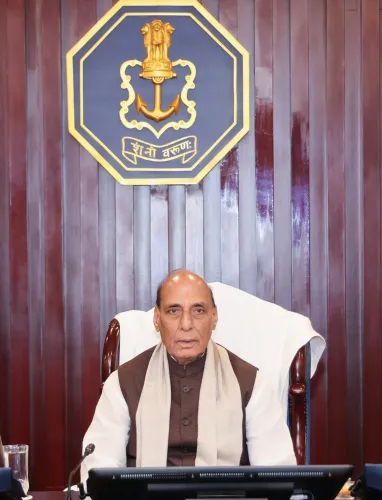
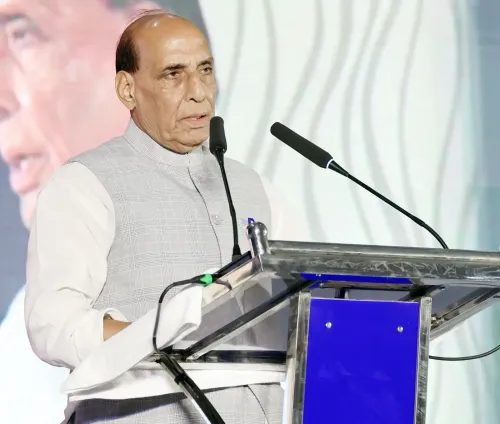
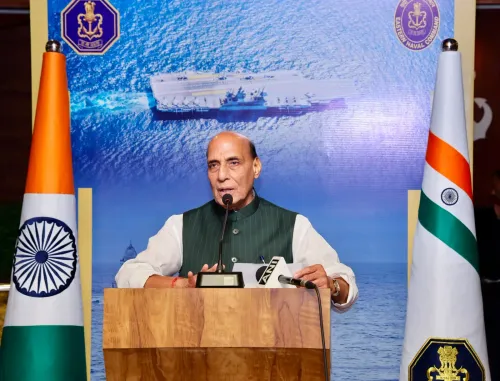
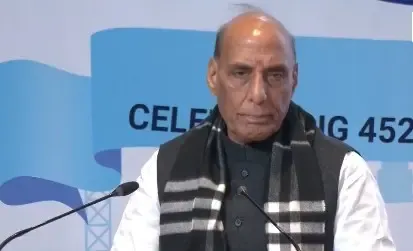
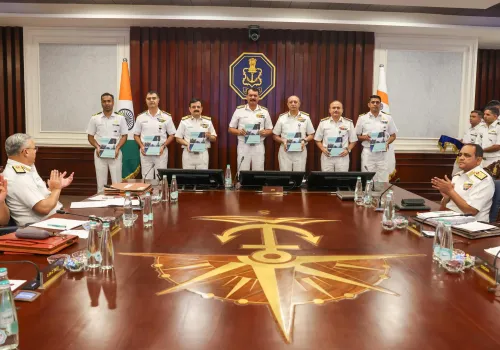
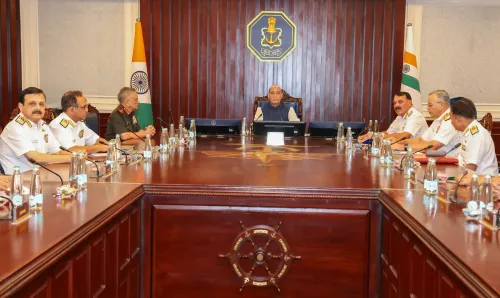
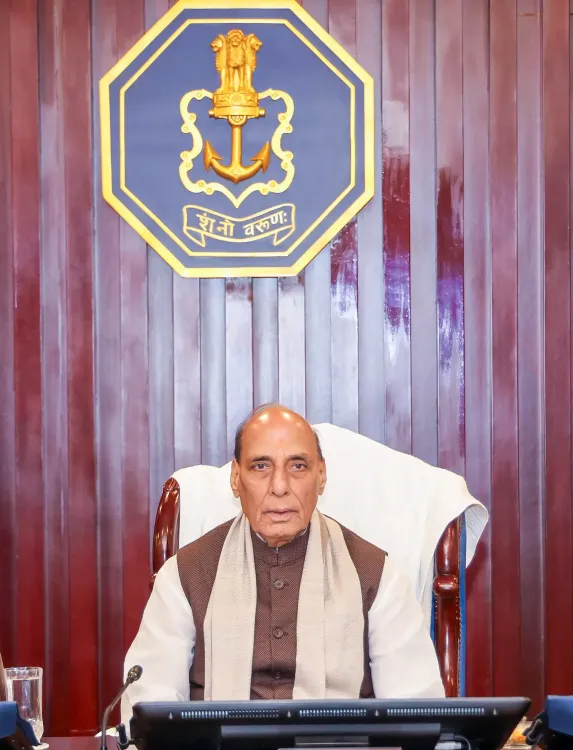
Defence Minister Rajnath Singh on Tuesday, 29 September 2026, declared that Indian warships are now operating as far as the South China Sea, the Mediterranean, and the Atlantic Ocean, asserting that the Indian Navy has firmly established itself as a credible blue-water force with truly global reach. The remarks came at the second edition of the Indian Navy's biannual Commanders' Conference 2026, held at Nausena Bhawan in New Delhi.
Key Developments at Commanders' Conference 2026
The three-day apex-level conference, running from 29 September to 1 October 2026, brings together the top leadership of the Indian Navy to review operational preparedness, maritime security, and future capability development. Singh also interacted with the Chief of Defence Staff (CDS) and the Chief of Army Staff on the sidelines of the event.
Addressing senior commanders, Singh called for a significant upgrade of India's maritime surveillance architecture, acknowledging the growing volume and complexity of maritime traffic. 'Today, issues such as congestion, deception, and grey-zone activities have made our maritime domain far more complex than ever before. Hence, we must elevate our monitoring and response mechanisms to a new level,' he said.
Navy as Strategic Anchor for Viksit Bharat 2047
Singh positioned the Navy as central to India's long-term national ambitions. 'The Indian Navy serves as a strategic anchor in the vision of 'Viksit Bharat 2047'. Beyond merely guarding maritime boundaries, our Navy strengthens economic protection, regional stability, and power projection,' he said.
He reiterated the government's commitment to naval modernisation under Prime Minister Narendra Modi, urging the force to maintain 'unrelenting momentum' in transforming into a 'future-ready, combat-ready, and globally respected force.'
Operation Urja Suraksha and Energy Security
Singh specifically highlighted the Navy's role in safeguarding Indian energy interests during the ongoing crisis in West Asia, praising Operation Urja Suraksha — which ensured the safe transit of Indian-flagged merchant vessels, particularly LPG tankers, through the Strait of Hormuz — as an 'outstanding achievement.'
The stakes are significant: India imports approximately 85–90 per cent of its crude oil and around 50 per cent of its natural gas through maritime routes, making sea-lane security directly linked to the country's economy, energy supplies, and defence preparedness.
Indigenous Warship Production Hits Global Benchmarks
Singh also underscored the Navy's strides in self-reliance under India's Atmanirbhar Bharat drive. 'The Indian Navy's warship production ecosystem is now meeting global benchmarks. The warships commissioned recently contain over 75 per cent indigenous content. In the times ahead, we must not only meet our own requirements but also export our warships to friendly foreign nations,' he said.
Notably, this ambition to export warships marks a qualitative shift in India's defence posture — from buyer to potential supplier — at a time when regional navies are actively expanding their fleets.
India as First Responder in the Indian Ocean Region
'India stands firm as the First Responder, Preferred Security Partner, and as a symbol of trust and reliability in the Indian Ocean Region, and the entire world is witnessing the growth of both our strategic position and our strategic responsibility in the region,' Singh added.
This comes amid heightened competition in the Indo-Pacific, with China's naval footprint expanding across the Indian Ocean Region and peer navies sharpening their presence along critical trade routes. With the next edition of the Commanders' Conference due in two years, the outcomes of this gathering are expected to shape the Indian Navy's capability roadmap through the end of the decade.
Point of View
Mediterranean, and Atlantic is not a routine ceremonial boast — it is a deliberate geopolitical signal directed at Beijing and at fence-sitting partners in the Indo-Pacific. The emphasis on exporting indigenously built warships adds a second layer: India is no longer content to be a net importer of defence hardware, and is staking a claim in the global naval supply chain. What remains unverified is the operational tempo and permanence of these deployments — presence on an occasional basis differs substantially from sustained patrol capacity. The real test of India's blue-water credentials will come in a crisis scenario, not a conference hall.
NationPress
29 Sept 2026
Frequently Asked Questions
What did Rajnath Singh say about the Indian Navy's global reach?
Defence Minister Rajnath Singh stated that Indian warships are now present in the South China Sea, the Mediterranean, and the Atlantic Ocean, confirming India's status as a blue-water naval force. He made these remarks at the Commanders' Conference 2026 at Nausena Bhawan in New Delhi on 29 September 2026.
What is Operation Urja Suraksha?
Operation Urja Suraksha is an Indian Navy mission to ensure the safe passage of Indian-flagged merchant vessels — particularly LPG tankers — through the Strait of Hormuz during the ongoing West Asia crisis. Rajnath Singh described it as an 'outstanding achievement', given that India imports 85–90% of its crude oil by sea.
How much indigenous content do new Indian Navy warships contain?
According to Rajnath Singh, recently commissioned Indian Navy warships contain over 75% indigenous content, which he said meets global benchmarks. He further called for India to begin exporting warships to friendly foreign nations.
What is the Commanders' Conference 2026 and who attended?
The Indian Navy's biannual Commanders' Conference 2026 is a three-day apex-level review meeting running from 29 September to 1 October 2026 at Nausena Bhawan in New Delhi. It brings together senior naval leadership to assess operational preparedness and future capabilities; Singh also met the Chief of Defence Staff and the Chief of Army Staff on the sidelines.
Why does maritime security matter to India's economy?
India imports approximately 85–90% of its crude oil and around 50% of its natural gas through sea routes, meaning any disruption to maritime lanes directly threatens the country's energy supply and economic stability. Singh stressed that sea-lane security is inseparable from India's defence preparedness.