Rajnath Singh vows to expel illegal infiltrators, flags West Bengal
Synopsis
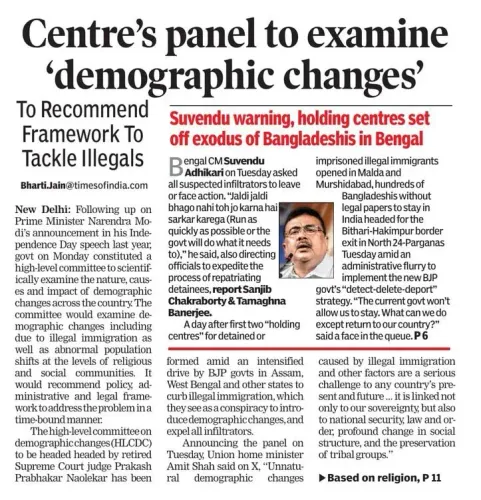
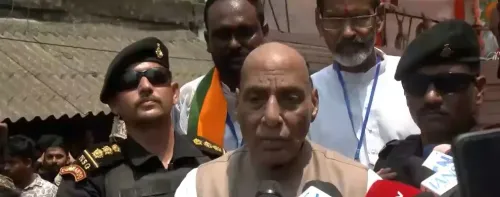
Union Defence Minister Rajnath Singh declared on 12 June 2026 that BJP-governed states are expelling illegal infiltrators and that the crackdown has begun in West Bengal too, framing it as a generational duty rather than an electoral move.
Key Takeaways
Union Defence Minister Rajnath Singh posted on 12 June 2026 that BJP-ruled states are actively expelling illegal infiltrators.
He stated that the expulsion drive has 'already begun' in West Bengal , a state governed by the opposition Trinamool Congress .
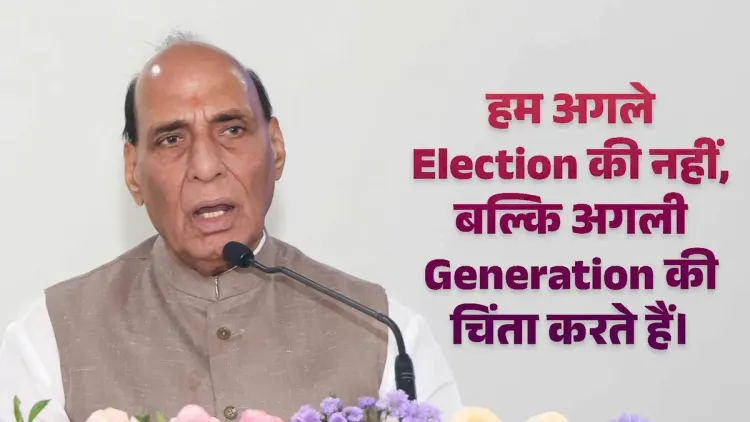
Singh framed the issue as a long-term generational concern, not an electoral strategy: 'We are not worried about the next election, but about the next generation.' The post fits within the BJP 's long-standing legislative framework of the NRC (published 2019 ) and the Citizenship Amendment Act (2019) .
West Bengal's long border with Bangladesh has historically made it the focal point of political disputes over alleged illegal immigration.
Analysts will watch for any formal coordination between the Union Home Ministry and West Bengal state authorities or moves toward a nationwide NRC .
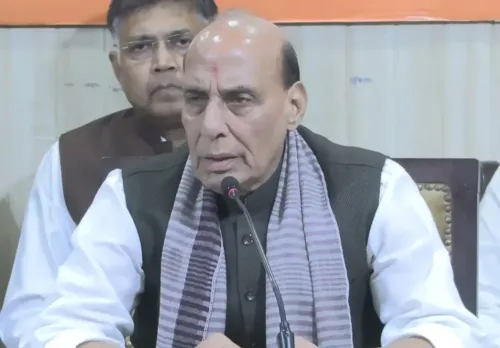
Union Defence Minister Rajnath Singh on Friday, 12 June 2026 declared that BJP-governed states are actively expelling illegal infiltrators and asserted that the drive has now begun in West Bengal as well, framing the party's approach as a generational commitment rather than an electoral calculation.
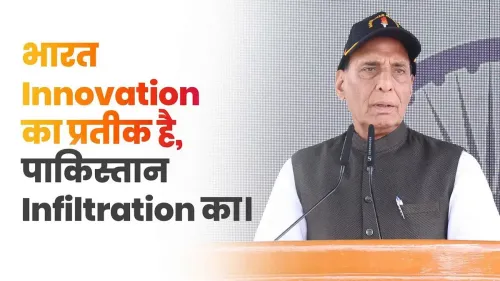
Posting in Hindi on X, Singh wrote: 'हमारी नियत बिल्कुल साफ है। हमारी कथनी और करनी में कोई अंतर नहीं है।' ('Our intent is absolutely clear. There is no gap between what we say and what we do.') He added that illegal infiltrators are being expelled from every state where the BJP is in power, and that West Bengal too has seen this work commence. 'We are not worried about the next election, but about the next generation,' he said.
Context
West Bengal shares a long and porous border with Bangladesh and has for decades been at the centre of political disputes over alleged illegal immigration. The state is governed by the Trinamool Congress, and the BJP has consistently accused successive state governments of ignoring or enabling demographic changes driven by cross-border movement. Singh's post signals that the Union government intends to press the issue regardless of which party holds power in the state capital.
The minister's assertion that action 'has already begun' in West Bengal is a pointed political signal, though the specific operational details of any central or coordinated drive in the state could not be independently confirmed as of this report.
Policy Backdrop
The BJP's stance on illegal immigration has deep legislative and administrative roots. The Assam Accord of 1985 established 24 March 1971 as the cut-off date for identifying illegal immigrants in Assam, a principle that underpinned the updated National Register of Citizens (NRC) published in 2019. That same year, Parliament passed the Citizenship Amendment Act (CAA), which offers expedited citizenship to non-Muslim persecuted minorities from Afghanistan, Bangladesh, and Pakistan who entered India before 2015.
Together, the NRC and the CAA form the two-track framework the party has used to distinguish between illegal immigrants who must be deported and persecuted minorities who may be regularised. Singh's post fits squarely within this long-standing ideological and legislative architecture.
Stakeholders and Impact
The most immediate stakeholders are residents of West Bengal and other border states, where questions of citizenship, identity, and demographic change carry acute social and political weight. Advocacy groups and opposition parties — particularly the Trinamool Congress — have historically pushed back against such drives, arguing they lead to harassment of Bengali-speaking Indian citizens, especially Muslims.
At the same time, residents of border districts who cite security and livelihood concerns linked to undocumented migration represent a constituency that the BJP has consistently sought to mobilise. Singh's framing around 'the next generation' is designed to elevate the issue above short-term electoral arithmetic.
What's Next
Observers will watch closely for any concrete coordination mechanism between the Union Home Ministry and West Bengal authorities, as well as any renewed push for a nationwide NRC exercise or fresh parliamentary legislation on immigration enforcement. With state elections in several key constituencies on the horizon, Singh's statement is likely to sharpen the political debate around border security and citizenship — issues that have historically driven high voter engagement in eastern and north-eastern India.
Point of View
Deliberately extending it into opposition-held West Bengal ahead of future electoral cycles. By invoking 'the next generation' rather than 'the next election,' Singh is attempting to depoliticise what is inherently a political issue — insulating the drive from accusations of vote-bank calculus while simultaneously energising a core BJP constituency in eastern India. The statement also serves as pressure on the Trinamool Congress government in Kolkata, signalling that the Centre will not cede the immigration issue to state discretion. It sits within a broader arc that connects the 1985 Assam Accord to the 2019 NRC and CAA, suggesting the party views this as unfinished constitutional business rather than a one-term policy.
NationPress
26 Oct 2026
Frequently Asked Questions
What did Rajnath Singh say about illegal infiltrators in West Bengal?
Rajnath Singh said on 12 June 2026 that the drive to expel illegal infiltrators from BJP-governed states has now also begun in West Bengal, adding that the party governs for the next generation, not the next election.
Which states are expelling illegal infiltrators according to BJP?
Rajnath Singh stated that all states where the BJP is in power are expelling illegal infiltrators, and that West Bengal — governed by the Trinamool Congress — has also seen this work commence.
What is the NRC and how does it relate to illegal immigration?
The National Register of Citizens (NRC) is a register of verified Indian citizens, updated for Assam in 2019 using 24 March 1971 as the cut-off date for identifying illegal immigrants, primarily from Bangladesh.
What is the Citizenship Amendment Act and who does it protect?
The Citizenship Amendment Act (CAA), passed in December 2019, grants expedited Indian citizenship to non-Muslim persecuted minorities from Afghanistan, Bangladesh, and Pakistan who entered India before 2015.
Why is West Bengal a focus in the illegal immigration debate?
West Bengal shares a long, porous border with Bangladesh and has for decades been cited by the BJP as a state where alleged illegal immigration has caused significant demographic changes, making it a recurring flashpoint in national politics.