Rajnath Singh Confident of BJP's Majority in Upcoming West Bengal Elections
Synopsis
As the West Bengal Assembly elections draw near, Defence Minister Rajnath Singh expresses confidence in the BJP's potential to secure a clear majority and hints at the possibility of achieving a two-thirds majority, urging voters to embrace change for a better future.
Key Takeaways
Rajnath Singh expresses optimism about BJP's majority in West Bengal elections.
The possibility of a two-thirds majority is highlighted.
Women’s Reservation Bill aims for 33% representation for women.
Two-phase voting process is a significant change.
Polling dates are set for April 23 and April 29 .
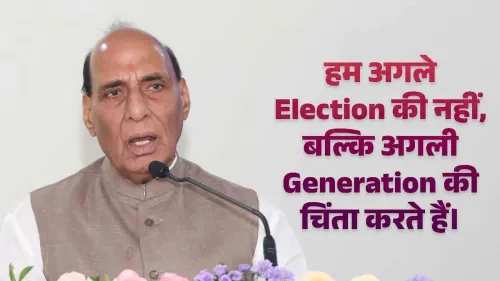
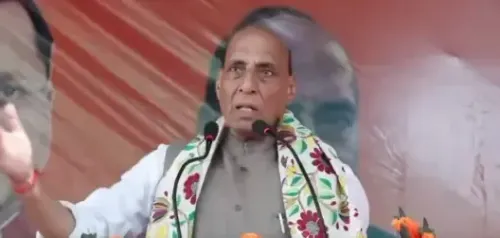
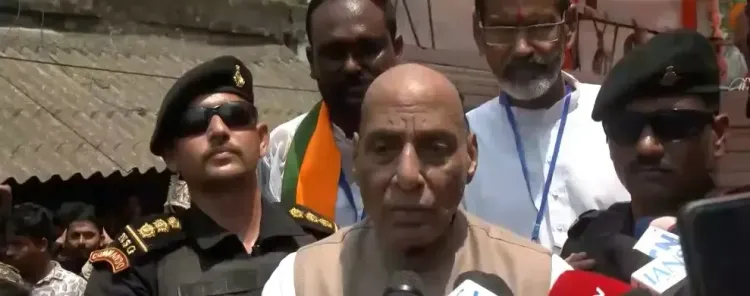
Nanoor, April 20 (NationPress) As the Assembly elections in West Bengal approach, Defence Minister Rajnath Singh conveyed optimism regarding the BJP's likelihood of obtaining a substantial majority, emphasizing that the prospect of achieving a two-thirds majority remains possible.
During a press interaction, Singh highlighted the prevailing conditions in West Bengal, which he described as riddled with fear, violence, and atrocities over the past 15 years. He remarked that the residents have supported the Trinamool Congress for three consecutive terms, suggesting that such a lengthy governance should have fostered significant development.
“Many states across India have made remarkable strides in just five to eight years. While West Bengal once contributed around 10 percent to the national economy, this figure has plummeted to nearly 5 percent under the Trinamool Congress,” he stated.
Singh called upon voters to embrace change, particularly appealing to women by assuring them that the Women’s Reservation Bill would be enacted to guarantee 33 percent representation for women in governance.
“Although I can't predict the exact seat count we will achieve, I am confident that the BJP will attain a clear majority, and I cannot dismiss the chance of achieving a two-thirds majority,” he expressed.
He further accused the Trinamool Congress, Congress, and other opposition parties of opposing the Women’s Reservation Bill, asserting that women voters would respond to this in the upcoming elections.
This year's election will unfold in a streamlined two-phase process, encompassing all 294 constituencies, a significant departure from previous multi-phase elections. The first phase of voting is scheduled for April 23, with the second phase on April 29. Vote counting will occur on May 4.
In the first phase, polling will cover 152 constituencies across 16 districts, with the remaining 142 constituencies in seven districts voting in the second phase, thereby concluding the electoral process.
This election signifies a noteworthy shift in West Bengal's voting pattern. Following a single-phase election in 2001, the state has typically seen multi-phase polls, including an extensive eight-phase election in 2021. The transition to a two-phase process is attributed to enhanced administrative planning and security measures.
Point of View
Defence Minister Rajnath Singh's statements resonate with the party's strategy to position itself as a harbinger of change. His emphasis on the BJP's potential majority reflects a broader electoral narrative aimed at capturing the sentiments of the electorate disillusioned by longstanding governance.
NationPress
7 Oct 2026
Frequently Asked Questions
What major changes are expected in the West Bengal elections?
This election marks a significant shift to a two-phase process, covering all 294 constituencies, a departure from previous multi-phase elections.
What is the Women's Reservation Bill?
The Women’s Reservation Bill aims to ensure 33% representation for women in legislative bodies, a key point raised by Rajnath Singh during the campaign.
When will the voting and counting occur for the West Bengal elections?
Voting will take place in two phases: on April 23 and April 29, with the counting of votes scheduled for May 4.
Why does Rajnath Singh believe the BJP can achieve a two-thirds majority?
Singh cites the declining economic contributions of West Bengal under the Trinamool Congress as a reason for voters to opt for change, potentially benefiting the BJP.
How has the political landscape changed in West Bengal?
The shift to a two-phase election process indicates improved administrative planning and security, marking a notable change from the previous election structure.