Giriraj Singh backs HLCDC, 'Detect Delete Deport' push in Bengal
Synopsis
Union Textiles Minister Giriraj Singh has publicly backed the Centre's High-Level Committee on Demographic Change and West Bengal's 'Detect, Delete, Deport' policy, framing both as historic steps to protect national sovereignty against illegal infiltration.
Key Takeaways
Union Textiles Minister Giriraj Singh posted on 27 May 2026 endorsing central and state action against illegal infiltration.
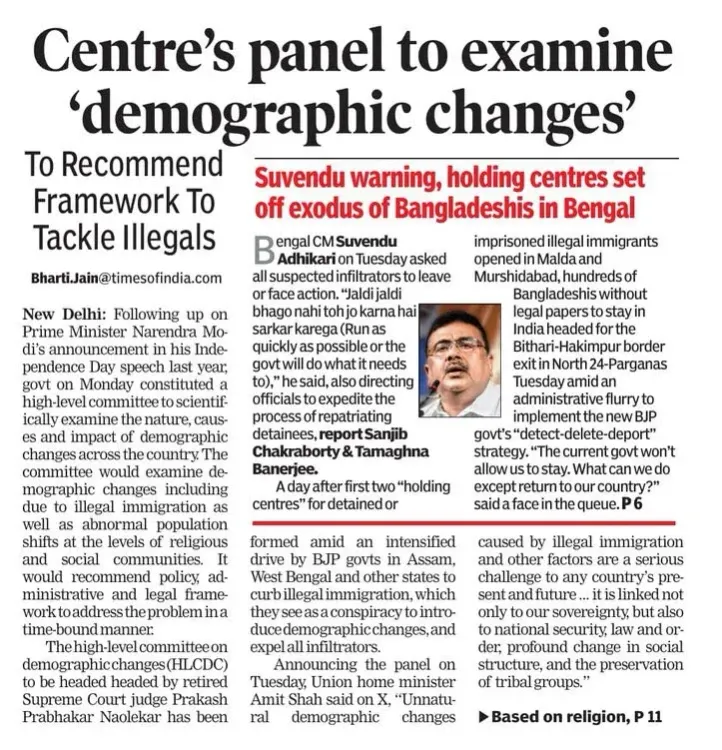
The central government has formed a High-Level Committee on Demographic Change (HLCDC) to scientifically investigate infiltration and demographic shifts.
The West Bengal BJP government has launched a 'Detect, Delete, Deport' policy with holding centres for suspected illegal immigrants.
Singh claimed infiltrators are voluntarily leaving due to fear of zero-tolerance enforcement.
The moves extend a policy pattern that includes the Assam NRC (2019) and the Citizenship Amendment Act (2019) .
The HLCDC's mandate and the operational status of Bengal's holding centres remain key developments to watch.
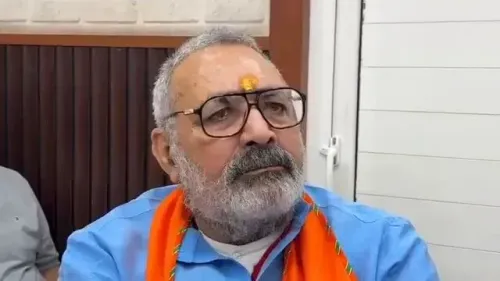
Union Textiles Minister Giriraj Singh on Wednesday, 27 May 2026 backed the central government's formation of a High-Level Committee on Demographic Change (HLCDC) and praised the West Bengal BJP government's 'Detect, Delete, Deport' policy, calling the twin moves a historic step for national security and sovereignty.
Context
Posting in Hindi on X, Singh declared, 'देश की सुरक्षा और अस्मिता सर्वोपरि!' ('The security and identity of the nation are paramount!'). He stated that the central government, under the vision of Prime Minister Narendra Modi, has constituted the HLCDC to conduct a scientific investigation into illegal infiltration and demographic change. Singh further noted that infiltrators are being forced to flee the country on their own due to the fear of zero-tolerance action.
The post comes amid sustained political focus on illegal immigration from Bangladesh into eastern India, a subject that has drawn recurring attention in West Bengal, Assam, and other border states. Singh used the hashtags #ZeroTolerance, #SecurityFirst, #NationalSecurity, and #DetectDeleteDeport.
Policy Backdrop
The BJP-led central government has pursued a layered approach to illegal immigration over successive terms. The National Register of Citizens (NRC) was finalised in Assam in 2019 following the 1985 Assam Accord, identifying individuals who could not prove legal residence. The Citizenship Amendment Act of 2019 provided a parallel pathway for persecuted minorities from neighbouring countries, including Bangladesh, Pakistan, and Afghanistan.
Border fencing projects along the India-Bangladesh border have been accelerated since the early 2000s, and successive BJP governments have framed demographic shifts in eastern states as a direct national security concern. The HLCDC, as described by Singh, represents an attempt to apply a data-driven, scientific lens to these concerns at the central level.
In West Bengal, the 'Detect, Delete, Deport' framework — with the establishment of holding centres — mirrors enforcement mechanisms previously associated with Assam's post-NRC process, now being extended to a state that shares a long and porous border with Bangladesh.
Stakeholders and Impact
Border communities in West Bengal and other eastern states are the most directly affected, as enforcement drives and holding centres alter ground-level realities for both documented residents and those whose status is contested. State security agencies and district administrations bear the operational burden of implementing the 'Detect, Delete, Deport' mandate.
Civil liberties organisations and opposition parties, particularly those with a strong presence in West Bengal, have historically contested such drives, arguing that bona fide citizens — especially from minority communities — risk being wrongly targeted. The HLCDC's scientific methodology, if made public, will be scrutinised by these stakeholders for transparency and due process safeguards.
What's Next
The operational status of the holding centres in West Bengal and the formal mandate and findings of the HLCDC are the two key developments to watch. Should the HLCDC submit an interim or final report, it is likely to inform legislative or executive action on immigration enforcement beyond Assam. Singh's public endorsement signals that the issue will remain a central plank of BJP's political messaging heading into state and national electoral cycles.
Point of View
Extending the Assam NRC template to West Bengal ahead of future electoral contests. The invocation of a 'scientific' high-level committee lends institutional weight to what has largely been a campaign-trail argument, suggesting the party seeks to move from rhetoric to documented policy output. By spotlighting the 'Detect, Delete, Deport' slogan alongside holding centres, the messaging ties state-level enforcement to a central government vision — reinforcing Modi government ownership of the issue. The framing of infiltrators 'fleeing on their own' serves a dual purpose: claiming deterrence success without requiring verifiable deportation data.
NationPress
10 Oct 2026
Frequently Asked Questions
What is the HLCDC set up by the Indian government?
The HLCDC, or High-Level Committee on Demographic Change, is a central government body formed under Prime Minister Narendra Modi's direction to scientifically investigate illegal infiltration and demographic shifts, particularly in border states.
What is the 'Detect, Delete, Deport' policy in West Bengal?
'Detect, Delete, Deport' is a policy framework adopted by the West Bengal BJP government aimed at identifying, removing from records, and deporting illegal immigrants, supported by the establishment of holding centres.
What did Giriraj Singh say about illegal infiltration on 27 May 2026?
Giriraj Singh posted on X backing the HLCDC and West Bengal's 'Detect, Delete, Deport' policy, calling them historic steps for national sovereignty and claiming infiltrators are fleeing due to zero-tolerance enforcement.
How does the HLCDC relate to the Assam NRC?
The Assam NRC, finalised in 2019, was a state-specific exercise to identify illegal immigrants. The HLCDC appears to be a central-level mechanism intended to apply a similar scientific approach to demographic change across other states, including West Bengal.
What are holding centres in West Bengal?
Holding centres are detention facilities set up under West Bengal's 'Detect, Delete, Deport' policy to house individuals identified as suspected illegal immigrants pending deportation proceedings.