Giriraj Singh: Govt resolute on removing all illegal infiltrators
Synopsis
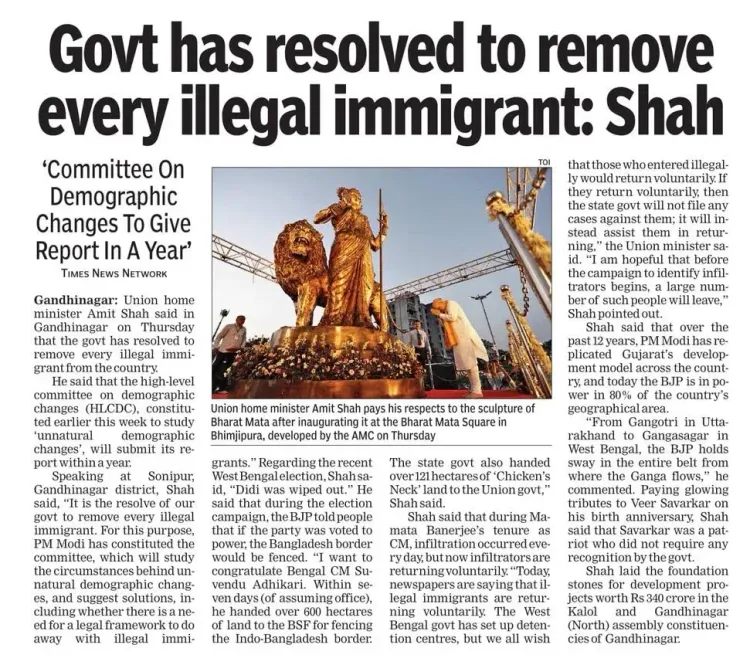
Union Textiles Minister Giriraj Singh has reaffirmed the Modi government's resolve to deport all illegal infiltrators, citing a one-year deadline for the HLCDC report and the handover of land to the BSF to accelerate India-Bangladesh border fencing.
Key Takeaways
The central government's High-Level Committee on Deportation and Citizenship (HLCDC) is mandated to submit its report within one year .
Land has reportedly been handed over to the Border Security Force (BSF) to accelerate fencing along the India-Bangladesh border , which stretches approximately 4,096 km .
The government claims fear of detention centres is prompting illegal infiltrators to leave India voluntarily.
The policy builds on the Assam Accord of 1985 , the Citizenship Amendment Act 2019 , and the NRC exercise completed in Assam in 2019 .
Union Home Minister Amit Shah is cited in the post, indicating cross-ministerial coordination on border security.
Border-state residents in Assam and West Bengal are among the primary stakeholders watching enforcement outcomes.
Union Textiles Minister Giriraj Singh on Friday, 29 May 2026, posted on X reaffirming the central government's commitment to removing every illegal infiltrator from India, citing Prime Minister Narendra Modi's vision and outlining two concrete steps: a time-bound high-level committee report and accelerated border fencing on the India-Bangladesh frontier.
Context
In his post, Singh wrote — translated from Hindi — that 'Kendra sarkar desh se har avaidh ghuspaidhiye ko hatane ke liye sankalpita hai' ('the central government is resolved to remove every illegal infiltrator from the country'). He stated that the High-Level Committee on Deportation and Citizenship (HLCDC) will submit its report within one year. Singh also said that land has been handed over to the Border Security Force (BSF) to accelerate fencing along the India-Bangladesh border, and that fear of detention centres is already prompting some illegal infiltrators to leave voluntarily. He described these measures as 'an historic step towards a secure India.'
Policy Backdrop
Concerns over illegal immigration across the India-Bangladesh border — approximately 4,096 km long — have shaped Indian security and citizenship policy for decades. The Assam Accord of 1985 established 24 March 1971 as the cut-off date for identifying and deporting illegal migrants from Bangladesh, a benchmark that has anchored legal proceedings in Assam and neighbouring states ever since. Fencing along this frontier began in the 1980s and has been pursued across multiple phases, with the pace accelerating after 2014.
More recent legislative steps include the Citizenship Amendment Act 2019, which drew a legal distinction for certain non-Muslim migrants, and the completion of the National Register of Citizens (NRC) exercise in Assam in 2019, which flagged individuals unable to document citizenship for further proceedings. Union Home Minister Amit Shah, whose ministry oversees the BSF and internal security enforcement, is tagged in Singh's post, signalling cross-ministerial coordination on the issue.
Stakeholders and Impact
Residents of border states — particularly Assam and West Bengal — have long pressed successive governments to complete border fencing and enforce deportation orders, arguing that unregulated migration strains local resources and alters demographic patterns. BSF personnel on the ground stand to receive additional operational capacity if the reported land handover for fencing expedites infrastructure work along disputed or incomplete segments of the barrier.
Civil society groups and legal advocates, meanwhile, have consistently raised due-process concerns around detention centres and the NRC process, arguing that administrative lapses risk detaining genuine citizens. The government's emphasis on 'self-deportation' driven by fear of detention is likely to renew scrutiny of conditions inside existing detention facilities.
What's Next
The most immediate marker will be the HLCDC report, due within one year of its constitution. Parliament watchers and border-state legislators are expected to seek updates on the committee's composition, terms of reference, and the pace of fencing completion. Any follow-up legislation — such as amendments to deportation procedures or state-level detention centre notifications — will be closely tracked. The government's framing of voluntary departures as a policy outcome also sets a benchmark against which future enforcement data will be measured.
Point of View
' naming Home Minister Amit Shah, and citing two concrete deliverables — the HLCDC report and BSF land handover — the messaging moves beyond rhetoric toward accountability markers that can be tracked. The 'self-deportation' framing is notable: it allows the government to claim deterrence effects without requiring verifiable deportation statistics, while simultaneously keeping pressure on the opposition to counter a security narrative. If the HLCDC report lands within the stated year, it could become a legislative anchor for further immigration enforcement bills in Parliament.
NationPress
16 Sept 2026
Frequently Asked Questions
What is the HLCDC and what will it do?
The HLCDC, or High-Level Committee on Deportation and Citizenship, is a government-constituted body tasked with examining illegal immigration and deportation mechanisms. According to Minister Giriraj Singh's post, it is expected to submit its report within one year.
What is the current status of India-Bangladesh border fencing?
India has been fencing its approximately 4,096-km border with Bangladesh since the 1980s across multiple phases. The pace accelerated after 2014, and the government now says land has been handed over to the BSF to further speed up fencing work.
What are detention centres in the context of illegal immigration in India?
Detention centres are facilities where individuals identified as illegal immigrants are held pending deportation proceedings. They have been set up primarily in Assam and have been the subject of ongoing legal and humanitarian debate regarding conditions and due process.
What was the Assam Accord and why does it matter for illegal immigration?
The Assam Accord of 1985 set 24 March 1971 as the cut-off date for identifying and deporting illegal migrants from Bangladesh in Assam. It remains the foundational legal reference for citizenship and deportation proceedings in the state.
Why is Amit Shah tagged in Giriraj Singh's post about illegal immigration?
Amit Shah, as Union Home Minister, oversees the Border Security Force and internal security enforcement, making him the nodal minister for illegal immigration policy. Singh's tag signals coordinated messaging across the Union Cabinet on this issue.