Rajnath Singh at ADMM-Plus: ASEAN Centrality Key to Indo-Pacific
Synopsis
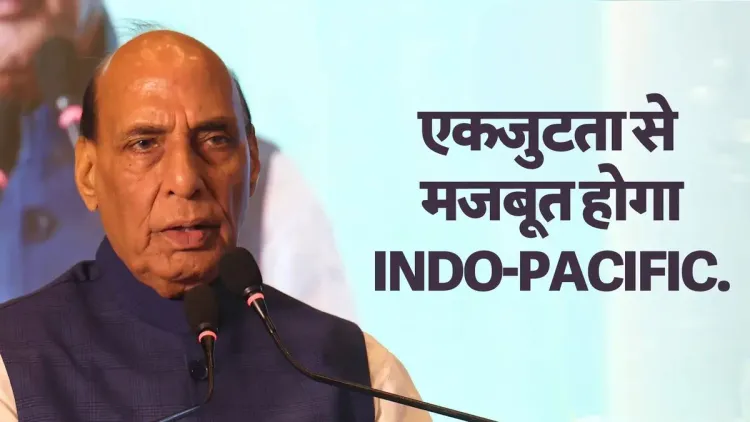
Union Defence Minister Rajnath Singh addressed ADMM-Plus on 29 October 2026, grounding India's defence doctrine in the Sanskrit ideal 'Sarve Bhavantu Sukhinah' and reaffirming India's commitment to an open, inclusive, rules-based Indo-Pacific with ASEAN at its centre.
Key Takeaways
Union Defence Minister Rajnath Singh spoke at the ADMM-Plus forum on 29 October 2026 , invoking Sarve Bhavantu Sukhinah as the spirit of India's defence and foreign policy.
Singh endorsed the ADMM-Plus theme 'Navigating Our Future, Together', stressing shared responsibility, mutual trust, and cooperation among member states.
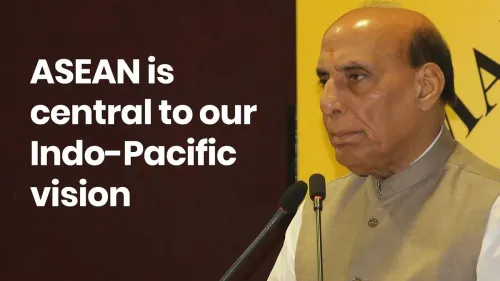
India reaffirmed commitment to an 'open, inclusive and Rules-Based Indo-Pacific' and underlined ASEAN's central role in regional security architecture.
India has been a member of ADMM-Plus since its founding in 2010 , participating in expert groups on maritime security, counter-terrorism, and humanitarian assistance.
PM Modi's 2018 Shangri-La Dialogue speech first formally articulated India's Indo-Pacific vision with ASEAN centrality — Singh's remarks continue that policy lineage.
India's use of civilisational framing — Vasudhaiva Kutumbakam at G20, Sarve Bhavantu Sukhinah at ADMM-Plus — is a consistent soft-power strategy to position New Delhi as a benign regional power.
A Sanskrit invocation and a multilateral forum — Union Defence Minister Rajnath Singh opened India's case at the ADMM-Plus meeting on Thursday, 29 October 2026 by anchoring his country's defence philosophy in an ancient ideal: सर्वे भवन्तु सुखिनः ('May all beings be happy'). That is not just poetry. It is a foreign-policy claim — one that India has been building, forum by forum, for the better part of a decade.
What Singh said — and what it signals
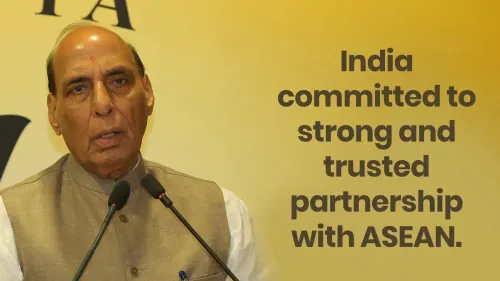
Singh's post, delivered in Hindi, placed the Sanskrit phrase 'Sarve Bhavantu Sukhinah' at the centre of India's defence and foreign-policy doctrine, calling it the foundational spirit of both. He pointed to the ADMM-Plus theme — 'Navigating Our Future, Together' — as a direct expression of shared responsibility, mutual trust, and cooperation. India, he said, is committed to building an 'open, inclusive and Rules-Based Indo-Pacific' in which ASEAN's central role and India's long-term strategic partnerships are indispensable.
The phrasing is deliberate and calibrated. 'Rules-based' is the term the West, India, and ASEAN's democratic members routinely use to push back, without naming it, against unilateral maritime assertions in the South China Sea. By pairing it with 'ASEAN centrality', Singh is reaffirming that India does not seek to bypass the bloc or supplant its leadership with any rival architecture — a position Prime Minister Narendra Modi first put on record at the Shangri-La Dialogue in 2018.
ADMM-Plus and India's fifteen-year stake in the platform
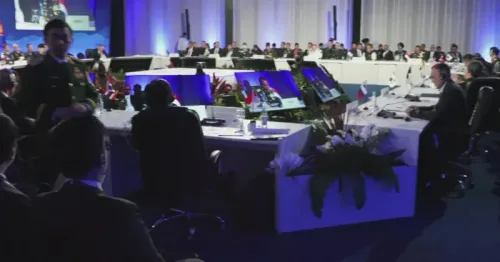
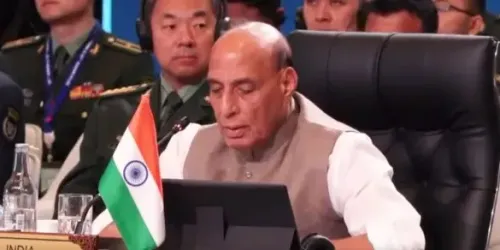
The ASEAN Defence Ministers' Meeting-Plus (ADMM-Plus) brings together defence ministers from all ten ASEAN nations and eight dialogue partners — including India, the United States, China, Japan, and Australia. It is one of the few forums where all these powers sit in the same room under an ASEAN-chaired agenda. India joined at the platform's launch in 2010 and has since worked through its Experts' Working Groups on maritime security, counter-terrorism, and humanitarian assistance and disaster relief.
Sixteen years of participation have given India both credibility and leverage inside the mechanism. Singh's invocation of 'long-term Strategic Partnership' with ASEAN members signals that New Delhi sees ADMM-Plus not as a talking shop but as a foundation for deeper bilateral defence ties — defence industry cooperation, joint exercises, and intelligence-sharing arrangements that have been expanding steadily across Southeast Asia.
The 'Sarve Bhavantu Sukhinah' framing — soft power with a strategic edge
Opening a defence ministers' meeting with a classical Sanskrit invocation is a conscious branding choice. India has increasingly used civilisational vocabulary — Vasudhaiva Kutumbakam ('the world is one family') at the G20, and now Sarve Bhavantu Sukhinah at ADMM-Plus — to position itself as a benign, non-hegemonic power whose strategic interests happen to align with regional stability. For ASEAN states navigating pressure from multiple great powers, that framing carries real appeal.
It also inoculates India against the charge that its Indo-Pacific engagement is purely a containment exercise. By rooting the argument in universal welfare rather than alliance politics, Singh is making the case that a stronger Indian presence in the region is a public good — not a zero-sum move.
The real test will come in the joint statements and working-group deliverables that emerge from this ADMM-Plus cycle. Words at ministerial level matter, but the architecture they authorise — port access, logistics agreements, joint patrols, technology transfers — is where India's Indo-Pacific commitment gets measured. Singh has set the frame; now the region will watch how much structure follows the sentiment.
Point of View
New Delhi is signalling that its Indo-Pacific engagement is driven by principle rather than great-power rivalry — a message carefully calibrated for Southeast Asian audiences wary of being forced to choose sides. This mirrors the Vasudhaiva Kutumbakam framing at the G20, suggesting a deliberate doctrine of soft-power multilateralism running alongside harder defence partnerships. The real question the region will ask is whether India's ADMM-Plus commitments translate into concrete deliverables — logistics pacts, joint exercises, technology transfers — before the next ministerial cycle.
NationPress
29 Oct 2026
Frequently Asked Questions
What is ADMM-Plus and why is India a member?
ADMM-Plus is the ASEAN Defence Ministers' Meeting-Plus, a multilateral platform bringing together defence ministers from ten ASEAN nations and eight dialogue partners including India, the United States, China, Japan, and Australia. India joined at the forum's founding in 2010 to engage on regional security, maritime safety, counter-terrorism, and humanitarian response.
What did Rajnath Singh say at ADMM-Plus in October 2026?
Singh said India's defence and foreign policy is rooted in the Sanskrit ideal 'Sarve Bhavantu Sukhinah' (May all beings be happy). He endorsed the ADMM-Plus theme 'Navigating Our Future, Together' and reaffirmed India's commitment to an open, inclusive, rules-based Indo-Pacific with ASEAN playing a central role.
What does 'Sarve Bhavantu Sukhinah' mean in the context of India's defence policy?
'Sarve Bhavantu Sukhinah' is a Sanskrit phrase meaning 'May all beings be happy.' Singh used it to frame India's approach to regional security as universalist and benign — positioning India as a power that pursues stability for all rather than narrow strategic advantage.
What is India's position on ASEAN centrality in the Indo-Pacific?
India officially endorses ASEAN's central role in shaping Indo-Pacific security architecture. This position was first formally articulated by Prime Minister Modi at the Shangri-La Dialogue in 2018 and has been consistently reiterated at ADMM-Plus and East Asia Summit meetings since.
What is a rules-based Indo-Pacific and why does India push for it?
A 'rules-based Indo-Pacific' refers to a regional order governed by international law, freedom of navigation, and peaceful dispute resolution rather than by the unilateral assertion of power. India promotes this framework to protect its own maritime interests and to reassure smaller regional states that New Delhi supports a stable, predictable order in the Indian and Pacific Ocean regions.