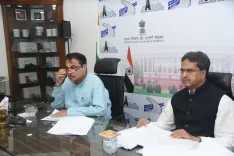
Rajnath Singh hails ₹7,145 cr Kanpur–Kabrai Greenfield Highway nod
Synopsis
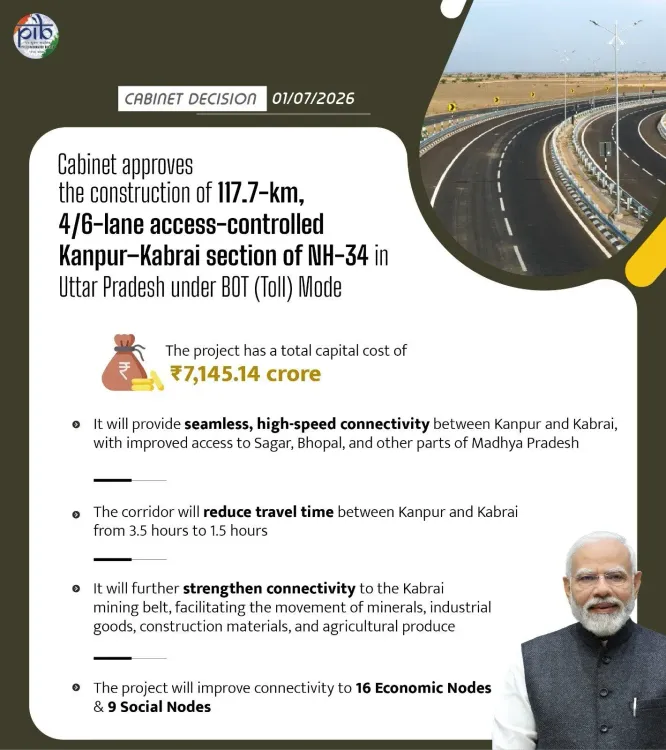
The Union Cabinet has approved a ₹7,145 crore Access-Controlled Greenfield Highway from Kanpur to Kabrai, aligned with PM GatiShakti, aimed at slashing travel time, cutting logistics costs and unlocking economic potential across Bundelkhand in Uttar Pradesh and Madhya Pradesh.
Key Takeaways
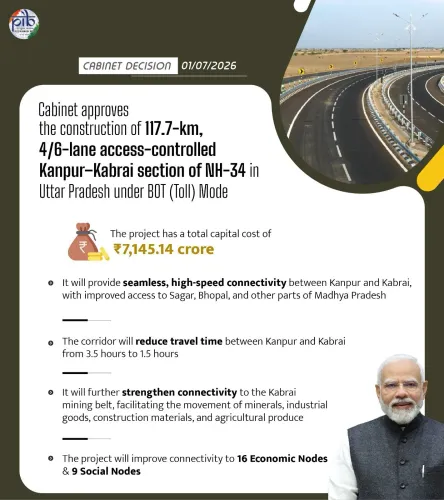
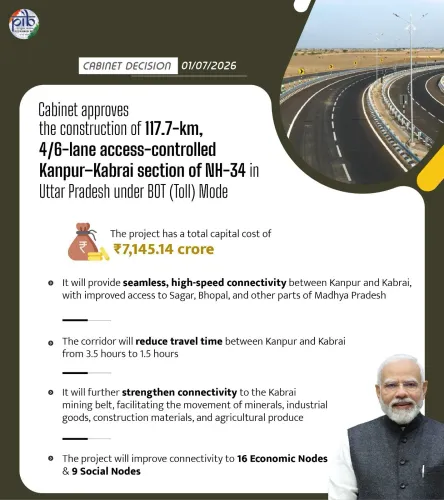
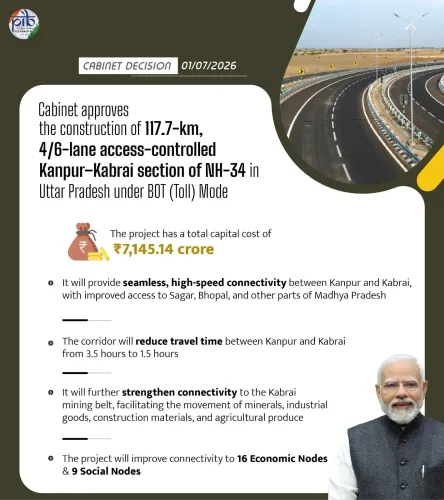
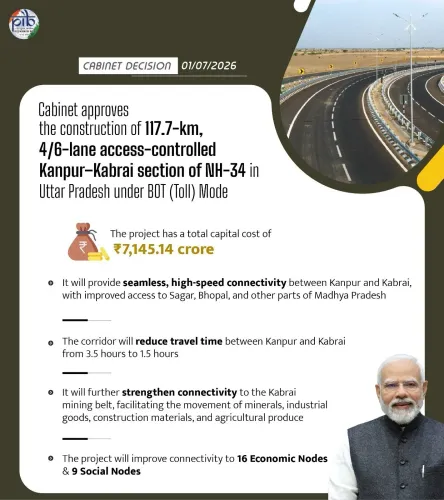
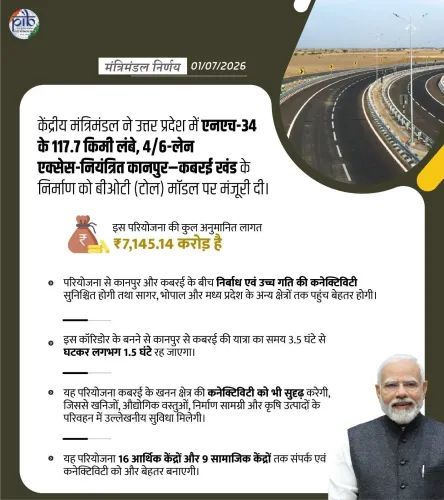
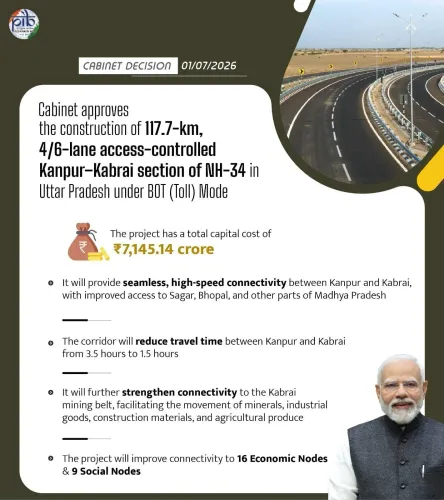
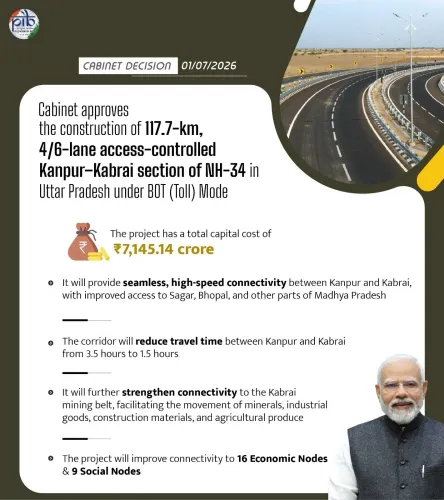
The Union Cabinet approved the ₹7,145 crore Kanpur–Kabrai Access-Controlled Greenfield Highway on 1 July 2026 .
The corridor is a greenfield, access-controlled design — bypassing congested towns to enable faster freight and passenger movement.
The project is aligned with PM GatiShakti , the National Master Plan launched in October 2021 for integrated infrastructure planning.
Key expected outcomes include reduced travel time, stronger logistics, industrial growth, and employment generation across Bundelkhand .
The corridor spans regions of both Uttar Pradesh and Madhya Pradesh , targeting a historically underserved area.
Land acquisition timelines and NHAI tender awards are the critical next steps before construction can commence.
Union Defence Minister Rajnath Singh on Wednesday, 1 July 2026 welcomed the Union Cabinet's approval of the ₹7,145 crore Kanpur–Kabrai Access-Controlled Greenfield Highway, calling it 'another landmark step in India's infrastructure transformation.' The Cabinet meeting was chaired by Prime Minister Narendra Modi.
Context
The approved corridor will connect Kanpur, Uttar Pradesh's major industrial and leather manufacturing hub, to Kabrai in the Bundelkhand region. Singh stated the project will 'dramatically reduce travel time, strengthen logistics, accelerate industrial growth, boost trade and agriculture, and create large-scale employment.'
The highway is designed as an access-controlled greenfield corridor — a category that bypasses congested towns entirely, enabling higher average speeds and lower freight costs compared with upgraded existing roads.
Policy Backdrop
The project is described as 'seamlessly aligned' with PM GatiShakti, the National Master Plan launched in October 2021 to coordinate road, rail and logistics planning across ministries using GIS-based tools. GatiShakti aims to eliminate the siloed planning that historically delayed large infrastructure corridors.
The greenfield highway also fits within the broader Bharatmala Pariyojana Phase-I, approved in 2017, which targets 34,800 km of national highways including expressways. India's National Infrastructure Pipeline, unveiled in 2019, had set a target of ₹111 lakh crore in roads and connectivity investment — a goal the Kanpur–Kabrai project incrementally advances.
India has steadily moved from widening existing highways to building access-controlled greenfield corridors that cut travel times and reduce logistics costs, currently estimated at above 13 percent of GDP — well above the global benchmark.
Stakeholders and Impact
Bundelkhand, straddling southern Uttar Pradesh and northern Madhya Pradesh, has historically faced lower industrialisation and recurring agricultural distress. Improved high-speed connectivity is expected to benefit farmers, agri-logistics firms and industrial units seeking faster access to markets in Kanpur and beyond.
Singh specifically cited the project's potential to 'unlock the immense economic potential of Bundelkhand and adjoining regions of Uttar Pradesh and Madhya Pradesh,' signalling that the corridor is positioned as a regional development instrument, not merely a transport upgrade. Large-scale employment generation during construction and operation phases is also anticipated, though exact figures have not been specified in the Cabinet announcement.
What's Next
Attention will now shift to NHAI notifications on land acquisition timelines and tender awards, which will determine how quickly ground-level work can begin. Complementary proposals — such as logistics parks or rail linkages under PM GatiShakti along the same corridor — may follow as the project moves into detailed project report and procurement stages.
The approval reinforces a recurring policy emphasis on extending world-class infrastructure to lagging central Indian regions, and signals that Bundelkhand will remain a focal point of the government's connectivity agenda in the near term.
Point of View
Access-controlled corridors in lagging central Indian regions — a strategy that pairs political optics with genuine logistics economics. By anchoring the announcement in PM GatiShakti, the Cabinet signals institutional continuity rather than one-off spending. For Bundelkhand, which has featured in multiple policy documents without commensurate on-ground transformation, the real test will be the speed of land acquisition and tender awards. Rajnath Singh's public gratitude to PM Modi also underlines the political dividend the BJP seeks to extract from infrastructure approvals ahead of state electoral cycles in Uttar Pradesh and Madhya Pradesh.
NationPress
1 Jul 2026
Frequently Asked Questions
What is the Kanpur–Kabrai Greenfield Highway project?
It is a ₹7,145 crore Access-Controlled Greenfield Highway approved by the Union Cabinet on 1 July 2026, connecting Kanpur in Uttar Pradesh to Kabrai in the Bundelkhand region, designed to reduce travel time and boost economic activity.
What is PM GatiShakti and how is it related to this highway?
PM GatiShakti is a National Master Plan launched in October 2021 to coordinate infrastructure planning across ministries using GIS tools. The Kanpur–Kabrai highway is described as aligned with GatiShakti, meaning it is integrated into the broader national connectivity grid.
Which states will benefit from the Kanpur–Kabrai Highway?
The highway primarily benefits Uttar Pradesh and Madhya Pradesh, particularly the Bundelkhand region that straddles both states and has historically faced lower industrialisation and agricultural challenges.
Why is Bundelkhand significant for this infrastructure project?
Bundelkhand is a region spanning southern Uttar Pradesh and northern Madhya Pradesh that has historically seen limited industrial growth and recurring agricultural distress. The highway is intended to unlock its economic potential by improving connectivity to major markets.
What are the next steps after Cabinet approval of the Kanpur–Kabrai Highway?
Following Cabinet approval, NHAI is expected to issue notifications on land acquisition timelines and invite tenders. Complementary logistics or rail proposals under PM GatiShakti for the same corridor may also be announced.