Rajnath Singh hails Cabinet nod for Rs 10,998 cr Varanasi corridor
Synopsis
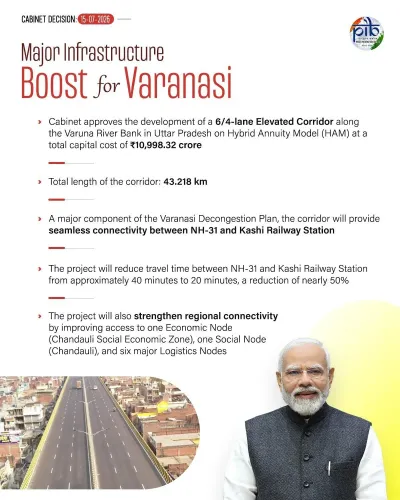
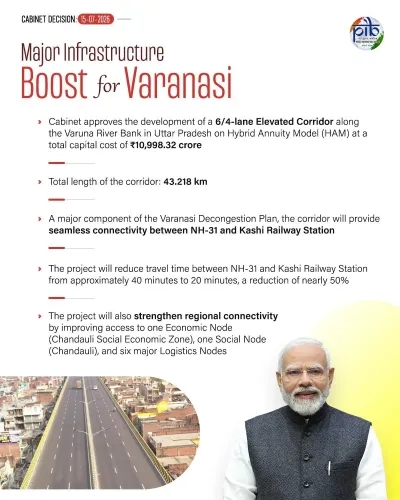
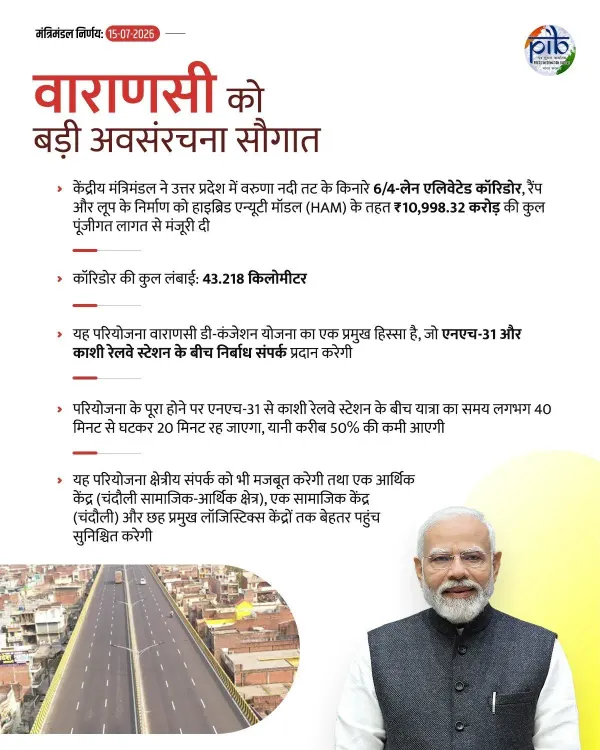
The Union Cabinet, chaired by PM Modi, has approved a Rs 10,998 crore, 43.218-km elevated Varuna River Corridor in Varanasi. Defence Minister Rajnath Singh welcomed the move, saying it will ease city traffic and link key transport hubs including NH-31, the airport, and Ramnagar Port.
Key Takeaways
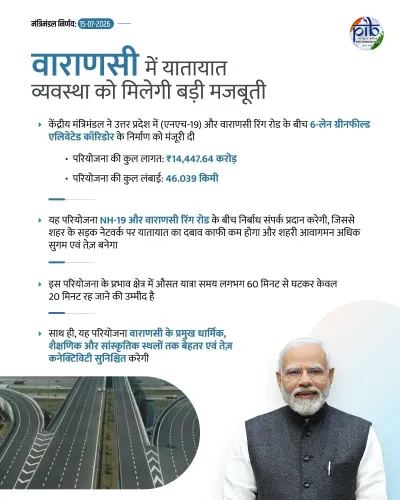
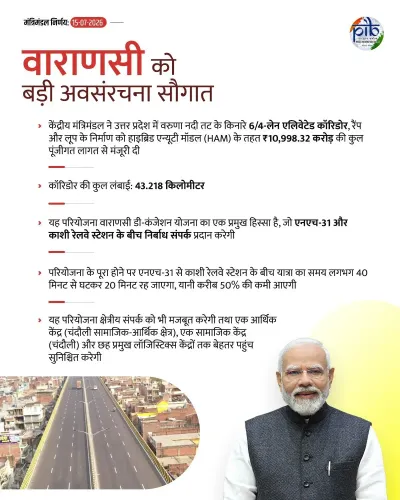
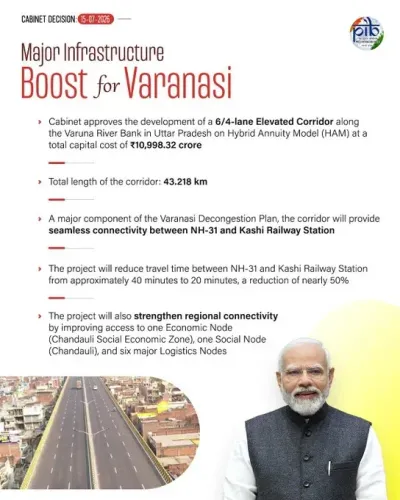
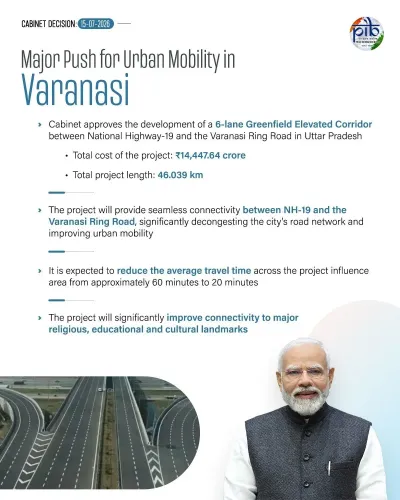
The Union Cabinet approved the Varuna River Link/Connector Corridor in Varanasi at a cost of Rs 10,998 crore .
The elevated corridor will stretch 43.218 km , connecting NH-31 , the Varanasi Ring Road , railway stations, the city airport, and Ramnagar Port .
The project is intended to reduce traffic congestion in the city's dense urban core and improve multimodal freight and passenger movement.
The approval aligns with the PM Gati Shakti National Master Plan (2021) and builds on the Bharatmala Pariyojana ring-road framework initiated in 2018 .
Defence Minister Rajnath Singh credited PM Modi's leadership for the rapid pace of modern infrastructure development across India.
Next steps include finalisation of the detailed project report, land acquisition, and tendering — all of which will determine the construction timeline.
Union Defence Minister Rajnath Singh on Wednesday, 15 July 2026, welcomed the Union Cabinet's approval of a Rs 10,998 crore elevated road corridor in Varanasi, saying the project would ease traffic pressure in one of India's most congested pilgrimage cities and improve multimodal connectivity across the region.
Posting on X in Hindi, Singh said the Cabinet, chaired by Prime Minister Narendra Modi, had cleared the construction of the 43.218-km Varuna River Link/Connector Corridor — an elevated passage that will connect key nodes including NH-31, the Varanasi Ring Road, railway stations, the city airport, and Ramnagar Port. He extended his gratitude to the Prime Minister, noting that modern infrastructure is being built rapidly across the country under Modi's leadership.
Context
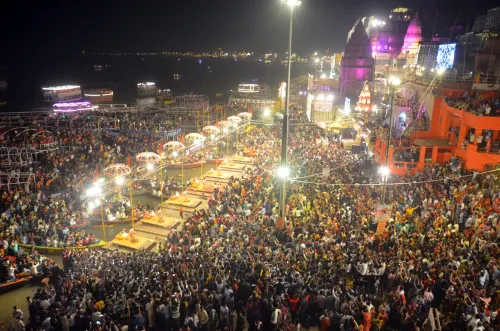
Varanasi, a historic city in Uttar Pradesh and the Lok Sabha constituency of Prime Minister Modi, has been a focal point of central government infrastructure spending over the past decade. The city's dense urban core, combined with heavy pilgrim and tourist footfall, has long strained its road network. The new corridor is designed to separate through traffic from local movement, a model increasingly adopted in Indian pilgrimage and heritage cities.
The proposed alignment along the Varuna river offers a natural elevated corridor linking the city's northern and eastern periphery, reducing the need for vehicles to pass through the old city centre.
Policy Backdrop
The project fits within two overlapping policy frameworks. The Bharatmala Pariyojana, under which a Varanasi Outer Ring Road Phase-I was approved in 2018, first established the principle of ring-and-bypass infrastructure to decongest the city. The PM Gati Shakti National Master Plan, launched in October 2021, subsequently mandated the integration of road, rail, port, and airport connectivity under a single planning umbrella across 16 ministries.
The Varuna Corridor directly implements that integration logic by physically linking NH-31, the ring road, two railway stations, Lal Bahadur Shastri International Airport, and Ramnagar Port — an inland waterway terminal on the Ganga being developed for multimodal freight under the Jal Marg Vikas Project.
Similar elevated corridor and ring-road projects have been sanctioned in recent years for Lucknow, Kanpur, and Prayagraj, reflecting a broader Union government push to modernise urban mobility in Uttar Pradesh's major cities.
Stakeholders and Impact
Daily commuters in Varanasi stand to benefit most immediately, with the elevated alignment expected to cut travel times between the city's major transport hubs. Logistics operators using Ramnagar Port for Ganga waterway freight would gain faster road access to the national highway network, potentially lowering last-mile costs.
The tourism and hospitality sector, which serves millions of pilgrims visiting the Kashi Vishwanath temple corridor and the Ghats each year, could also see indirect gains if airport-to-city transit becomes smoother. Infrastructure contractors and local employment markets in eastern Uttar Pradesh are additional stakeholders in a project of this scale.
What's Next
Following Cabinet approval, the standard sequence involves finalisation of the detailed project report, land acquisition proceedings, and competitive tendering. Watchers will track how quickly the project moves through these stages, given that land acquisition near the Varuna river in a densely populated city can be time-intensive.
Planners will also need to coordinate the corridor's design with the proposed Ganga Expressway spur toward Varanasi and the ongoing expansion of the city's airport runway — two projects that share overlapping connectivity goals. The pace of these parallel processes will determine when the corridor can realistically reach construction stage.
Point of View
Rail, air, and waterway nodes in a single elevated structure, the project operationalises the Gati Shakti integration doctrine in a high-visibility location. Rajnath Singh's public welcome, rather than a statement from the Road Transport Ministry, signals the project's political salience beyond its technical scope. The real test will be execution speed: elevated urban corridors in India have a mixed record on timelines, and land acquisition near a river in a heritage city adds a layer of complexity that approvals alone cannot resolve.
NationPress
15 Jul 2026
Frequently Asked Questions
What is the Varuna River Link Corridor in Varanasi?
The Varuna River Link/Connector Corridor is a proposed 43.218-km elevated road in Varanasi , approved by the Union Cabinet in July 2026 at a cost of Rs 10,998 crore . It will run along the Varuna river and connect major transport nodes including NH-31 , the ring road, railway stations, the airport, and Ramnagar Port .
How much will the Varanasi elevated corridor cost?
The Union Cabinet approved the project at an estimated cost of Rs 10,998 crore . The figure was cited in Defence Minister Rajnath Singh's post on X welcoming the Cabinet decision.
What connectivity will the Varuna Corridor provide?
The corridor will link NH-31 , the Varanasi Ring Road , city railway stations, Lal Bahadur Shastri International Airport , and Ramnagar Port — an inland waterway terminal on the Ganga — into a single elevated road alignment.
Why is Varanasi getting so much infrastructure investment?
Varanasi is the Lok Sabha constituency of Prime Minister Narendra Modi and a major pilgrimage and tourism centre. The Union government has channelled sustained infrastructure funding to the city under schemes such as Bharatmala Pariyojana and the PM Gati Shakti National Master Plan to ease congestion and improve multimodal connectivity.
What is the PM Gati Shakti plan and how does this project relate to it?
The PM Gati Shakti National Master Plan , launched in October 2021 , aims to integrate road, rail, port, and airport infrastructure across 16 central ministries under a unified planning framework. The Varuna Corridor directly embodies this approach by physically connecting all four modes of transport in a single project in Varanasi .