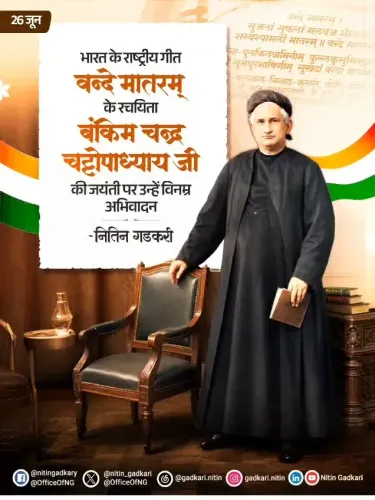
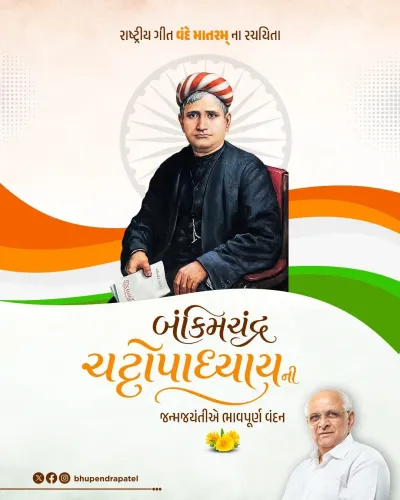
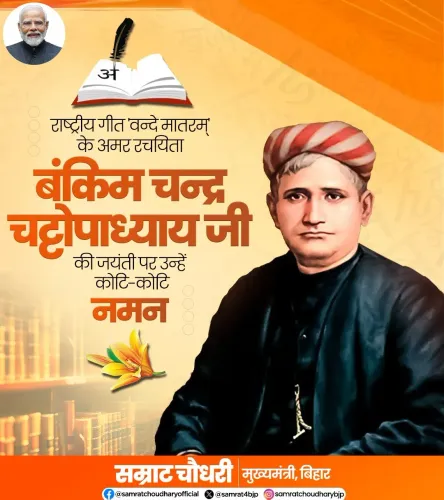
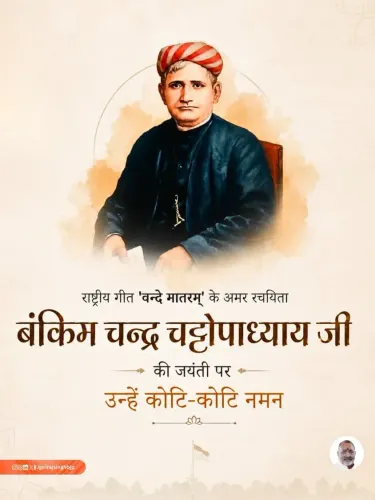
Rajnath Singh pays tribute to Bankim Chandra Chattopadhyay

Synopsis
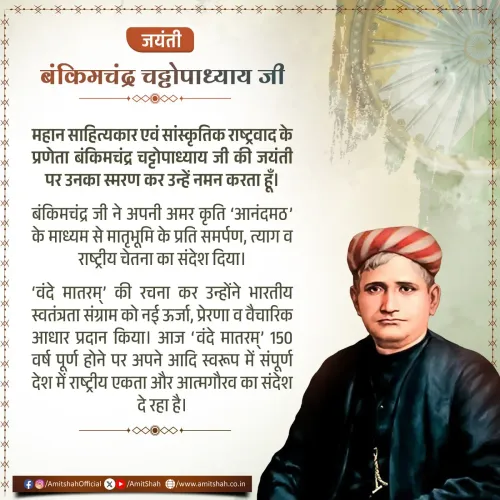
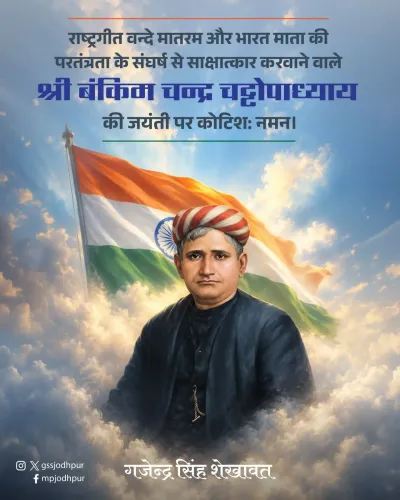
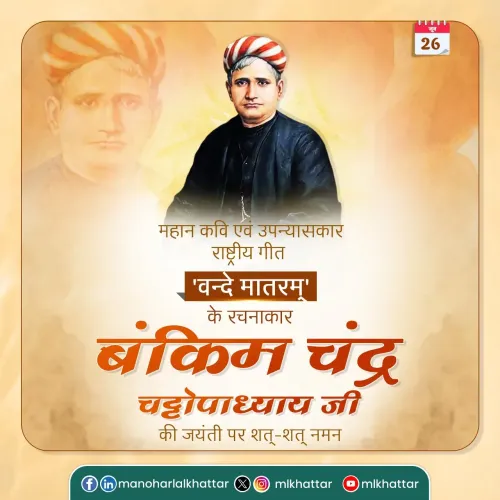
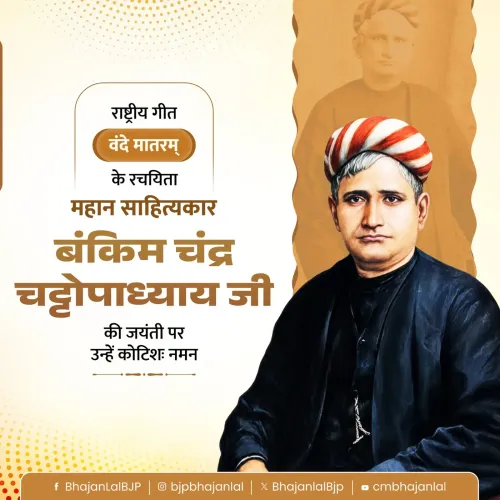
Union Defence Minister Rajnath Singh paid tribute to Bankim Chandra Chattopadhyay on his birth anniversary, honouring the 19th-century Bengali litterateur as the composer of Vande Mataram and a pioneer of the Indian renaissance whose writings inspired the freedom struggle.
Key Takeaways
Union Defence Minister Rajnath Singh posted a tribute to Bankim Chandra Chattopadhyay on his birth anniversary on 27 June 2026 .
Chattopadhyay (1838–1894) authored the novel Anandamath ( 1882 ), which introduced the song Vande Mataram .
Vande Mataram was formally adopted as India's national song by the Constituent Assembly on 24 January 1950 .
Singh credited Chattopadhyay with giving 'new direction to the struggle for independence' and strengthening national unity and pride.
The tribute reflects a broader official pattern of commemorating 19th-century nationalist and literary figures to reinforce contemporary nation-building narratives.
Union Defence Minister Rajnath Singh on Friday, 27 June 2026 paid homage to Bankim Chandra Chattopadhyay on the literary icon's birth anniversary, honouring him as the composer of India's national song and a towering figure of the 19th-century Indian renaissance.
Posting in Hindi on X, Singh wrote: 'Bharat ke rashtriya geet ke rachayita, mahan sahityakar, chintak evam Bharatiya navjagaran ke agradoot Bankim Chandra Chattopadhyay ji ki jayanti par unhe sadar naman' — ('Respectful salutations to Bankim Chandra Chattopadhyay, composer of India's national song, great litterateur, thinker and pioneer of the Indian renaissance, on his birth anniversary.')
Context
Bankim Chandra Chattopadhyay (1838–1894) was a Bengali novelist, essayist and intellectual whose works defined the contours of 19th-century Indian thought. His 1882 novel Anandamath introduced the composition Vande Mataram, which became one of the most powerful rallying cries of the freedom movement. Singh noted that Chattopadhyay's pen 'gave new direction to the struggle for independence and strengthened the spirit of national unity and national pride.'
The minister also observed that the literary giant 'awakened in the hearts of Indians the feelings of swaraj (self-rule), self-respect, and patriotism,' and made Indian society conscious of its civilisation, culture, and national identity.
Policy Backdrop
The Constituent Assembly formally adopted Vande Mataram as India's national song on 24 January 1950, alongside Jana Gana Mana as the national anthem. The decision recognised the song's unique historical role in galvanising mass participation during the colonial-era independence movement.
Singh's tribute reflects a consistent pattern among ruling-party leaders of publicly commemorating 19th-century literary and nationalist figures, linking their intellectual legacy to contemporary nation-building. Such official remembrances draw a line from social-reform movements of the Bengal Renaissance to present-day cultural and national identity discourse.
Stakeholders and Impact
Cultural organisations, literary bodies, and state governments — particularly in West Bengal, Chattopadhyay's home state — typically mark his birth anniversary with programmes celebrating his contribution to Indian literature and nationalism. The national song remains a living symbol taught in schools and performed at civic and state functions across the country.
Singh's post reinforces the significance of Vande Mataram as a constitutional symbol, describing it as having 'infused new energy and enthusiasm among Indians and inspired them to break the shackles of slavery.'
What's Next
Annual state-level commemorations and cultural-ministry programmes marking Chattopadhyay's birth anniversary are expected to continue as part of India's official calendar of national remembrance. The enduring centrality of Vande Mataram in civic life ensures that Chattopadhyay's legacy remains a reference point in both cultural policy and political discourse, with his birth anniversary serving as an occasion for leaders across the spectrum to reaffirm the intellectual foundations of Indian nationhood.
Point of View
Particularly those associated with the Bengal Renaissance. By foregrounding Chattopadhyay's role as the composer of Vande Mataram, the post connects a constitutional symbol directly to a narrative of cultural self-assertion that predates the formal independence movement. This pattern of official commemoration serves a dual function: honouring genuine historical legacy while reinforcing the ideological continuity the ruling dispensation draws between 19th-century cultural nationalism and present-day governance. The tribute carries no immediate policy implication but adds to a consistent record of such statements that collectively shape the cultural register of Indian political discourse.
NationPress
26 Jun 2026
Frequently Asked Questions
Who was Bankim Chandra Chattopadhyay?
Bankim Chandra Chattopadhyay (1838–1894) was a pioneering Bengali novelist, essayist and thinker widely regarded as a central figure of the 19th-century Indian renaissance. He authored the novel Anandamath (1882), which contained the composition Vande Mataram, later adopted as India's national song.
What is Vande Mataram and why is it significant?
Vande Mataram is India's national song, composed by Bankim Chandra Chattopadhyay and first published in his 1882 novel Anandamath. It became a powerful rallying cry during the freedom movement and was formally adopted by the Constituent Assembly on 24 January 1950, alongside Jana Gana Mana as the national anthem.
Why did Rajnath Singh post a tribute to Bankim Chandra Chattopadhyay?
Rajnath Singh posted the tribute to mark Bankim Chandra Chattopadhyay's birth anniversary, honouring him as the composer of Vande Mataram, a great litterateur and a pioneer of the Indian renaissance who inspired the freedom struggle.
When was Vande Mataram adopted as India's national song?
The Constituent Assembly adopted Vande Mataram as India's national song on 24 January 1950, the same day Jana Gana Mana was confirmed as the national anthem.
What was Bankim Chandra Chattopadhyay's contribution to the Indian independence movement?
Through his writings, particularly Vande Mataram, Chattopadhyay instilled a sense of patriotism, self-respect, and national identity among Indians. His work gave intellectual and emotional direction to the independence struggle and helped forge a sense of shared national consciousness during colonial rule.