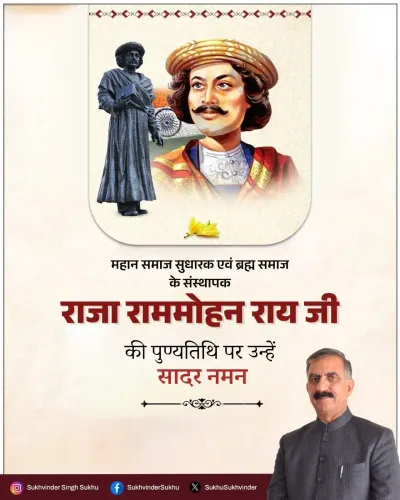
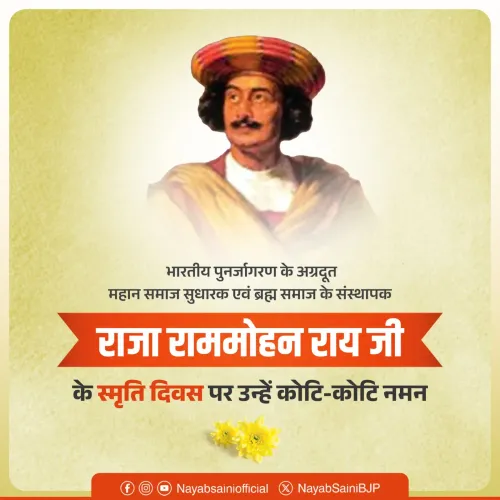
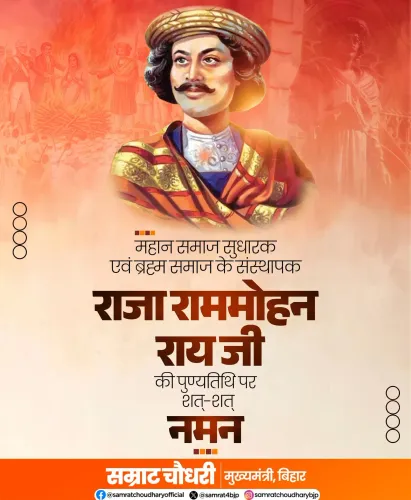
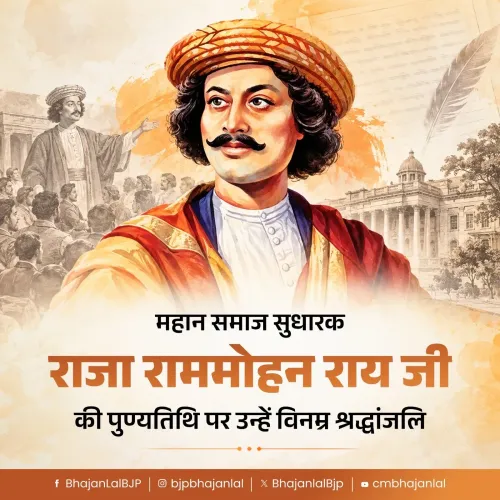
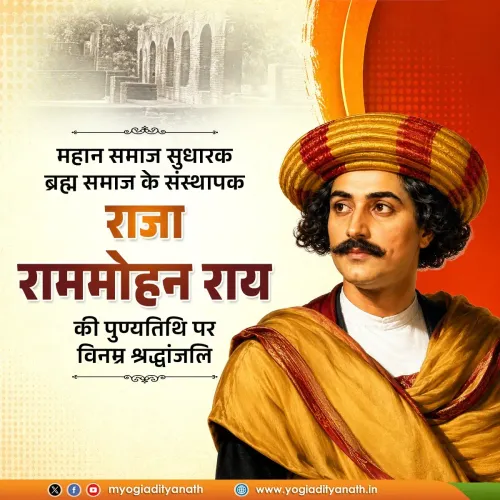
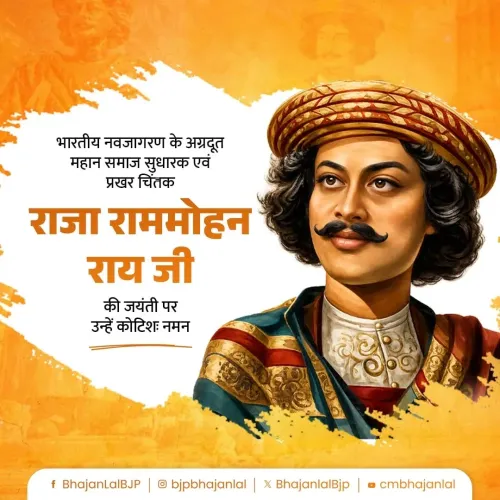
Rajnath Singh pays tribute to Raja Ram Mohan Roy on death anniversary

Synopsis
Union Defence Minister Rajnath Singh honoured Raja Ram Mohan Roy on his death anniversary, praising the 19th-century reformer's campaigns against sati, his founding of the Brahmo Samaj, and his advocacy for women's education and rational inquiry.
Key Takeaways
Rajnath Singh posted a tribute to Raja Ram Mohan Roy on his death anniversary on 27 September 2026 .
Singh highlighted Roy's role in breaking social orthodoxies and pioneering the Indian Renaissance .
Roy ( 1772–1833 ) founded the Brahmo Samaj and successfully campaigned for the abolition of sati through the Bengal Sati Regulation of 1829 .
Singh specifically cited Roy's contributions to women's education , social equality and modern learning.
Tributes to 19th-century social reformers are a regular feature of the Indian political calendar across party lines.
Two centuries after he fought to tear down some of India's most entrenched social evils, Raja Ram Mohan Roy is remembered on his death anniversary — and Union Defence Minister Rajnath Singh marked the occasion on Sunday, 27 September 2026 with a tribute to the reformer's enduring legacy.
Posting in Hindi, Singh offered his respects, writing — 'महान समाज सुधारक एवं भारतीय नवजागरण के अग्रदूत राजा राममोहन राय जी की पुण्यतिथि पर उन्हें नमन' — 'I bow in homage to Raja Ram Mohan Roy, the great social reformer and pioneer of the Indian Renaissance, on his death anniversary.' Singh noted that Roy had 'charted a new path of transformation at a time when society was encircled by numerous orthodoxies,' and that his ideas on education, rational thinking and human dignity gave fresh direction to a spirit of awakening and reform.
The man who remade 19th-century India
Born in 1772 in Bengal, Raja Ram Mohan Roy confronted a society where the practice of sati — the immolation of widows on their husbands' funeral pyres — was commonplace, and where access to modern learning was negligible. His sustained campaign against sati directly contributed to the colonial government's landmark Bengal Sati Regulation of 1829, one of the earliest legislative victories of the Indian reform movement. He founded the Brahmo Samaj, an organisation that rejected idolatry and caste discrimination and championed a rational, monotheistic spirituality grounded in human dignity. Roy was equally a champion of women's education and social equality — causes that Singh specifically cited in his tribute, noting that Roy's 'efforts towards women's education, social equality and modern education gave new momentum to the direction of social reform.' Roy died in 1833 in Bristol, England, but his intellectual legacy became the seedbed for subsequent waves of Indian reformers and, eventually, the broader nationalist movement.A refrain in Indian political memory
Tributes to 19th-century reformers like Roy have become a fixture of the Indian political calendar, with leaders across party lines invoking figures such as Ishwar Chandra Vidyasagar and Jyotirao Phule on their respective anniversaries. The practice reflects a broader political consensus that the reform tradition — rational inquiry, women's rights, equality — belongs to the nation's shared heritage rather than any single ideological camp. Singh's post fits squarely in this tradition, closing with the reflection that Roy's life inspires people 'to work resolutely in the public interest and to keep striving continuously for positive change in society.' The reformer who once stood nearly alone against an age of orthodoxy still has something urgent to say.Point of View
Invoking universally revered 19th-century figures allows the party to project a broad cultural nationalism that transcends religious and caste lines. The emphasis on 'rational inquiry' and 'human dignity' is particularly notable, signalling an alignment with Enlightenment-adjacent values that the party often deploys to counter charges of obscurantism. Such tributes carry low political risk but reinforce a soft-power image of a party attentive to India's reform legacy.
NationPress
27 Sept 2026
Frequently Asked Questions
Why did Rajnath Singh post about Raja Ram Mohan Roy today?
27 September marks the death anniversary of Raja Ram Mohan Roy , who passed away on this date in 1833 in Bristol, England. Singh posted a tribute in keeping with the Indian political tradition of honouring 19th-century reformers on their anniversaries.
Who was Raja Ram Mohan Roy?
Raja Ram Mohan Roy ( 1772–1833 ) was a Bengali social reformer widely regarded as the 'father of the Indian Renaissance.' He founded the Brahmo Samaj , led the campaign that resulted in the abolition of sati in 1829 , and championed women's education and modern Western learning in India.
What was the Brahmo Samaj?
The Brahmo Samaj was a socio-religious reform movement founded by Raja Ram Mohan Roy in 1828 . It rejected idolatry, caste discrimination and superstition, and promoted rational, monotheistic spirituality and social equality.
What did Rajnath Singh say about Raja Ram Mohan Roy?
Singh said Roy 'charted a new path of transformation at a time when society was encircled by numerous orthodoxies,' and praised his ideas on education, rational thinking and human dignity. He also highlighted Roy's efforts for women's education and social equality.
How did Raja Ram Mohan Roy help abolish sati?
Raja Ram Mohan Roy waged a sustained public and intellectual campaign against the practice of sati — widow immolation — which led the colonial government to enact the Bengal Sati Regulation of 1829 , formally banning the practice.