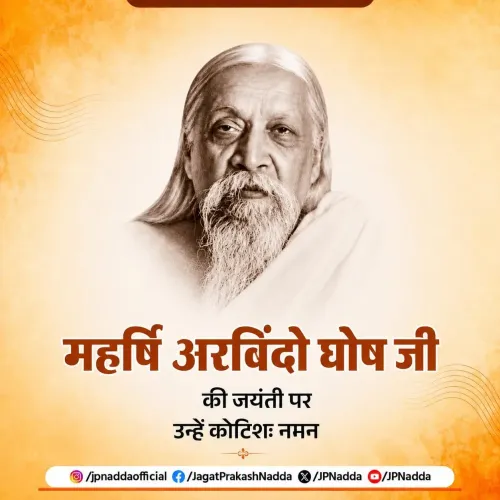
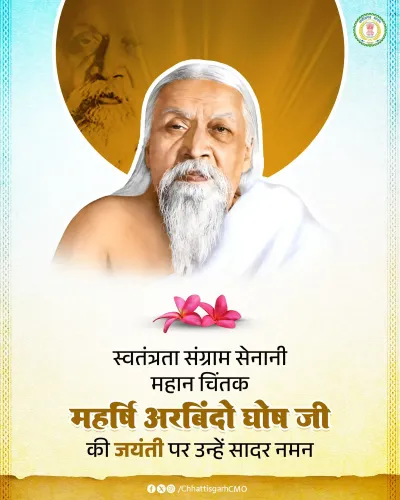
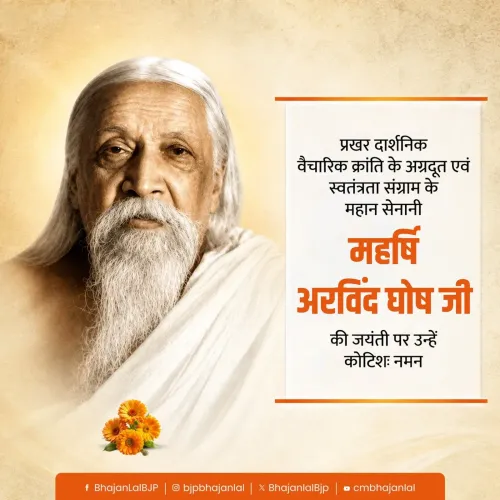
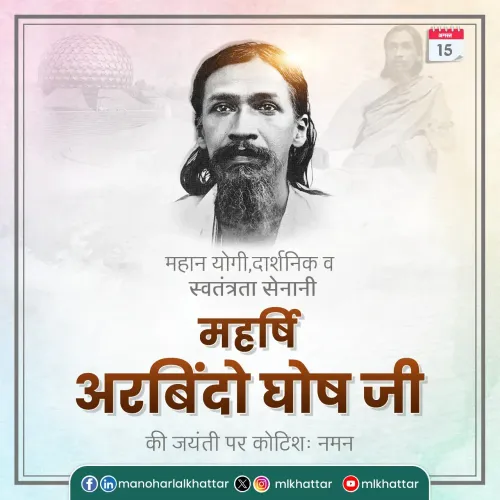
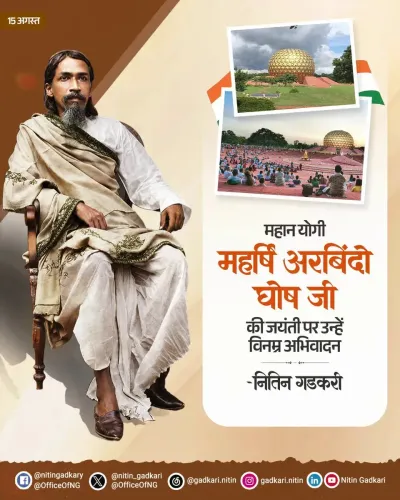
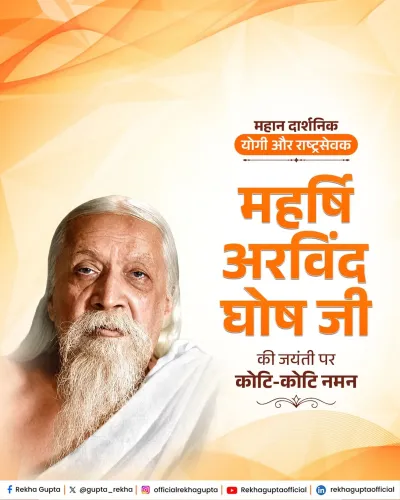
Rajnath Singh pays tribute to Sri Aurobindo on birth anniversary
Synopsis
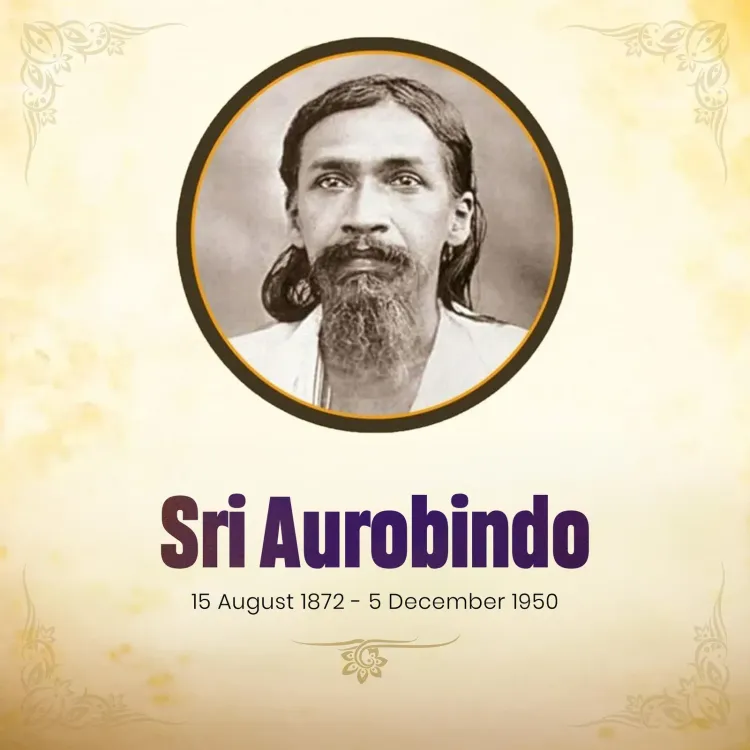
Union Defence Minister Rajnath Singh marked Sri Aurobindo's birth anniversary on Independence Day, honouring the nationalist philosopher's early call for complete independence and his development of Integral Yoga as pillars of India's civilisational heritage.
Key Takeaways
Rajnath Singh paid tribute to Sri Aurobindo on 15 August 2026 , his birth anniversary and India's Independence Day.
Singh credited Aurobindo as one of the first Indian political leaders to openly demand complete independence from British rule.
Aurobindo ( 1872–1950 ) developed Integral Yoga and produced major philosophical works including The Life Divine .
Aurobindo's birth date, 15 August 1872 , coincides with India's Independence Day — a resonance he himself considered significant.
The tribute follows a broader pattern of official commemorations of independence-era figures by Indian political leaders.
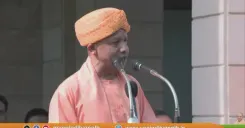
On India's Independence Day, 15 August, Union Defence Minister Rajnath Singh paid tribute to Sri Aurobindo, honouring the nationalist philosopher and yogi on his birth anniversary — a date that doubles as the nation's own founding moment.
Singh described Aurobindo as 'one of India's great nationalists, philosophers and spiritual thinkers,' crediting him as among the first political leaders to openly demand complete independence from British rule — a radical position for his era.
The revolutionary who turned inward
Sri Aurobindo (1872–1950) began his public life as a firebrand. Educated in England, he returned to India and plunged into the independence movement at a time when most mainstream leaders were still petitioning for incremental reforms. His calls for purna swaraj — complete self-rule — preceded the mainstream nationalist consensus by decades.
After his arrest and a transformative experience during imprisonment in Alipore Jail, Aurobindo withdrew from active politics and relocated to Pondicherry, then a French territory, in 1910. There he devoted the rest of his life to philosophy and spiritual practice, producing foundational works including The Life Divine and developing Integral Yoga — a system that sought to synthesise matter and spirit, individual evolution and collective transformation.
Why August 15 carries a double resonance
Aurobindo was born on 15 August 1872 — the same date India gained independence in 1947. He regarded the coincidence as deeply significant. For Indian political leaders, the anniversary is therefore a natural moment of dual commemoration: the nation's birth and the birth of one of its most singular intellectual architects.
Singh's tribute fits a wider pattern of official remembrance on this date, with ministers and institutions marking Aurobindo's legacy alongside Independence Day ceremonies. His synthesis of political nationalism and spiritual philosophy has made him a figure claimed across India's ideological spectrum.
Generations of readers continue to engage with his vision of human evolution and India's civilisational role — a legacy that, as Singh noted, shows no sign of dimming.
Point of View
Singh signals a reading of Indian nationalism that is as much cultural as it is constitutional. The timing — Independence Day itself — amplifies the resonance of both messages simultaneously.
NationPress
15 Aug 2026
Frequently Asked Questions
Why is Sri Aurobindo's birthday on August 15 significant?
Sri Aurobindo was born on 15 August 1872 , the same date India gained independence in 1947 . Aurobindo himself regarded this as deeply meaningful, and it makes his anniversary a natural point of dual commemoration each Independence Day.
What is Integral Yoga developed by Sri Aurobindo?
Integral Yoga is a spiritual practice developed by Sri Aurobindo that seeks to integrate all aspects of human existence — physical, mental and spiritual — aiming at a collective transformation of consciousness, not just individual liberation.
What did Rajnath Singh say about Sri Aurobindo?
Rajnath Singh described Sri Aurobindo as 'one of India's great nationalists, philosophers and spiritual thinkers,' and noted he was among the first political leaders to openly call for complete independence for the country.
What was Sri Aurobindo's role in India's independence movement?
Sri Aurobindo was an early and outspoken advocate of purna swaraj — complete independence — at a time when most leaders sought incremental reforms. He was active in the independence movement before withdrawing to Pondicherry in 1910 to pursue philosophy and spiritual practice.
Who was Sri Aurobindo and what is he known for?
Sri Aurobindo ( 1872–1950 ) was an Indian nationalist, philosopher and yogi. He is known for his early radicalism in the independence movement, his development of Integral Yoga , and his major philosophical work The Life Divine .