Uttarakhand CM Office: REAP Scheme Boosts Pithoragarh Shop

Synopsis
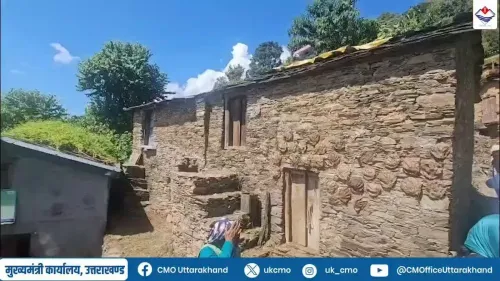
The Chief Minister's Office of Uttarakhand spotlighted Madhavanand Kapdi of Satgarh, Pithoragarh, whose retail shop was expanded under the Gramotthan REAP project using a ₹3 lakh business plan — a grassroots win for rural self-employment in a district challenged by out-migration.
Key Takeaways
Madhavanand Kapdi of Satgarh village, Pithoragarh expanded his retail shop under the Gramotthan (REAP) project .
The expansion was backed by a structured ₹3 lakh business plan under the scheme.
The Gramotthan (REAP) initiative targets rural self-employment and village-level enterprise upliftment in Uttarakhand.
Pithoragarh is a remote hilly district in the Kumaon region where out-migration is a persistent socio-economic concern.
The Chief Minister's Office of Uttarakhand amplified the case on 20 October 2026 as an example of the scheme's on-ground impact.
A small retail shop in a remote Kumaon village just got a lifeline — and a blueprint for what rural self-employment can look like. The Chief Minister's Office of Uttarakhand highlighted on Tuesday, 20 October 2026, how resident Madhavanand Kapdi of Satgarh village in Pithoragarh district expanded his retail shop with support from the state's Gramotthan (REAP) project, backed by a business plan worth ₹3 lakh.
The post, shared in Hindi, reads: 'Janpad Pithoragarh ke Satgarh mein Gramotthan (REAP) pariyojana se Madhavanand Kapdi ki retail shop ka vistar, 3 lakh rupaye ke business plan se gramin swarozgar ko mila protsahan.' — or in English: 'In Satgarh, Pithoragarh, the expansion of Madhavanand Kapdi's retail shop through the Gramotthan (REAP) project has given a boost to rural self-employment through a ₹3 lakh business plan.'
Satgarh's story: what REAP actually does on the ground
The REAP (Rural Enterprise Acceleration Project), branded under the state's broader Gramotthan ('village upliftment') framework, is designed to do exactly what its name promises — accelerate enterprise at the village level. It works by identifying individuals with viable business ideas and pairing them with structured financial and planning support, rather than simply distributing cash. Kapdi's expanded retail shop in Satgarh is a direct product of that model.
Pithoragarh sits at the northern edge of Uttarakhand's Kumaon range — a district defined by rugged terrain, scattered habitations, and an economy that has historically struggled to retain its working-age population. Out-migration to the plains remains a chronic pressure here. A ₹3 lakh business plan enabling a local shop to grow is, in that context, more than a transaction. It is a signal that viable livelihoods can be built in situ.
Rural enterprise and the fight against out-migration
Uttarakhand has run a series of livelihood and self-employment schemes across its hill districts for well over a decade, motivated largely by the state's distinctive demographic challenge: villages that empty out as residents seek urban work in Dehradun, Delhi, or further afield. Schemes targeting individual entrepreneurs — rather than large co-operatives or infrastructure projects alone — have gained traction as a complementary strategy because they create immediate, visible outcomes at the household level.
The REAP project's district-level rollout in Pithoragarh reflects that philosophy. By anchoring support around a concrete business plan, the scheme builds accountability into the process — both for the beneficiary and for administrators tracking outcomes.
Whether outcomes like Kapdi's become the rule or the exception depends on how consistently the state funds and monitors beneficiary progress — and on whether the next round of budget allocations extends the scheme's reach deeper into Pithoragarh's more remote blocks. That is the number to watch.
Point of View
Rural enterprise programmes carry an outsized political weight because out-migration from Kumaon and Garhwal hills is a live electoral concern. Whether REAP can deliver at meaningful scale across Pithoragarh's dispersed settlements — not just in photogenic individual cases — remains the real test of the programme's design.
NationPress
20 Oct 2026
Frequently Asked Questions
What is the REAP Gramotthan project in Uttarakhand?
REAP, or the Rural Enterprise Acceleration Project under the Gramotthan framework, is an Uttarakhand state scheme aimed at promoting rural self-employment by providing individuals with structured business plans and financial support to start or expand small enterprises in village areas.
Who is Madhavanand Kapdi and why is he in the news?
Madhavanand Kapdi is a resident of Satgarh village in Pithoragarh district, Uttarakhand, whose retail shop was expanded under the REAP Gramotthan project with a ₹3 lakh business plan — highlighted by the Chief Minister's Office as an example of rural self-employment success.
Where is Satgarh village located?
Satgarh is a village in Pithoragarh district, located in the Kumaon region of northern Uttarakhand — a predominantly rural and hilly area bordering Nepal.
How much funding did the REAP project provide for the Satgarh shop?
The Chief Minister's Office post states that Madhavanand Kapdi's retail shop expansion was supported through a business plan worth ₹3 lakh under the REAP Gramotthan project.
Why does Uttarakhand focus on rural self-employment schemes in hilly districts?
Hilly districts like Pithoragarh face chronic out-migration as residents move to plains cities for work. Rural self-employment schemes aim to create viable local livelihoods so residents can sustain themselves in their home villages, reducing demographic decline in remote areas.