Revanth Reddy Cites Academic Study to Debunk Kaleshwaram Credit Claims
Synopsis
Telangana CM Revanth Reddy amplified a vice-chancellor's research paper claiming good monsoon and 15 lakh new borewells — not the BRS-era Kaleshwaram project — account for the state's paddy area surge, while the same study flags a decade of stagnant farmer net income.
Key Takeaways
Prof Aldas Janaiah , vice-chancellor of Professor Jayashankar Telangana Agricultural University, argues the Kaleshwaram Lift Irrigation Project had no role in Telangana's paddy production increase.
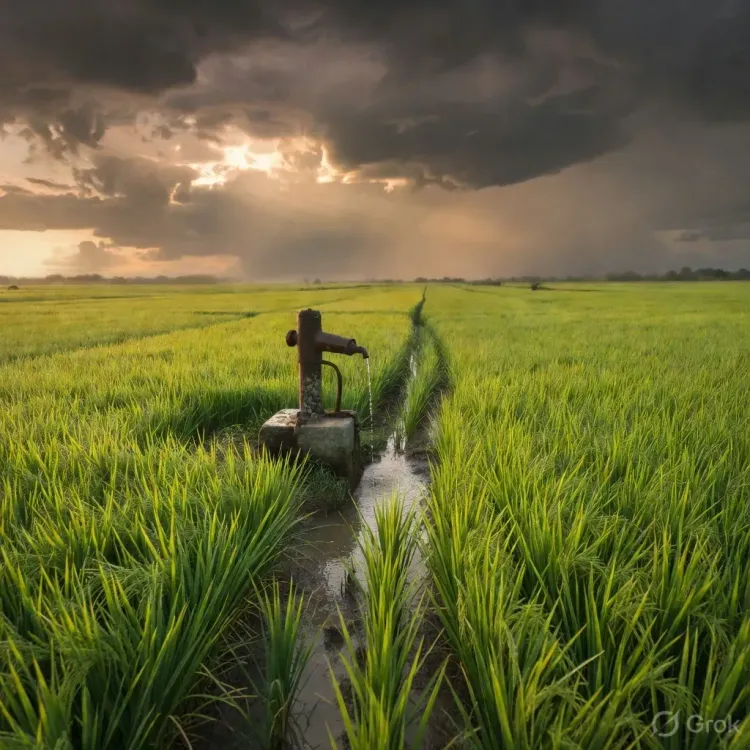
Good monsoon over the last 10 years and 15 lakh new borewells are identified as the primary drivers, adding 40 lakh acres to cultivated area.
The same study notes no growth in farmer net income over the last decade, with rising irrigation costs offsetting production gains — a finding that spans both the BRS and Congress tenures.
CM Revanth Reddy cited the Congress government's welfare schemes — Rythu Runa Mafi, Rythu Bima, Rythu Bharosa , and 24-by-7 free power — as the real drivers of farmer welfare improvement.
The Kaleshwaram project was inaugurated in 2019 under the previous BRS government as a flagship irrigation initiative costing thousands of crores.
A university vice-chancellor's research paper has landed at the centre of Telangana's sharpest agricultural debate — and Chief Minister A. Revanth Reddy wasted no time deploying it. On Wednesday, 12 August 2026, the CM shared findings by Prof Aldas Janaiah, vice-chancellor of Professor Jayashankar Telangana Agricultural University, arguing that the previous BRS government's flagship Kaleshwaram Lift Irrigation Project deserves no credit for the state's paddy output surge.
What the Academic Argument Actually Says
Prof Janaiah's paper, as cited by the Chief Minister, identifies two primary drivers of Telangana's paddy expansion: good monsoon performance over the last 10 years and the addition of 15 lakh new borewells that brought an additional 40 lakh acres under cultivation. The paper's conclusion is blunt — borewells are 'singularly responsible for 100 percent growth in the irrigable area in Telangana,' with Kaleshwaram playing no material role in that expansion.
Revanth Reddy framed the findings as definitive, writing that 'the entire opposition hoax on agriculture has been exposed. Case over!' The combative sign-off signals how politically loaded the irrigation credit question remains in Telangana.
The Farmer Net-Income Problem Neither Side Wants to Lead With
Buried in the same academic argument is a harder finding. Prof Janaiah reportedly notes that despite area expansion, Telangana has shown no growth in farmer net income over the last 10 years — a period that spans both the BRS and Congress administrations. Rising irrigation expenditure, largely driven by borewell electricity and maintenance costs, has offset production gains. That finding cuts across the political timeline, complicating any single government's victory lap.
The Chief Minister's post, however, pivots quickly to the Congress government's own welfare architecture: Rythu Runa Mafi (farm loan waiver), Rythu Bima (farmer life insurance), Rythu Bharosa (direct income support), 24-by-7 free power, and improved water availability — positioning the Praja Palana programme as the genuine turning point for farmers' prosperity.
The Kaleshwaram Controversy That Won't Quit
The Kaleshwaram Lift Irrigation Project, formally inaugurated in 2019 under then-Chief Minister K. Chandrashekar Rao, was the centrepiece of BRS's agricultural promise to Telangana — a multi-thousand-crore infrastructure bet on bringing new ayacut under canal irrigation. Since the Congress government came to power in December 2023, the project has faced scrutiny over cost overruns and structural concerns, and the question of how much paddy acreage it actually enabled has become a live political flashpoint.
By amplifying an academic voice — a sitting vice-chancellor of the state's own agricultural university — Revanth Reddy is doing something more than tweeting. He is attempting to shift the debate from political assertion to institutional credibility. Whether the opposition accepts that framing is another matter entirely.
The next move belongs to the data: official agricultural production statistics from the state agriculture department will either anchor or complicate the claims on both sides — and Telangana's farmers are watching what the numbers, not the headlines, actually say about their incomes.
Point of View
Revanth Reddy is attempting to institutionalise the Congress government's counter-narrative on Telangana's agricultural record — a tactical shift from assertion to academic citation. The move is shrewd but double-edged: the same study's finding of stagnant farmer net income over a decade implicates Congress's own pre-2023 period at the centre and raises questions the welfare scheme list does not fully answer. Telangana's irrigation credit wars — Kaleshwaram versus groundwater versus rainfall — are ultimately a proxy for the larger contest over which government genuinely moved the needle for the state's farming households. Until official production and income data are published and independently assessed, the debate will remain a battle of competing framings rather than settled fact.
NationPress
27 Sept 2026
Frequently Asked Questions
What did the Telangana Agricultural University study say about Kaleshwaram?
The study by Prof Aldas Janaiah , vice-chancellor of Professor Jayashankar Telangana Agricultural University, argues that the Kaleshwaram Lift Irrigation Project played no role in Telangana's paddy production increase, attributing growth instead to good monsoon over 10 years and 15 lakh new borewells.
Why is Revanth Reddy attacking the Kaleshwaram project?
CM Revanth Reddy is using the academic study to counter opposition claims — particularly from the BRS — that the Kaleshwaram project was responsible for Telangana's agricultural growth, framing the Congress government's welfare schemes as the real turning point for farmers.
What is Rythu Bharosa and how is it different from Rythu Bandhu?
Rythu Bharosa is the direct income support scheme for farmers introduced or restructured by the Congress government after it came to power in December 2023 . It replaced Rythu Bandhu , a similar direct investment support scheme launched by the BRS government in 2018.
Did Telangana farmer incomes actually grow in the last 10 years?
According to the study cited by CM Revanth Reddy, Telangana has shown no growth in farmer net income over the last 10 years , as rising irrigation expenditure — largely from borewell costs — has offset gains from expanded cultivated area. This finding spans both the BRS and Congress periods.
How much new agricultural land came under cultivation in Telangana?
The study cited by the Chief Minister claims an additional 40 lakh acres came under cultivation due to 15 lakh new borewells sunk across the state, which it describes as solely responsible for the 100 percent growth in irrigable area.