Is Revanth Reddy Spreading Falsehoods About Musi Rejuvenation?
Click to start listening
Synopsis
K.T. Rama Rao challenges Revanth Reddy's integrity regarding the Musi rejuvenation project, alleging corruption and mismanagement. The accusations highlight a significant political conflict affecting thousands of residents.
Key Takeaways
- KTR accuses Revanth Reddy of falsehoods.
- Allegations of corruption in the Musi project.
- Concerns about the eviction of residents.
- Challenges regarding financial transparency.
- Political conflict reflecting governance issues.
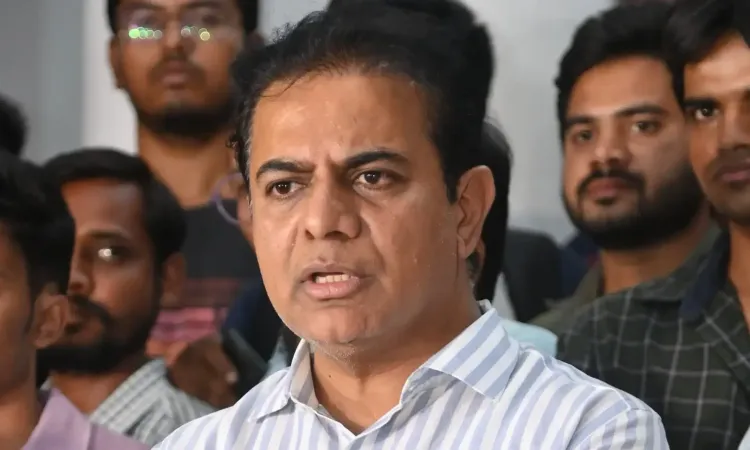
Hyderabad, Jan 2 (NationPress) K. T. Rama Rao, the working president of the Bharat Rashtra Samithi (BRS), accused Chief Minister Revanth Reddy of disseminating false information in the Assembly regarding the rejuvenation of the Musi River.
Rama Rao claimed that the Chief Minister is using the initiative as a facade for what he described as the largest corruption scheme in the history of Telangana.
KTR, a common abbreviation for the BRS leader, stated that the Chief Minister lacks a genuine vision for cleaning the Musi and suggested that anger and desperation drive Revanth Reddy, particularly against those challenging his alleged illicit wealth and those who oppose the current approach to the Musi project.
He also criticized the Chief Minister’s language, calling it more offensive than the polluted waters of the Musi.
KTR questioned the authenticity of Revanth Reddy’s claims, particularly how he could assert spending figures nearing Rs 1.5 lakh crore when the Detailed Project Report (DPR) is reportedly not due for another year.
“If the DPR hasn’t been finalized, then how were these enormous figures disclosed?” he asked, demanding clarity on the early deployment of bulldozers to dismantle the homes of the economically disadvantaged before any legal planning or approvals.
The statement claimed that under the pretext of Musi ‘beautification’, the Congress government is gearing up for a major financial exploitation.
KTR charged that the government intends to assign crucial components of the project to Mainhardt, a company allegedly blacklisted and facing Red Corner Notices.
“How can such a firm be entrusted with a project of this magnitude?” he queried, labeling it a calculated scheme to promote corruption.
KTR also accused the Chief Minister of openly declaring intentions to demolish the homes of over one lakh individuals living along the Musi, effectively rendering them homeless.
This, according to him, reveals the true nature of the Congress government.
“Under Congress rule, it’s all about demolitions, not construction,” KTR asserted, pointing out that illegal guest houses purportedly owned by ministers near Himayat Sagar and Osman Sagar remain untouched while poor families face eviction without mercy.
Blaming the Congress and TDP for years of neglect, KTR noted that these parties, which governed the united state for almost 60 years, are responsible for polluting the Musi and transforming it into a sewage drain.
He highlighted that Revanth Reddy had been a member of both parties and cannot dissociate from their legacy.
KTR also held previous administrations accountable for subjecting Nalgonda district to long-term distress due to contaminated water and fluoride issues, stating that it was only under the BRS administration, through Mission Bhagiratha, that the fluoride problem was effectively tackled.
KTR challenged the Chief Minister’s assertion of delivering 20 TMC of Godavari water to the Musi, asking him to clarify if that water originates from Kaleshwaram.
“If it does, he must concede that,” KTR stated, accusing Revanth Reddy of engaging in false propaganda against the Kaleshwaram project while relying on it for the Musi rejuvenation.
The BRS working president contended that the real aim behind the Musi initiative is large-scale real estate exploitation.
He accused the government of forcibly removing poor and middle-class residents from prime land in central Hyderabad to benefit benamis and loyalists.
“For this Chief Minister, governance has been reduced to real estate transactions,” he said.
KTR noted that global tenders were previously solicited at minimal costs for Musi rejuvenation, with nine renowned companies providing detailed designs.
A comprehensive master plan was developed at an estimated cost of about Rs 16,000 crore.
“Restarting the process with existing designs only makes sense if commissions are the goal,” he claimed, observing that cost estimates are being inflated from Rs 50,000 crore to Rs 75,000 crore and now up to Rs 1.5 lakh crore even before any work has commenced.
Point of View
The allegations made by KTR against Chief Minister Revanth Reddy highlight a significant political divide in Telangana. As these claims unfold, it is essential to maintain a focus on transparency and accountability in governance, ensuring that the interests of the citizens are prioritized over political gain.
NationPress
08/01/2026
Frequently Asked Questions
What are the allegations against Revanth Reddy?
K. T. Rama Rao accuses Revanth Reddy of spreading falsehoods about the Musi River rejuvenation and using it as a cover for corruption.
How much is the Musi rejuvenation project estimated to cost?
Estimates have varied from Rs 50,000 crore to Rs 1.5 lakh crore, raising questions about the project's financial management.
What is KTR's stance on the Congress government?
KTR believes the Congress government is prioritizing demolitions over construction and is responsible for the long-term neglect of the Musi River.
What impact could this project have on local residents?
KTR claims that over one lakh residents may face eviction due to the project, raising concerns about their housing security.
What was the previous government's contribution to the Musi's condition?
KTR blames previous administrations for polluting the Musi River and not addressing the water quality issues effectively.