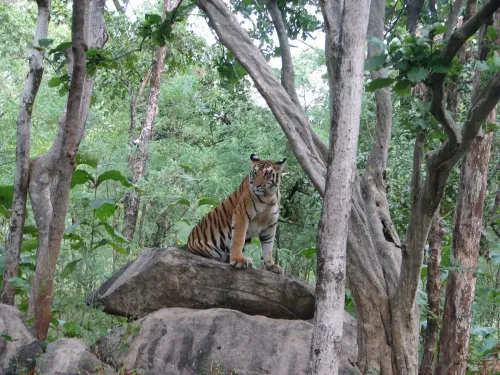
Rijiju calls for tiger habitat protection on International Tiger Day

Synopsis
On International Tiger Day, 29 July 2026, Union Minister Kiren Rijiju called on Indians to protect tiger habitats and combat poaching, echoing India's five-decade conservation commitment under Project Tiger and the National Tiger Conservation Authority framework.
Key Takeaways
Union Parliamentary Affairs Minister Kiren Rijiju marked International Tiger Day (29 July) with a call to protect tiger habitats and prevent poaching.
Project Tiger , launched in 1973 , remains the foundational framework for India's in-situ tiger conservation efforts.
The National Tiger Conservation Authority oversees the programme; successive tiger censuses have recorded population recovery.
No new scheme or policy announcement accompanied Rijiju's post — it reflects the standard annual leadership messaging pattern.
The next All India Tiger Estimation report and state-level habitat corridor notifications are the key developments to watch.
Every year on 29 July, the world pauses to reckon with a creature that has become both a conservation triumph and an ongoing battle — and this year, Union Parliamentary Affairs Minister Kiren Rijiju added his voice to that call, urging Indians to commit to protecting the tiger and the forests it calls home.
Posting on International Tiger Day, Rijiju wrote: 'Let us pledge to protect our majestic national animal and preserve the forests that are its home. By conserving habitats and preventing poaching, we can ensure that the powerful roar of the tiger continues to echo through thriving forests for generations to come.'
Half a century of Project Tiger — and what it built
The pledge Rijiju invokes sits on a foundation laid more than five decades ago. Project Tiger, launched by the Government of India in 1973, established the framework for in-situ tiger conservation that still underpins India's approach today. The National Tiger Conservation Authority has since expanded that architecture, and successive All India Tiger Estimation reports have recorded a measurable recovery in population numbers — a rare conservation success story on a planet where such stories are scarce. India's tigers are its national animal, and the forests they require are among the country's most biodiverse ecosystems. Habitat corridors, anti-poaching patrols, and community forest rights all feed into whether a tiger population holds or collapses — making the annual observance more than ceremonial.Annual messaging, but the stakes remain real
Senior leaders across parties mark International Tiger Day with statements each year, and Rijiju's post follows that pattern. The research flags no new scheme or statistic announced alongside it. Yet the consistency of the messaging itself reflects something: political will, signalled annually, keeps state forest departments and conservation organisations oriented toward the same goal. What to watch next is the release of the forthcoming All India Tiger Estimation report, which will reveal whether population gains have held, and any state-level notifications on habitat corridor protections — the unglamorous but critical work that determines whether pledges translate into thriving forests.Point of View
But the ritual is not without function — annual high-level signalling keeps conservation on the government's visible agenda and provides legitimacy to forest departments and NGOs operating on the ground. The absence of a new policy announcement means this is consolidation messaging, not a pivot. The real test of political will lies in corridor notifications and anti-poaching budgets, not social media pledges. India's tiger recovery story is genuine, but it remains contingent on unglamorous administrative follow-through that rarely makes headlines.
NationPress
29 Jul 2026
Frequently Asked Questions
When is International Tiger Day celebrated?
International Tiger Day is observed every year on 29 July to raise global awareness about tiger conservation and the threats facing the species.
What is Project Tiger in India?
Project Tiger is a central government scheme launched in 1973 to conserve tigers through in-situ habitat protection; it is administered by the National Tiger Conservation Authority.
What did Kiren Rijiju say on International Tiger Day 2026?
Rijiju called on citizens to protect tiger habitats and prevent poaching, saying the goal is to ensure 'the powerful roar of the tiger continues to echo through thriving forests for generations to come.'
Has India's tiger population increased?
Successive All India Tiger Estimation reports have recorded population recovery attributed to the Project Tiger and National Tiger Conservation Authority framework, though the next report will confirm current trends.
What is the National Tiger Conservation Authority?
The National Tiger Conservation Authority (NTCA) is a statutory body under India's Ministry of Environment that oversees tiger reserves, anti-poaching measures, and habitat management across the country.