Rijiju Hits Back at Congress Over 'Non-Stop Attacks' on PM Modi
Synopsis
Union Parliamentary Affairs Minister Kiren Rijiju on 27 June 2026 accused the Congress party of abusing Prime Minister Narendra Modi '24X7', calling it 'dictatorial' and asserting that voters would not return it to power — escalating BJP-Congress digital sparring ahead of the next election cycle.
Key Takeaways
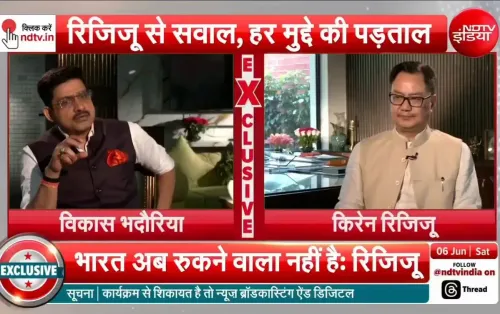
Kiren Rijiju , Union Minister of Parliamentary Affairs, posted on X on 27 June 2026 accusing Congress of abusing PM Modi around the clock.
Rijiju labelled Congress 'dictatorial' and predicted voters would deny it a return to power.
The post draws on a long-standing BJP narrative contrasting Congress's historical record — including the 1975 Emergency — with its own governance.
BJP has used the '24X7 attack on PM Modi' framing consistently since 2014 to characterise opposition criticism as exceeding legitimate dissent.
The exchange reflects intensifying political rhetoric between India's two largest national parties ahead of the next general election cycle.
Union Parliamentary Affairs Minister Kiren Rijiju on Saturday, 27 June 2026, sharply rebuked the Indian National Congress, accusing the opposition party of abusing Prime Minister Narendra Modi around the clock and warning that voters would reject what he called its 'dictatorial' character.
Posting on X, Rijiju wrote: 'That's why people won't bring such a dictatorial Congress party to power again. Everyone has freedom of expression but Congress is literally abusing PM Modi Ji 24X7.' The remark was pointed and unambiguous — framing sustained opposition criticism of the Prime Minister not as political accountability but as abuse that crosses a democratic line.
Context
The post fits a well-established pattern of BJP leaders responding to opposition attacks on Prime Minister Modi by questioning the Congress party's democratic credentials. Rijiju, who manages the government's legislative business in Parliament as Union Minister of Parliamentary Affairs, also holds the Minority Affairs portfolio and is one of the party's most prominent voices from Arunachal Pradesh.
While the specific trigger for this particular post has not been independently confirmed, the broader context is one of intensifying political rhetoric between the two national parties, particularly on social media platforms.
Policy Backdrop
BJP leaders have consistently invoked the 1975 Emergency — imposed by a Congress government — when labelling the party 'dictatorial.' That episode, which suspended fundamental rights and saw mass political detentions, remains a live fault line in Indian political memory and is regularly cited in BJP communications to contrast Congress's historical record with the current dispensation.
Since 2014, accusations that the opposition wages a relentless, personalised campaign against the Prime Minister have been a recurring theme in BJP's digital and parliamentary messaging. The party has repeatedly argued that criticism of this nature goes beyond legitimate dissent.
Stakeholders and Impact
The exchange underscores the deeply polarised nature of political discourse between India's two largest national parties as both prepare for the next electoral cycle. For the Indian electorate, such public sparring shapes perceptions of political civility, the limits of free speech, and the accountability of those in power.
Congress has consistently maintained that robust criticism of the Prime Minister is a constitutional right and a core function of opposition politics. The party has not shied away from sharp rhetoric targeting the government's record on economic management, social harmony, and institutional independence.
What's Next
With general election cycle preparations already underway, exchanges of this nature are likely to intensify on digital platforms and inside Parliament. Observers will watch whether sustained political attacks on PM Modi prompt any formal parliamentary privilege motions or broader legislative debate about the boundaries of political speech. Rijiju's post signals that BJP intends to keep Congress's historical record — and its current conduct — at the centre of its electoral narrative.
Point of View
Rather than holding power to account, engages in personalised abuse — a framing designed to shift the moral burden onto the opposition. By invoking the word 'dictatorial', he activates the 1975 Emergency memory, one of BJP's most durable electoral weapons against Congress. The '24X7 abuse' formulation also serves a defensive function, pre-empting any criticism of the government as extreme or illegitimate. As election preparations gather pace, expect this language to migrate from social media into campaign speeches and parliamentary debates.
NationPress
27 Jun 2026
Frequently Asked Questions
Why did Kiren Rijiju attack Congress on 27 June 2026?
Rijiju posted on X accusing Congress of abusing Prime Minister Modi '24X7' and called the party 'dictatorial', framing sustained opposition criticism as going beyond legitimate free speech.
What did Kiren Rijiju say about Congress and PM Modi?
He said 'Everyone has freedom of expression but Congress is literally abusing PM Modi Ji 24X7' and asserted that voters would not bring such a 'dictatorial' party back to power.
Why does BJP call Congress dictatorial?
BJP leaders routinely cite the 1975 Emergency imposed by a Congress government — which suspended fundamental rights — as evidence of the party's authoritarian tendencies, a charge Congress rejects.
What is Kiren Rijiju's role in the government?
Kiren Rijiju is the Union Minister of Parliamentary Affairs and Minister of Minority Affairs, and a senior BJP leader from Arunachal Pradesh.
How has Congress responded to BJP's criticism of its attacks on PM Modi?
Congress has consistently maintained that criticising the Prime Minister is a constitutional right and a fundamental duty of any opposition party in a democracy.