Rijiju Meets Tamil Nadu Minorities Minister in Delhi
Synopsis
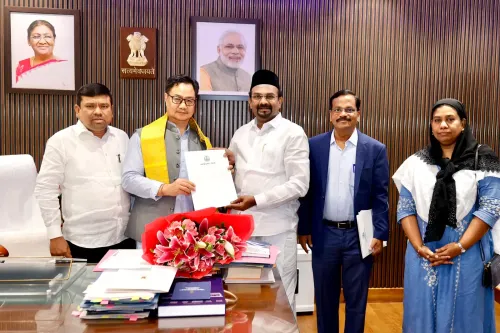
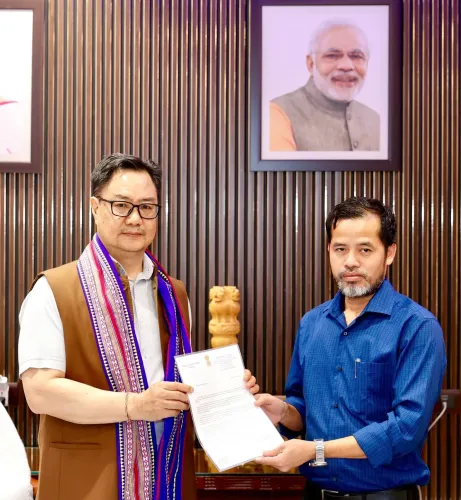
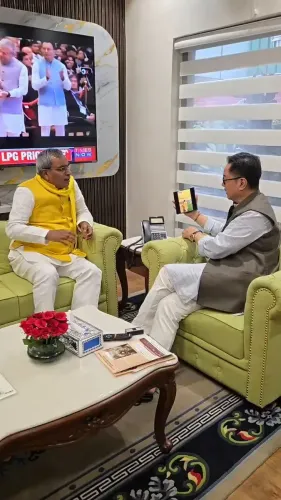
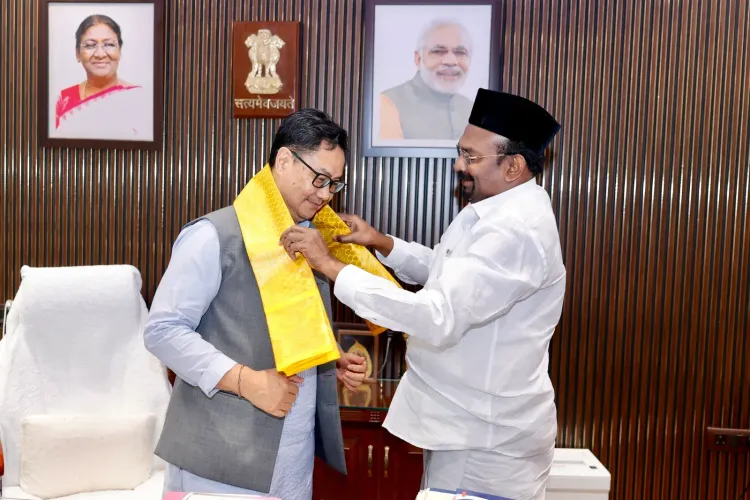
Union Minister Kiren Rijiju met Tamil Nadu Minorities Welfare Minister A. M. Shahjahan, Lok Sabha MP K. Navaskani, and two IAS officers at his New Delhi residence on September 24, 2026, exchanging views on minority welfare and empowerment in a Centre-state coordination meeting.
Key Takeaways
Union Minister Kiren Rijiju hosted Tamil Nadu's Minorities Welfare Minister A.
Shahjahan at his New Delhi residence on September 24, 2026 .
The delegation also included Lok Sabha MP K.
Navaskani , IAS Secretary V.
Dakshinamoorthy , and IAS Commissioner M.
Discussions centred on the welfare and empowerment of minority communities at both central and state levels.
The Ministry of Minority Affairs , set up in 2006 , is the nodal Union body coordinating programmes for India's six notified minority communities.
No specific scheme outcomes or joint statements were announced following the interaction.
Union Minister of Minority Affairs Kiren Rijiju held a meeting at his New Delhi residence on Thursday, September 24, 2026, with a high-level Tamil Nadu delegation led by A. M. Shahjahan, Minister for Minorities Welfare in the state government — a face-to-face exchange that signals active Centre-state coordination on minority empowerment ahead of what both governments frame as a critical implementation phase.
Who came to the table at Rijiju's Delhi home
The Tamil Nadu delegation was notably broad. Joining Minister Shahjahan were K. Navaskani, Member of Parliament from Lok Sabha; V. Dakshinamoorthy, IAS, Secretary of the Minorities Welfare Department; and M. Asia Marim, IAS, Commissioner for Minority Welfare. The presence of two senior civil servants alongside a cabinet minister and an MP gave the interaction an official, working character beyond a courtesy call.
Rijiju described the exchange as 'warm' and said the two sides discussed 'matters related to the welfare and empowerment of minority communities.' No specific scheme outcomes were announced.
Centre-state axis on minority welfare
The Ministry of Minority Affairs, established in 2006, serves as the nodal body coordinating welfare programmes across India's six notified minority communities — Muslims, Christians, Sikhs, Buddhists, Zoroastrians, and Jains. Tamil Nadu, with one of the country's largest minority populations, is a key state in the Ministry's implementation matrix.
Meetings of this kind between the Union Minister and state counterparts are the standard mechanism through which central schemes get aligned with state delivery pipelines. With Tamil Nadu running its own Minorities Welfare Department in parallel to central programmes, the interface between New Delhi and Chennai carries real stakes for communities on the ground.
Navaskani's role and the parliamentary dimension
The inclusion of K. Navaskani, a sitting Lok Sabha MP from Tamil Nadu, adds a legislative layer to what might otherwise be a purely executive interaction. MPs routinely flag constituency-level gaps in scheme implementation; Navaskani's presence suggests the discussion may have covered on-the-ground delivery concerns that have surfaced in Parliament.
Both the Centre and Tamil Nadu have political incentives to demonstrate responsiveness to minority communities — making follow-up coordination on joint programmes the number to watch from here.
Point of View
Where scheme delivery ultimately depends on state machinery. With Tamil Nadu governed by the DMK — a party in the Opposition bloc — a cordial working session between a BJP Union Minister and a state cabinet minister on minority welfare carries an implicit message of institutional continuity over political rivalry. The participation of senior IAS officers alongside elected representatives signals this was a substantive policy-level exchange, not a photo-op. Observers will watch whether it yields any coordinated push on central flagship schemes for minority communities in Tamil Nadu.
NationPress
25 Sept 2026
Frequently Asked Questions
Why did Tamil Nadu's Minorities Minister meet Kiren Rijiju in Delhi?
Tamil Nadu Minorities Welfare Minister A. M. Shahjahan visited Union Minister Kiren Rijiju in New Delhi on September 24, 2026, to exchange views on the welfare and empowerment of minority communities, a routine but important Centre-state coordination exercise.
Who is Kiren Rijiju?
Kiren Rijiju is a senior BJP leader from Arunachal Pradesh who serves as the Union Minister of Minority Affairs and Minister of Parliamentary Affairs in the Government of India.
Who is A. M. Shahjahan?
A. M. Shahjahan is the cabinet minister heading the Minorities Welfare Department in the Government of Tamil Nadu.
What does India's Ministry of Minority Affairs do?
Established in 2006, the Ministry of Minority Affairs is the nodal Union government body that formulates and coordinates welfare and empowerment programmes for India's six officially notified minority communities — Muslims, Christians, Sikhs, Buddhists, Zoroastrians, and Jains.
What was the outcome of the Rijiju-Tamil Nadu meeting on minority welfare?
No specific scheme outcomes or joint statements were announced; both sides described the interaction as a warm exchange of views on minority welfare and empowerment matters.