RRU, CAPSI sign MoU to launch 'Bharat Gold Standard' for private security
Synopsis
India's private security sector — employing an estimated 10 million people — is set for a structural overhaul. RRU and CAPSI have signed an MoU to build the 'Bharat Gold Standard', an indigenous certification framework integrating AI, drones, OSINT and scenario-based training. The move marks India's first serious attempt to professionalise a workforce larger than several national armies.
Key Takeaways
RRU and CAPSI signed an MoU on 25 September 2026 in Gandhinagar to develop the 'Bharat Gold Standard' for private security.
The framework covers training, assessment, certification and continuing professional development for India's estimated 10 million private security personnel.
RRU's Advanced Security Skills Training Centre will serve as the institutional platform, offering simulation, drone training, OSINT labs and K9 exposure.
The initiative aligns with Union Home Minister Amit Shah's vision for a trained, technology-enabled private security sector.
The professional pathway will allow personnel to progress from entry-level guarding to managerial, consulting and entrepreneurial roles.
The framework is designed to evolve with changes in technology, security threats and operating environments.
Rashtriya Raksha University (RRU) and the Central Association of Private Security Industry (CAPSI) signed a Memorandum of Understanding (MoU) on 25 September 2026 at the RRU campus in Gandhinagar to develop an indigenous training, assessment and professional certification framework for India's private security workforce. The proposed 'Bharat Gold Standard' is designed to align personnel skills with India's regulatory, operational and technological requirements across a sector that CAPSI estimates employs around 10 million people nationwide.
The Partnership and What It Covers
The MoU combines RRU's academic, research, simulation and assessment capabilities with CAPSI's industry network and understanding of ground-level operational needs. The initiative is anchored at RRU's Advanced Security Skills Training Centre, which will serve as the institutional platform for curriculum design, delivery and certification.
The framework targets a wide range of learners: young entrants to the sector, serving security personnel seeking career advancement, veterans and former police personnel transitioning to civilian roles, agency owners and managers, and professionals in risk, compliance and facility management.
Training Architecture and Technology Focus
The training ecosystem is designed to integrate classroom instruction with simulation, scenario-based learning, laboratory exposure and physical preparedness. Infrastructure includes driving and firing simulators, OSINT and technology laboratories, drone training facilities, K9 exposure, maritime-security modules, a dedicated Private Security Lab, moot-court exposure and human-performance infrastructure.
Notably, the framework places technology literacy at par with traditional security skills. With private security increasingly involving CCTV analytics, electronic access control, alarm systems, drones, digital communications and AI-enabled platforms, trained personnel would be equipped in prevention, detection, reporting, escalation and first response.
Professional Progression Pathway
The proposed professional pathway would link deployment directly with skills assessment, certification, specialisation and career mobility. Personnel could progress from entry-level guarding and site duties to supervisory and specialised roles — including K9, drones and OSINT — and ultimately to managerial, consulting and entrepreneurial positions. The initiative also envisages training of trainers, executive education and continuing professional development to extend competencies across private security organisations.
Policy Vision and Key Figures
The initiative aligns with Union Home Minister Amit Shah's stated vision for a trained, technology-enabled private security sector capable of serving as an effective first line of response and complementing public security institutions.
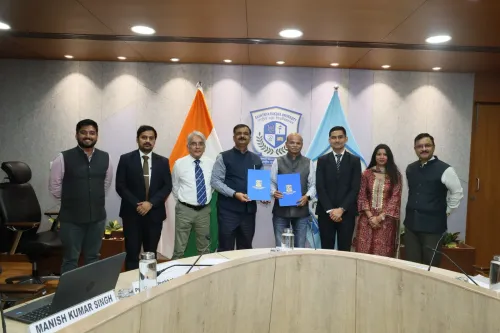
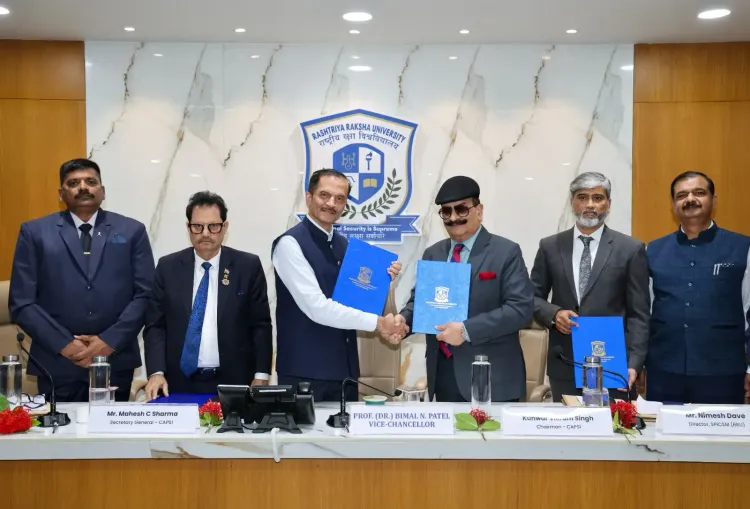
At the signing ceremony, Vice Chancellor Prof Bimal Patel engaged with the CAPSI delegation on the broader direction of professionalising private security in India. RRU was represented by Nimesh Dave, Director of SICSM, and Lt Col B. S. Rao, Coordinator. The CAPSI delegation was led by Chairman Kunwar Vikram Singh and included Secretary General Mahesh Sharma, National Vice President Anil Puri, President V. V. Katti, and other senior officials from across the association.
Scale of the Sector and What Comes Next
CAPSI's estimate of 10 million private security personnel — deployed across industrial facilities, financial institutions, corporate establishments, hospitals, educational campuses, residential communities and logistics networks — underscores the scale of the challenge. The 'Bharat Gold Standard' is envisaged as a living framework, intended to evolve with shifts in technology, security threats and operating environments. The initiative positions India to establish its own professional certification ecosystem rather than adapt foreign models.
Point of View
But the real test is implementation — whether the 'Bharat Gold Standard' produces verifiable, industry-recognised credentials or becomes another well-intentioned framework that stalls at the pilot stage. The technology integration component — AI platforms, drones, OSINT — is forward-looking, but it will be irrelevant if basic guarding standards remain unverified at scale. The Home Ministry's backing gives the initiative political weight; what it still needs is a mandatory regulatory peg, without which adoption by private agencies will remain voluntary and uneven.
NationPress
25 Sept 2026
Frequently Asked Questions
What is the 'Bharat Gold Standard' for private security?
The 'Bharat Gold Standard' is a proposed indigenous professional framework covering training, assessment, certification and continuing development for private security personnel in India. Developed jointly by RRU and CAPSI, it is designed to align skills with India's regulatory, operational and technological requirements and will be anchored at RRU's Advanced Security Skills Training Centre in Gandhinagar.
Why have RRU and CAPSI signed this MoU?
The MoU aims to professionalise India's private security sector, which employs an estimated 10 million personnel but currently lacks a standardised national certification framework. The partnership brings together RRU's academic and simulation capabilities with CAPSI's industry network to establish common professional standards linking training, assessment and career progression.
Who are the key figures involved in the RRU-CAPSI partnership?
The signing ceremony was attended by RRU Vice Chancellor Prof Bimal Patel, Director of SICSM Nimesh Dave, and Lt Col B. S. Rao from the university side. CAPSI was represented by Chairman Kunwar Vikram Singh, Secretary General Mahesh Sharma, President V. V. Katti, and other senior national and Gujarat chapter officials.
What technologies will be included in the new private security training framework?
The framework integrates CCTV analytics, electronic access control, alarm systems, drone operation, digital communications and AI-enabled security platforms alongside traditional skills. Training infrastructure includes driving and firing simulators, OSINT laboratories, K9 and maritime-security modules, and a dedicated Private Security Lab.
Who is eligible for training under the Bharat Gold Standard framework?
The framework targets young entrants to the security sector, serving personnel seeking career advancement, veterans and former police transitioning to civilian roles, agency owners and managers, and professionals in risk, compliance and facility management. It also includes a training-of-trainers component and executive education track.