Shiv Sena (UBT) slams BJP over Wangchuk crackdown, Speaker's split nod
Synopsis
Shiv Sena (UBT)'s Saamana editorial pulls no punches — accusing the BJP-led Centre of orchestrating a midnight police crackdown on hunger-striking activist Sonam Wangchuk and engineering unconstitutional party splits with the Speaker's blessing. The party is now calling for the Modi government's alleged democratic violations to be placed before the international community.
Key Takeaways
Shiv Sena (UBT) accused the BJP -led Centre of an 'assault on Indian democracy' in a Monday editorial in Saamana .
Delhi Police allegedly removed activist Sonam Wangchuk from Jantar Mantar on the 20th day of his hunger strike over the NEET paper leak ; he reportedly continued protesting from the ICU .
The Lok Sabha Speaker recognised rebel factions from Shiv Sena and TMC , which the party alleged violates the 10th Schedule of the Constitution.
The editorial alleged six Shiv Sena MPs were 'bought for ₹50 crore each ' by the Eknath Shinde faction before a Speaker-approved merger.
Shiv Sena (UBT) called for the government's alleged constitutional violations to be raised on the global stage .
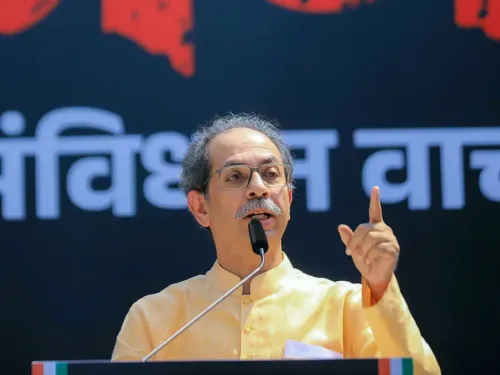
Shiv Sena (Uddhav Balasaheb Thackeray) on Monday launched a sharp attack on the BJP-led government at the Centre, accusing it of mounting a systematic assault on Indian democracy, constitutional freedoms, and opposition voices. The salvo came through an editorial in the party's mouthpiece Saamana, zeroing in on two developments over the preceding 48 hours: the early-morning police action against climate activist Sonam Wangchuk at Jantar Mantar in New Delhi, and the Lok Sabha Speaker's recognition of rebel factions from both Shiv Sena and the All India Trinamool Congress (TMC).
The Wangchuk Crackdown
According to the Saamana editorial, Delhi Police forcibly removed Sonam Wangchuk from Jantar Mantar in the early hours of the morning, on the 20th day of his hunger strike. Wangchuk had been demanding the resignation of Union Education Minister Dharmendra Pradhan over the NEET paper leak controversy.
The editorial described the police action as a 'cowardly night operation', alleging that armed personnel entered the protest site after midnight 'like thieves to drag away an exhausted activist who was unable to resist'. The party drew comparisons between the crackdown and an anti-terrorist combing operation, arguing it exposed the government's anxiety over growing public sympathy for Wangchuk's cause.
Despite being subsequently admitted to hospital, Wangchuk reportedly continued his protest from the intensive care unit (ICU). The editorial cited a handwritten message attributed to him: 'This is the Second Freedom Movement. A Fear-Free India, an Injustice-Free India!' The party warned that suppression would only accelerate the spread of his movement nationwide.
Speaker's Recognition of Rebel Factions
The Thackeray camp alleged that, under cover of darkness, the Lok Sabha Speaker recognised breakaway factions from both Shiv Sena and TMC — a move the editorial characterised as a direct violation of the 10th Schedule of the Indian Constitution, which, it argued, does not permit recognition of party splits.
The editorial further alleged that six Members of Parliament elected on the Shiv Sena's 'Flaming Torch' (Mashal) symbol were 'bought for ₹50 crore each by the Eknath Shinde faction' before seeking a merger, which was subsequently approved by the Speaker. The party termed this a direct assault on parliamentary integrity and constitutional norms.
Broader Allegations Against the Modi Government
The Uddhav Thackeray-led party claimed that the Modi government survives entirely on 'falsehoods, repression, and gunpoint threats'. Linking the issue to the NEET exam controversy, the editorial alleged that electoral malpractices had been used to secure the ruling dispensation's return to power.
'Under the 10th Schedule of the Constitution, no form of party splitting is recognised. Still, BJP engineers splits in parties daily to build new outfits, and the Speaker continues to legitimise these traitorous groups,' the editorial stated. It called for the Modi government's alleged constitutional violations to be 'exposed on the global stage'.
The editorial also argued that the actions against Shiv Sena, TMC, and the Aam Aadmi Party (AAP) reflected a concerted effort to suppress opposition voices through authority and intimidation.
What Comes Next
The Shiv Sena (UBT)'s editorial call to internationalise the issue signals an escalation in opposition rhetoric ahead of upcoming political contests. Wangchuk's condition and the trajectory of the NEET controversy will likely keep pressure on the government in the days ahead. The 10th Schedule dispute over the Speaker's recognition orders may also face fresh legal scrutiny.
Point of View
Shiv Sena (UBT) is attempting to build a single narrative of authoritarian overreach that can travel beyond Maharashtra. The call to internationalise the issue is a notable escalation, though its practical impact remains to be seen. What is harder to dismiss is the constitutional question: if the Speaker's recognition of rebel factions does conflict with the 10th Schedule, as the Thackeray camp alleges, it is a question courts — not editorials — will ultimately have to answer. The ₹50 crore-per-MP allegation, meanwhile, is serious and unverified; its repetition without independent corroboration risks undermining the editorial's more substantive constitutional arguments.
NationPress
20 Oct 2026
Frequently Asked Questions
What did Shiv Sena (UBT)'s Saamana editorial accuse the BJP government of?
The Saamana editorial accused the BJP-led Centre of committing a systematic assault on Indian democracy, constitutional freedoms, and opposition parties. It specifically cited the police removal of activist Sonam Wangchuk from Jantar Mantar and the Lok Sabha Speaker's recognition of rebel factions from Shiv Sena and TMC as key examples.
Why was Sonam Wangchuk on a hunger strike at Jantar Mantar?
Sonam Wangchuk was on a hunger strike demanding the resignation of Union Education Minister Dharmendra Pradhan over the NEET paper leak controversy. According to the Saamana editorial, he was on the 20th day of his fast when Delhi Police allegedly removed him from the protest site after midnight.
What is the 10th Schedule dispute raised by Shiv Sena (UBT)?
The 10th Schedule of the Indian Constitution governs anti-defection provisions. Shiv Sena (UBT) alleged that the Lok Sabha Speaker's recognition of breakaway factions from Shiv Sena and TMC violates this Schedule, which the party argues does not permit recognition of party splits.
What allegation did Saamana make about Shiv Sena MPs joining the Shinde faction?
The editorial alleged that six MPs elected on Shiv Sena's 'Flaming Torch' symbol were 'bought for ₹50 crore each' by the Eknath Shinde faction before seeking a merger, which was subsequently approved by the Lok Sabha Speaker. This allegation has not been independently verified.
What action did Shiv Sena (UBT) call for in its editorial?
The party called for the Modi government's alleged violations of democracy and the Constitution to be raised before the international community. The editorial also warned that suppression of Sonam Wangchuk's movement would only accelerate its spread across India.