Assam-Manipur Vaishnavite ties: CM Himanta Sarma highlights Sankardev's legacy
Synopsis
At Sankardev's birthplace in Nagaon, Assam CM Himanta Biswa Sarma used the simultaneous sound of Assam's Khol and Manipur's Pung to make a pointed argument: the two states share not just a border but a civilisational root stretching back five centuries to a saint-reformer's Bhakti revolution.
Key Takeaways
Assam CM Himanta Biswa Sarma posted a video on X on 19 May from Sri Sri Batadrava Than , Nagaon, highlighting Assam-Manipur cultural ties.
He cited the shared Vaishnavite tradition rooted in the legacy of Mahapurush Srimanta Sankardev , the 15th–16th century saint-reformer.
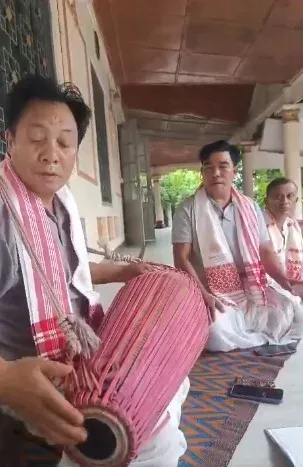
Assam's Khol and Manipur's Pung — both central to Vaishnav ritual — were performed together at the historic site.
Historians note Vaishnavism took deep root in Manipur during the 18th century under Meitei royal patronage, shaped in part by Assam's Satra culture.
The cultural and religious exchanges between the two states have continued through festivals, music, dance, and shared religious institutions.
Assam Chief Minister Himanta Biswa Sarma on Tuesday, 19 May underscored the centuries-old cultural and spiritual bonds between Assam and Manipur, asserting that the Vaishnavite traditions shared by both northeastern states continue to reinforce the region's civilisational unity. Sarma made the remarks while posting a video on X from Sri Sri Batadrava Than in Nagaon district, the birthplace of medieval saint-reformer Mahapurush Srimanta Sankardev.
What Sarma Said
Writing in Hindi, the Chief Minister stated: 'Assam and Manipur are deeply connected through Vaishnav traditions. At Sri Sri Batadrava Than, the birthplace of Mahapurush Srimanta Sankardev, the melodies of Assam's Khol and Manipur's Pung once again revived the cultural unity of the Northeast.' The post was accompanied by a video of devotional performances and traditional percussion from both states at the historic site.
The Sankardev Legacy
The cultural kinship between the two states traces back several centuries to the neo-Vaishnavism pioneered by Srimanta Sankardev during the 15th and 16th centuries. His reformist Bhakti movement — centred on devotion to Lord Krishna, social harmony, and spiritual inclusiveness — radiated across large parts of the Northeast, including Manipur. Historians note that Vaishnavism became deeply embedded in Manipuri society during the 18th century under the patronage of the then Meitei kings, with Assam's Satra culture, devotional music, and performing arts gradually shaping Manipur's own religious traditions.
The Khol and the Pung
At the heart of this shared heritage are two traditional percussion instruments. Assam's Khol — a terracotta drum central to Sattriya devotional practice — and Manipur's Pung — integral to Manipuri classical dance and Vaishnav ritual — represent parallel musical lineages rooted in the same spiritual soil. Their simultaneous performance at Batadrava Than was, in Sarma's framing, a living symbol of northeastern unity.
Broader Significance
The event comes amid ongoing cultural diplomacy between the two states, which have maintained close religious and artistic ties through festivals, devotional music, dance traditions, and shared religious institutions. Notably, Sarma's outreach at one of Assam's most sacred Vaishnavite sites carries political resonance at a time when the Northeast's civilisational identity is a recurring theme in public discourse. The Chief Minister's choice of Sri Sri Batadrava Than — a site of pan-northeastern reverence — as the setting for this message amplifies its symbolic weight beyond a routine cultural observation.
Cultural exchanges between Assam and Manipur are expected to continue deepening through institutional partnerships and joint festivals rooted in their Vaishnavite heritage.
Point of View
One of Assam's most politically and spiritually charged sites, frames northeastern identity through a Hindu Vaishnavite lens at a moment when Manipur's social fabric remains under strain. The choice to speak in Hindi, rather than Assamese or Meitei, signals a message aimed at a national audience as much as a regional one. Whether this cultural outreach translates into concrete inter-state cooperation — or remains symbolic — will depend on whether it is followed by institutional action beyond social media posts.
NationPress
16 Sept 2026
Frequently Asked Questions
What did Assam CM Himanta Biswa Sarma say about Assam and Manipur's cultural ties?
CM Sarma stated that Assam and Manipur are deeply connected through Vaishnav traditions, citing the shared legacy of Mahapurush Srimanta Sankardev. He made the remarks in a post on X from Sri Sri Batadrava Than in Nagaon, accompanied by a video of devotional performances featuring both states' traditional percussion instruments.
What is Sri Sri Batadrava Than and why is it significant?
Sri Sri Batadrava Than in Nagaon district, Assam, is the birthplace of medieval saint-reformer Mahapurush Srimanta Sankardev, the founder of neo-Vaishnavism in Assam. It is one of the most revered Vaishnavite sites in the Northeast and a symbol of the region's shared spiritual heritage.
How are the Khol and Pung instruments connected to Vaishnavite traditions?
The Khol is a terracotta percussion instrument central to Assam's Sattriya devotional tradition, while the Pung is an essential part of Manipuri classical dance and Vaishnav ritual. Both instruments are rooted in the Bhakti traditions spread by Sankardev and represent the parallel but connected musical lineages of the two states.
When did Vaishnavism take root in Manipur?
According to historians, Vaishnavism became deeply embedded in Manipuri society during the 18th century under the patronage of the then Meitei kings. Assam's Satra culture, devotional music, and performing arts gradually shaped Manipur's religious and cultural traditions over subsequent generations.
Why is CM Sarma's cultural outreach at Batadrava Than significant now?
The outreach comes at a time when northeastern civilisational identity is a prominent theme in public discourse, and when Manipur has faced social tensions. Sarma's choice of one of Assam's most sacred Vaishnavite sites as the setting underscores the symbolic weight of the message and its potential role in inter-state cultural diplomacy.