Goa CM Sawant Marks World Bicycle Day, Backs Fit India Push

Synopsis
Goa Chief Minister Pramod Sawant marked World Bicycle Day on June 3, 2026, calling cycling a healthy, sustainable and eco-friendly way of life. He urged citizens, especially the youth, to adopt cycling in line with the Fit India Movement launched by the Centre in 2019.
Key Takeaways
Goa CM Pramod Sawant posted a World Bicycle Day message on June 3, 2026.
He framed cycling as healthy, sustainable and eco-friendly.
The appeal was explicitly linked to the Fit India Movement launched in August 2019.
Youth were singled out as the primary target audience.
World Bicycle Day was proclaimed by the UN General Assembly in 2018.
The message reinforces Goa's alignment with central wellness and sustainability themes.
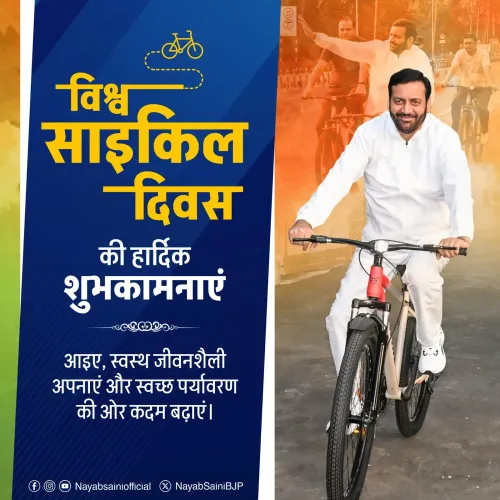
Goa Chief Minister Pramod Sawant on 3 June 2026 marked World Bicycle Day with a public appeal urging citizens, particularly the youth, to embrace cycling as a healthy and eco-friendly way of life. In his message, posted on X, the chief minister tied the observance to the central government's Fit India Movement, framing cycling as both a personal health choice and a sustainability statement.
'On World Bicycle Day, let us celebrate cycling as a healthy, sustainable, and eco-friendly way of life,' Sawant wrote. 'Aligned with the vision of the Fit India Movement, let us encourage people, especially the youth, to adopt cycling as a step towards a healthier lifestyle.'
Context
World Bicycle Day is observed every year on June 3, following a 2018 resolution by the United Nations General Assembly recognising the bicycle as a simple, affordable, reliable and environmentally fit means of transport. The day has become a fixture for political leaders globally to message on public health, urban mobility and climate goals.
Sawant, who has led Goa since 2019, has frequently woven national wellness and sustainability themes into his public communications, in line with the messaging discipline of the Bharatiya Janata Party.
Policy backdrop
The Fit India Movement was launched by Prime Minister Narendra Modi in August 2019 as a nationwide campaign to encourage physical activity and active lifestyles across age groups. The movement has since spawned school-level fitness challenges, plogging drives and cycling rallies, and is routinely invoked by state leaders on health-themed occasions.
Cycling sits at the intersection of two policy strands the Centre has pushed in tandem: preventive health and low-carbon mobility. India's broader commitments under sustainable development frameworks have encouraged states to promote non-motorised transport, especially in tourism-heavy regions.
Stakeholders and impact
The appeal is directed primarily at Indian youth and urban residents, the two constituencies most often targeted by Fit India messaging. For a coastal state like Goa, where tourism is the dominant economic driver, cycling also carries an industry dimension, with rental cycles and guided cycle tours forming part of the state's wellness and eco-tourism offering.
Public health practitioners have long argued that regular cycling can reduce the burden of non-communicable diseases such as diabetes and cardiovascular illness, both of which are rising concerns in urban India. Environmental groups, meanwhile, view a modal shift towards cycling as a practical lever to cut tailpipe emissions in congested town centres.
What's next
Sawant's message stops short of announcing any new state scheme, but it signals continued alignment between Goa's wellness and tourism messaging and the Centre's flagship fitness programme. Watchers will look for any rollout of dedicated cycling infrastructure, public bike-sharing pilots or Fit India-linked events in Goa in the months ahead.
As Indian cities grapple with congestion and air quality, sub-national endorsements of cycling, even symbolic ones, contribute to shaping the public conversation around everyday mobility choices.
Point of View
In this case the Fit India Movement. By anchoring cycling to both health and sustainability, he taps a dual narrative the BJP has cultivated since 2019, linking lifestyle choices to national mission branding. For a tourism-dependent state like Goa, the framing also doubles as soft promotion of eco-tourism. The real test, however, will be whether such messaging translates into concrete cycling infrastructure on the ground.
NationPress
17 Oct 2026
Frequently Asked Questions
When is World Bicycle Day observed?
World Bicycle Day is observed every year on June 3. It was proclaimed by the United Nations General Assembly in 2018 to recognise cycling as an affordable, reliable and sustainable mode of transport.
What did Goa CM Pramod Sawant say on World Bicycle Day 2026?
Pramod Sawant urged citizens, especially the youth, to adopt cycling as a healthy, sustainable and eco-friendly way of life. He linked the appeal to the vision of the Fit India Movement.
What is the Fit India Movement?
The Fit India Movement is a national initiative launched by Prime Minister Narendra Modi in August 2019. It aims to encourage Indians of all ages to incorporate physical activity into their daily lives.
Why is cycling being promoted in India?
Cycling is being promoted as a low-cost, low-emission mode of transport that also delivers health benefits. Governments view it as a tool to cut urban pollution and reduce the burden of lifestyle diseases.
Has Goa announced any new cycling scheme?
Sawant's World Bicycle Day message did not announce any specific new scheme. It was a public appeal aligned with the Centre's Fit India Movement rather than a policy launch.