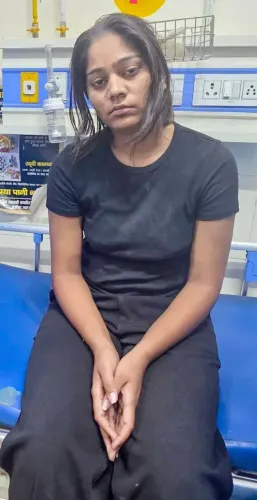
SC notices Meghalaya govt plea on Sonam Raghuvanshi bail in honeymoon murder case
Synopsis
The Supreme Court has flagged 'prima facie reservations' about the Meghalaya High Court's decision to uphold bail for Sonam Raghuvanshi — the woman accused of conspiring to murder her husband Raja Raghuvanshi during their honeymoon near Weisawdong Falls. With 90-plus witnesses still to be examined and the state calling the HC ruling a 'wrong precedent', the case tests how courts balance procedural arrest errors against the gravity of a murder charge.
Key Takeaways
The Supreme Court issued notice on 4 July 2025 on the Meghalaya government's plea challenging bail granted to Sonam Raghuvanshi in the Raja Raghuvanshi honeymoon murder case .
The apex court declined to stay the bail order, as Sonam had already been released from custody.
The Bench of Justice M.M.
Sundresh and Justice Sheel Nagu expressed prima facie reservations about the High Court's reasoning and listed the matter for Thursday.
Solicitor General Tushar Mehta argued that the HC judgment sets a 'wrong precedent' and that more than 90 prosecution witnesses are yet to be examined.
Bail was originally granted after courts found all arrest documents cited Section 403(1) BNS (wrongly) instead of Section 103(1) , the murder provision.
Raja Raghuvanshi's body was recovered from a gorge near Weisawdong Falls, Meghalaya , after his honeymoon trip in May 2025 .
The Supreme Court on Friday, 4 July 2025, issued notice on a petition filed by the Meghalaya government challenging the Meghalaya High Court's order that upheld bail granted to Sonam Raghuvanshi, the prime accused in the Raja Raghuvanshi honeymoon murder case. The apex court, however, declined to stay the bail order, noting that Sonam had already been released from custody.
A Bench of Justice M.M. Sundresh and Justice Sheel Nagu directed Sonam Raghuvanshi to file a counter-affidavit and listed the matter for further hearing the following Thursday.
What the Supreme Court Observed
The Bench expressed reservations about the High Court's reasoning, even as it stopped short of reversing the bail. Justice Sundresh, speaking for the Bench, said: 'We have a reservation, prima facie, about the High Court order. We will see how the trial proceeds. The fact remains that she was informed about the grounds. In the earlier bail pleas, she did not raise this issue.'
The court's reluctance to stay the order was explicitly tied to the fact that the accused had already walked free — a practical reality that made an immediate stay largely moot.
Meghalaya Government's Arguments
Solicitor General Tushar Mehta, appearing for the Meghalaya government, argued that the courts below had failed to consider relevant material and that the grounds of arrest had, in fact, been communicated to the accused. He told the apex court that the trial was already underway and that more than 90 prosecution witnesses were yet to be examined. He further contended that the High Court judgment set a 'wrong precedent' on the question of procedural lapses in arrest documentation.
Why Bail Was Granted: The Procedural Lapse
The bail chain began with an April 2026 order by the Additional Deputy Commissioner (Judicial), Shillong, which found serious procedural errors in Sonam's arrest. Specifically, all arrest-related documents — including the arrest memo, checklist for justification of arrest, inspection memo, intimation of rights, and extracts of the case diary — incorrectly cited Section 403(1) of the Bharatiya Nyaya Sanhita (BNS) instead of Section 103(1), which is the provision dealing with murder.
The trial court held that this was not a mere typographical error, given that the same mistake appeared consistently across every arrest document. It concluded that Sonam was never formally informed that she had been arrested for murder, thereby prejudicing her defence.
On 29 June 2025, a single-judge Bench of Justice W. Diengdoh of the Meghalaya High Court upheld this reasoning, refusing to interfere with the bail order and dismissing the state government's appeal. The state had argued before the High Court that the procedural lapse caused no actual prejudice and cited a Supreme Court precedent holding such irregularities to be curable defects — an argument the High Court rejected.
The Underlying Case
Raja Raghuvanshi, an Indore-based businessman, travelled to Meghalaya with his wife Sonam shortly after their marriage in May 2025 for their honeymoon. His body was subsequently recovered from a gorge near Weisawdong Falls. According to the Meghalaya Police, Sonam allegedly conspired with her alleged lover and hired assailants to kill her husband during the trip. A chargesheet has been filed and the trial is currently underway.
What Happens Next
The Supreme Court will take up the matter for substantive hearing next Thursday. The Bench's observation that it holds 'prima facie reservations' about the High Court order signals that the state's challenge will receive close scrutiny, even if the bail itself remains operative for now. The outcome could have implications for how courts weigh procedural lapses in arrest documentation against the state's right to prosecute serious offences.
Point of View
Yet the consistent repetition of the wrong BNS section across every arrest document gave the lower courts room to find otherwise. With over 90 witnesses still to be examined, a prolonged bail period carries real risks for trial integrity. The case may ultimately force the Supreme Court to sharpen the line between technical non-compliance and genuine prejudice to the accused — a distinction that has been inconsistently applied across jurisdictions.
NationPress
2 Oct 2026
Frequently Asked Questions
What is the Raja Raghuvanshi honeymoon murder case?
The case involves the death of Raja Raghuvanshi , an Indore-based businessman whose body was recovered from a gorge near Weisawdong Falls in Meghalaya during his honeymoon in May 2025 . The Meghalaya Police allege that his wife, Sonam Raghuvanshi , conspired with her alleged lover and hired assailants to kill him. A chargesheet has been filed and trial is underway.
Why was Sonam Raghuvanshi granted bail?
Bail was granted after the Additional Deputy Commissioner (Judicial), Shillong found that all arrest documents — including the arrest memo and case diary extracts — incorrectly cited Section 403(1) BNS instead of Section 103(1) , the murder provision. The court held this was not a typographical error and that Sonam was never formally told she was arrested for murder.
What did the Supreme Court say about the bail order?
The Supreme Court expressed 'prima facie reservations' about the Meghalaya High Court's decision upholding the bail, but declined to stay it since Sonam had already been released. The Bench issued notice and directed her to file a counter-affidavit, listing the matter for further hearing the following Thursday.
What is the Meghalaya government's argument against the bail?
Solicitor General Tushar Mehta , appearing for the state, argued that the procedural lapse in arrest documents caused no actual prejudice to the accused and that the High Court ruling sets a 'wrong precedent'. He also noted that more than 90 prosecution witnesses are yet to be examined, raising concerns about the accused being free during an ongoing trial.
What happens next in the Sonam Raghuvanshi case?
The Supreme Court will hear the matter substantively on the following Thursday. The Bench's observation about prima facie reservations suggests the state's challenge will be closely examined, though the bail remains operative in the interim. The outcome could clarify how courts treat procedural arrest errors in serious criminal cases.