Amit Shah: Border trade up 16x in 12 years, 11 new land ports coming
Synopsis
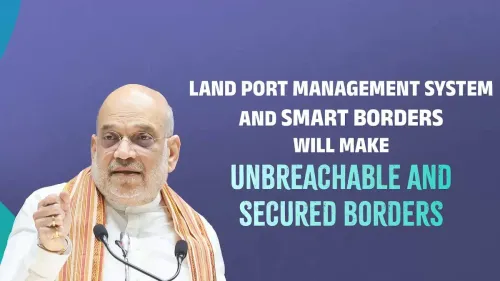
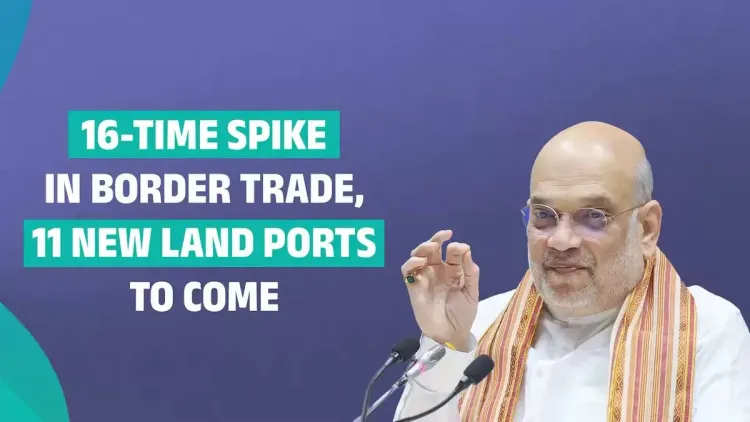
Union Home Minister Amit Shah on June 9, 2026 announced a 16-fold rise in border trade through land ports over 12 years and said 11 new land ports will be operational within three years, signalling continued expansion of India's cross-border trade infrastructure under the Land Ports Authority of India.
Key Takeaways
Union Home Minister Amit Shah stated on June 9, 2026 that border trade through land ports has grown 16 times over the last 12 years .
11 new land ports are to become operational within the next three years .
The Land Ports Authority of India (LPAI) , constituted in 2012 , manages integrated check posts and land ports under the Ministry of Home Affairs.
Key operational ICPs include Attari (2012) and Agartala (2016) , part of a network spanning borders with Bangladesh, Nepal, Bhutan, Myanmar, and Pakistan .
The expansion aligns with India's Neighbourhood First and Act East policy orientations.
Specific locations and timelines for the 11 new ports are yet to be officially notified by the LPAI.
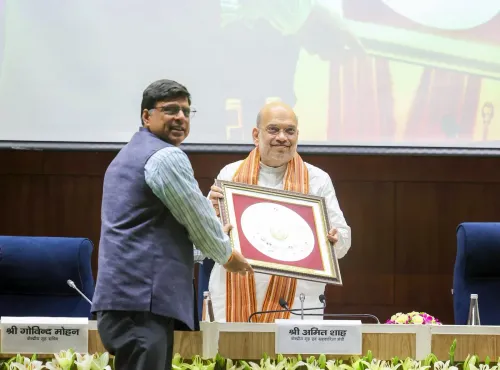
Union Home Minister Amit Shah on Tuesday, June 9, 2026 stated that border trade through land ports has grown 16 times over the last 12 years, and announced that 11 new land ports will become operational in the next three years.
Context
Shah's post, shared on X, declared: 'In the last 12 years border trade through land ports has increased by 16 times. In the next 3 years 11 new land ports will be functional.' The statement comes as the government continues to highlight infrastructure expansion at India's land borders as a cornerstone of its neighbourhood engagement and trade facilitation agenda.
Land ports serve as the primary gateways for overland trade with Bangladesh, Nepal, Bhutan, Myanmar, and Pakistan. As the minister in charge of the Ministry of Home Affairs, Shah oversees the Land Ports Authority of India (LPAI), the statutory body responsible for developing and managing these facilities.
Policy Backdrop
The Land Ports Authority of India was constituted in 2012 to replace ageing land customs stations with modern, multi-agency Integrated Check Posts (ICPs). Early milestones included the commissioning of Attari ICP in 2012 and Agartala ICP in 2016, which consolidated customs, immigration, and security functions at single facilities.
The broader programme aligns with two strategic orientations — Neighbourhood First, which prioritises relations with South Asian neighbours, and Act East, which deepens connectivity with Southeast Asia through India's northeastern corridor. Complementary investments in new bridges, roads, and electronic cargo-tracking systems have accompanied the ICP rollout along multiple border stretches.
Successive central governments have pursued physical and procedural upgrades at land borders to reduce transaction costs and formalise trade flows that had historically moved through informal channels. The 16-fold growth figure cited by Shah, if borne out by official trade data, would represent one of the more striking outcomes of this sustained infrastructure push.
Stakeholders and Impact
The primary beneficiaries of expanded land-port capacity are border traders, small exporters, and farming communities in frontier districts whose livelihoods depend on cross-border commerce. Cheaper and faster clearance at modern ICPs directly lowers logistics costs and makes Indian goods more competitive in neighbouring markets.
For neighbouring countries — particularly Nepal and Bangladesh, which rely heavily on Indian land routes for both imports and transit — additional land ports ease supply-chain bottlenecks and reduce dependence on a small number of congested crossing points. State governments in West Bengal, Assam, Meghalaya, Mizoram, and Uttar Pradesh also stand to gain through increased economic activity in border districts.
What's Next
Attention will now turn to the specific locations and operationalisation timelines of the 11 new land ports announced by Shah. Official notifications from the LPAI or the Ministry of Home Affairs are expected to detail which border stretches will see the new facilities and the projected trade capacity of each.
Trade-volume data from the Ministry of Commerce and LPAI annual reports will be closely watched to validate the growth trajectory Shah has cited. The pace at which the new ports are delivered will also serve as a benchmark for the government's infrastructure execution record heading into the latter half of the decade.
Point of View
Quantifiable dividend of the government's Neighbourhood First doctrine — a metric that is harder to dispute than diplomatic communiqués. By citing a 16-fold trade increase over 12 years, the Home Ministry is implicitly claiming credit for infrastructure investment that spans multiple administrations, framing continuity as acceleration. The pledge of 11 new ports in three years raises the stakes: delivery will now be a measurable test of execution capacity, not just intent. For the BJP, visible border-infrastructure milestones also carry domestic political value in frontier states where cross-border trade directly affects voter livelihoods.
NationPress
19 Sept 2026
Frequently Asked Questions
How much has border trade through land ports increased in India?
According to Union Home Minister Amit Shah, border trade through land ports has increased 16 times over the last 12 years.
How many new land ports will India build?
Amit Shah announced that 11 new land ports will become operational in the next three years.
What is the Land Ports Authority of India?
The Land Ports Authority of India (LPAI) is a statutory body under the Ministry of Home Affairs, constituted in 2012, to plan, develop, and manage integrated check posts and land ports at India's borders.
Which countries does India trade with through land ports?
India's land ports facilitate trade primarily with Bangladesh, Nepal, Bhutan, Myanmar, and Pakistan, with key integrated check posts at locations such as Attari and Agartala.
What is India's Neighbourhood First policy?
Neighbourhood First is India's foreign policy orientation that prioritises diplomatic, economic, and connectivity engagement with its South Asian neighbours, with land-port and infrastructure development forming a key component of its implementation.