Amit Shah: Land Ports Get AI, Digital Tech for Smart Borders

Synopsis
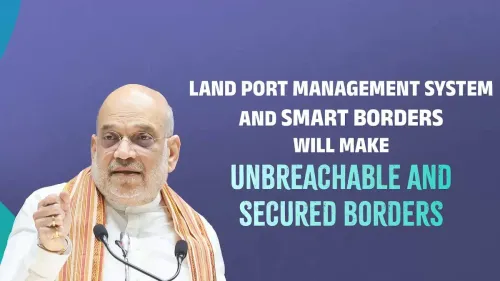
Union Home Minister Amit Shah announced on June 9, 2026 that India's land ports have been upgraded with AI and digital technologies for swift, transparent cargo and passenger movement, forming part of a planned smart-border security grid enabling real-time multi-agency information sharing.
Key Takeaways
Union Home Minister Amit Shah announced on June 9, 2026 that India's land ports are now equipped with the latest digital and AI technologies.
The upgrades are designed to make the legal movement of cargoes, passengers, and vehicles 'swift, transparent, and uninterrupted.' The technology will form part of 'smart borders on the anvil,' enabling spontaneous information sharing through a four-pronged security grid .
The Land Ports Authority of India , under the Ministry of Home Affairs, is the statutory body overseeing land port development since the 2011 Act .
India's first Integrated Check Post opened at Attari in 2012 ; the network has since expanded with progressive digital layering.
Key stakeholders include border traders, customs officials, and multiple security agencies who will share data through the new grid.
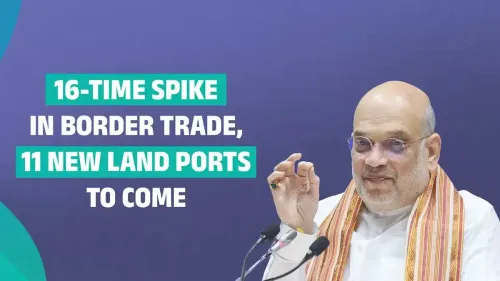
Union Home Minister Amit Shah on Tuesday, June 9, 2026 announced that India's land ports have been equipped with the latest digital and artificial intelligence technologies, enabling swift, transparent, and uninterrupted movement of cargo, passengers, and vehicles. Shah added that the upgrades would form an integral part of 'smart borders' being planned, with a four-pronged security grid enabling spontaneous information sharing among agencies.
Context
In his post, Shah stated: 'Today our land ports have been equipped with the latest digital and AI technologies, making the legal movement of cargoes, passengers, and vehicles swift, transparent, and uninterrupted.' He further noted the upgrades 'will also serve as an integral part of the smart borders on the anvil, facilitating spontaneous sharing of information among agencies in a four-pronged security grid.'
The Land Ports Authority of India (LPAI), a statutory body under the Ministry of Home Affairs, is responsible for developing and managing integrated check posts (ICPs) and land ports along India's borders with neighbouring countries. It was constituted under the Land Ports Authority of India Act, 2011.
Policy Backdrop
India's integrated check post programme has been a cornerstone of border infrastructure policy for over a decade. The first ICP opened at Attari in 2012, establishing a single-window model that combined trade facilitation with security screening at a single facility. Subsequent governments expanded the network, progressively adding digital layers to reduce transaction time and improve surveillance.
The current push to embed AI and digital tools into land port operations reflects a consistent policy emphasis on combining trade facilitation with layered border security along sensitive frontiers. The reference to a 'four-pronged security grid' suggests a multi-agency data-sharing architecture designed to coordinate customs, immigration, intelligence, and border-guarding functions in real time.
Stakeholders and Impact
Border traders and logistics operators stand to benefit most directly from the announced upgrades, as faster and more transparent clearance processes reduce dwell time and costs at land border crossings. Customs officials and security agencies are the intended operational users of the new AI-driven data-sharing infrastructure.
India shares land borders with Bangladesh, Bhutan, China, Myanmar, Nepal, and Pakistan, and land ports along these frontiers handle significant volumes of bilateral trade as well as passenger movement. Technology integration at these points has long been flagged as critical for both economic and national-security reasons. The Ministry of Home Affairs, which Shah heads, oversees both the LPAI and broader internal security architecture.
What's Next
Attention will now turn to the rollout timeline for similar AI and digital systems at the remaining integrated check posts across the country. The formal architecture and operational details of the 'four-pronged security grid' are expected to be elaborated in upcoming MHA communications or budget documentation.
Any formal gazette notification or operational circular from the LPAI would provide further clarity on which specific land ports have been upgraded and the precise capabilities deployed. The smart-borders initiative, if fully realised, could set a precedent for how India manages the intersection of trade facilitation and frontier security in the years ahead.
Point of View
Which, if operationalised, would mark a significant architectural shift in how India manages its land frontiers. This fits a broader pattern under Shah's tenure of using technology as a force-multiplier for border governance, complementing physical infrastructure investments with surveillance and data layers. The announcement also implicitly benchmarks India's land-border management against global smart-border standards, raising the stakes for timely and uniform rollout across all ICPs.
NationPress
25 Oct 2026
Frequently Asked Questions
What did Amit Shah announce about land ports on June 9 2026?
Amit Shah announced that India's land ports have been equipped with the latest digital and AI technologies to make cargo, passenger, and vehicle movement swift, transparent, and uninterrupted, and that these upgrades will form part of a smart-border security grid.
What is the Land Ports Authority of India?
The Land Ports Authority of India (LPAI) is a statutory body under the Ministry of Home Affairs, constituted under the Land Ports Authority of India Act 2011, responsible for developing and managing integrated check posts and land ports at India's borders.
What is India's four-pronged security grid for borders?
Shah referred to a four-pronged security grid as part of the smart-borders initiative, designed to enable spontaneous, real-time information sharing among multiple agencies — including customs, immigration, intelligence, and border-guarding bodies — at land ports.
What was India's first integrated check post and when did it open?
India's first Integrated Check Post (ICP) opened at Attari on the India-Pakistan border in 2012, establishing a single-window model combining trade facilitation and security screening.
How does AI technology help at Indian land ports?
AI and digital technologies at land ports are intended to speed up clearance processes, improve transparency, reduce dwell time for traders and travellers, and enable real-time data sharing among security and customs agencies.