Amit Shah flags Land Port Management System for secure borders
Synopsis
Union Home Minister Amit Shah has declared that the Land Port Management System and Smart Borders initiative will make India's land frontiers unbreachable. The statement reflects the Home Ministry's sustained push to integrate digital surveillance, logistics, and immigration clearance at land ports along the Pakistan, Bangladesh, and Myanmar borders.
Key Takeaways
Union Home Minister Amit Shah on June 9, 2026 said the Land Port Management System and Smart Borders will make India's borders 'unbreachable and secured.' The Land Ports Authority of India (LPAI) , established in 2011 and operational since 2012 , is the statutory body responsible for developing and managing land ports and integrated check posts.
The Comprehensive Integrated Border Management System , approved in the mid-2010s, introduced smart fencing and sensor-based surveillance on western and eastern borders — the framework the current initiative builds upon.
Key stakeholders include the Border Security Force , cross-border traders, and residents in border areas along the Pakistan , Bangladesh , and Myanmar frontiers.
Further cabinet approvals, budget allocations, and parliamentary disclosures on the Land Port Management System's rollout are anticipated in coming months.
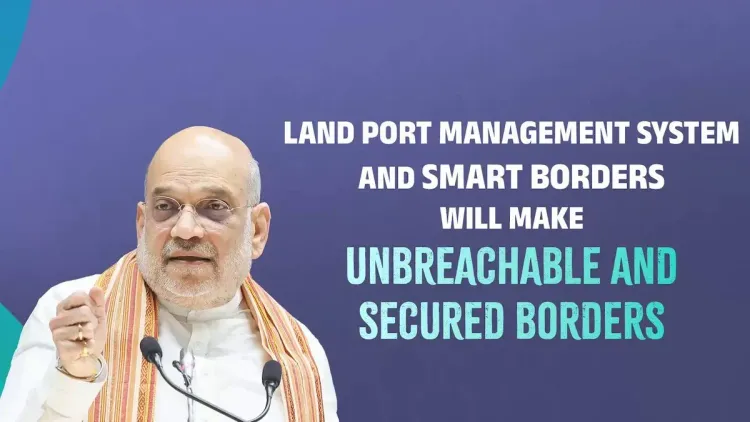
Union Home Minister Amit Shah on Tuesday, June 9, 2026, said the Land Port Management System and Smart Borders initiative will make India's land frontiers 'unbreachable and secured,' signalling the government's continued push toward technology-led border management.
Context
In his post on X, Shah stated: 'Land Port Management System and Smart Borders will make unbreachable and secured borders.' The statement comes as the Ministry of Home Affairs has been progressively digitising border infrastructure across India's land frontiers with Pakistan, Bangladesh, and Myanmar. The remarks underscore a broader governmental emphasis on integrating digital surveillance, logistics management, and immigration clearance into a single operational framework at land entry points.
Policy Backdrop
The institutional foundation for this push is the Land Ports Authority of India (LPAI), a statutory body established under an Act of Parliament in 2011 and made operational in 2012 under the Ministry of Home Affairs. The LPAI was created to develop and manage Integrated Check Posts (ICPs) — modern border facilities that replaced older land customs stations and offer single-window clearance for trade, immigration, and security functions. In the mid-2010s, the government approved the Comprehensive Integrated Border Management System framework, which introduced sensor-based surveillance and smart fencing along the western and eastern borders. The current Land Port Management System appears to build on this lineage, extending digital integration deeper into port-level operations.
Stakeholders and Impact
The initiative directly affects multiple constituencies: the Border Security Force (BSF), which guards the India-Pakistan and India-Bangladesh frontiers and is increasingly involved in technology-based surveillance; cross-border traders who depend on efficient and transparent clearance systems; and border-area residents whose daily movement is shaped by the operational tempo of land ports. Proponents argue that a unified digital management system reduces manual chokepoints that have historically been exploited for smuggling and illegal crossings. At the same time, a robust smart-border architecture is expected to accelerate authorised trade flows under India's neighbourhood and Act East policy frameworks.
What's Next
Further details on the Land Port Management System — including its technical architecture, phased rollout timeline, and budget allocation — are expected to emerge through cabinet approvals and parliamentary committee disclosures in coming months. Observers will watch for fresh announcements on new Integrated Check Posts, expanded smart fencing contracts, and interoperability agreements with border agencies of neighbouring countries. The Home Ministry's emphasis on 'unbreachable' borders also sets the tone for upcoming legislative and budgetary sessions where border infrastructure spending is likely to feature prominently.
Point of View
Multi-agency corridors. By publicly branding the Land Port Management System alongside 'Smart Borders,' the minister signals that the government intends to unify what have historically been fragmented efforts — customs, immigration, and surveillance — under a single technological umbrella. The timing, ahead of likely budget and legislative sessions, also serves to frame border security as a governance achievement rather than merely a defence imperative. For the BJP, which has consistently positioned strong borders as a political identity marker, such announcements carry both administrative and electoral resonance.
NationPress
26 Oct 2026
Frequently Asked Questions
What is the Land Port Management System in India?
The Land Port Management System is a digital platform being promoted by the Ministry of Home Affairs to manage operations at India's land ports, integrating security, immigration, and trade clearance functions into a unified system. Detailed technical specifications and a full rollout timeline have not yet been officially disclosed.
What is Smart Borders India?
Smart Borders refers to the government's approach of deploying technology — including sensors, cameras, smart fencing, and digital management platforms — to monitor and control movement across India's land frontiers with Pakistan, Bangladesh, and Myanmar.
What is the Land Ports Authority of India?
The Land Ports Authority of India (LPAI) is a statutory body set up under the Ministry of Home Affairs by an Act of Parliament in 2011 , made operational in 2012 , to develop and manage integrated check posts and land ports for cross-border trade and movement.
What are Integrated Check Posts in India?
Integrated Check Posts (ICPs) are modern border facilities developed since the 2000s to replace older land customs stations. They offer single-window clearance covering trade, immigration, and security checks at key land border crossings.
What is the Comprehensive Integrated Border Management System?
The Comprehensive Integrated Border Management System is a framework approved by the Indian government in the mid-2010s for sensor-based surveillance and smart fencing along the western and eastern land borders, aimed at curbing illegal crossings and smuggling.