Amit Shah contrasts Congress loan waivers with Modi's direct farm transfers
Synopsis
Home Minister Amit Shah contrasted Congress's ₹60,000 crore farm loan waiver over a decade with the Modi government's claimed ₹4.28 lakh crore deposited directly into farmers' bank accounts, reinforcing the BJP's direct-transfer narrative ahead of agrarian state elections.
Key Takeaways
Union Home Minister Amit Shah posted a direct numerical comparison between Congress's farm loan waiver record and the Modi government's direct transfers to farmers.
The Congress-led UPA government announced a ₹60,000 crore central farm loan waiver in 2008 for small and marginal farmers.
The BJP claims ₹4 lakh 28 thousand crore has been deposited directly into farmers' bank accounts under PM Modi .
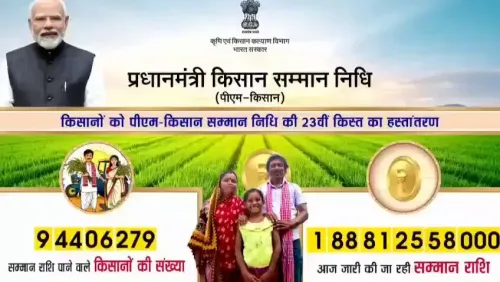
The PM-KISAN scheme, launched in February 2019 , provides ₹6,000 per year per farmer through the Direct Benefit Transfer framework.
The BJP's framing positions recurring direct transfers as superior to episodic debt relief in terms of targeting and financial inclusion.
The debate is expected to intensify ahead of Union Budget 2027 and upcoming elections in agrarian states.
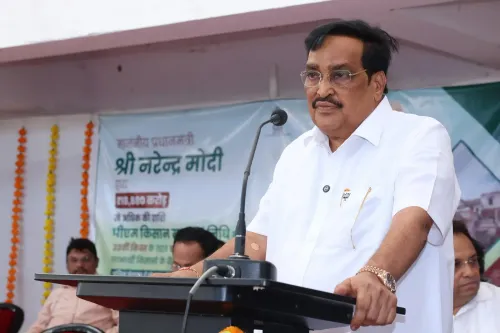
Union Home Minister Amit Shah on Saturday, 20 June 2026, sharpened the BJP's agrarian outreach by drawing a pointed comparison between the Congress-led UPA government's farm loan waiver record and the direct income support delivered to farmers under Prime Minister Narendra Modi.
Context
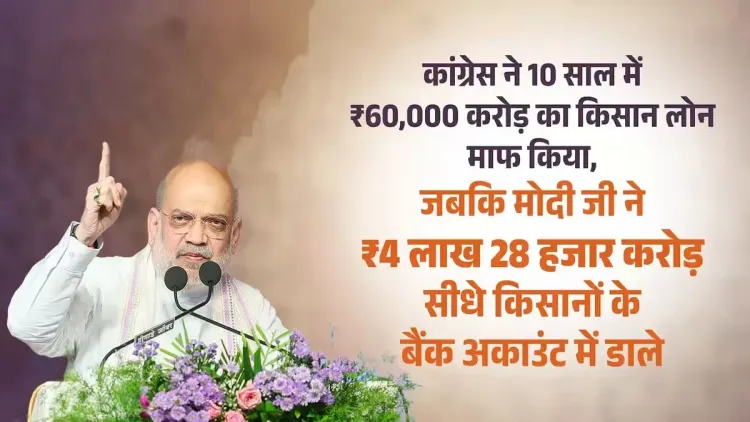
In his post, Shah wrote: 'Congress ne 10 saal mein ₹60,000 crore ka kisan loan maaf kiya, jabki Modi ji ne ₹4 lakh 28 hazar crore seedhe kisanon ke bank account mein daale' — 'Congress waived farm loans worth ₹60,000 crore in 10 years, while Modi has deposited ₹4 lakh 28 thousand crore directly into farmers' bank accounts.' The statement places the two policy approaches — episodic debt relief versus recurring direct transfers — in direct numerical contrast.
The remark comes as the BJP continues to highlight its welfare delivery record in states with large agrarian constituencies, where farm distress remains a defining electoral issue.
Policy Backdrop
The UPA government announced a landmark ₹60,000 crore central farm loan waiver in 2008, targeting small and marginal farmers burdened by agricultural debt. The measure was widely credited with providing relief but was also criticised by economists for leakage, moral hazard, and disruption of rural credit culture.
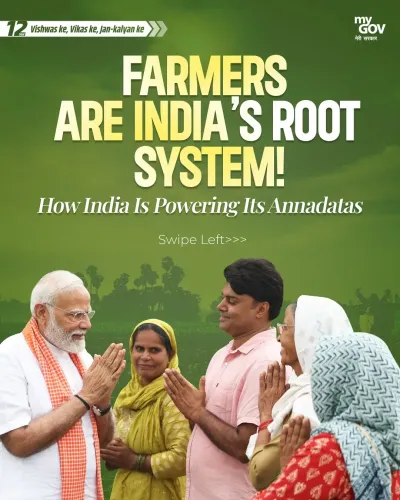
The Pradhan Mantri Kisan Samman Nidhi (PM-KISAN) scheme, launched in February 2019, shifted the government's approach by providing ₹6,000 per year in three instalments directly into the bank accounts of landholding farmers via the Direct Benefit Transfer (DBT) framework. The DBT architecture, scaled nationally after 2014, links payments to Aadhaar-seeded accounts to reduce intermediary leakage. Shah's figure of ₹4 lakh 28 thousand crore represents the BJP's claimed cumulative disbursement under this and related direct transfer programmes.
Multiple Congress-governed states also announced fresh agricultural debt waivers between 2017 and 2023, keeping loan relief as a contested policy instrument at the state level even as the Centre moved toward recurring transfers.
Stakeholders and Impact
Small and marginal farmers — who constitute the majority of India's agricultural households — sit at the centre of this policy debate. Proponents of direct transfers argue the DBT model ensures money reaches the intended beneficiary without delay or diversion, while critics of loan waivers point to their tendency to benefit larger borrowers disproportionately.
Rural banks and cooperative credit institutions have historically borne the burden of waiver-driven non-performing assets. The shift to income support, supporters argue, keeps credit discipline intact while still augmenting farm household income. Opposition voices counter that ₹6,000 per year is inadequate given rising input costs and that debt relief addresses structural distress more directly.
What's Next
Attention will now turn to Union Budget 2027 allocations for PM-KISAN and whether the government expands the per-farmer annual support amount, a demand that farm unions have repeatedly raised. Any fresh parliamentary discussion on agricultural credit reform or a revision of PM-KISAN eligibility criteria will test the durability of the direct-transfer model Shah is championing. With several agrarian state assembly elections on the horizon, the BJP's framing of welfare delivery as a contrast to Congress-era loan waivers is likely to intensify further.
Point of View
The messaging keeps the opposition on the defensive without engaging with state-level waivers announced by BJP governments themselves. The timing, ahead of agrarian state elections, signals that farm welfare will remain a central axis of the ruling party's political communication. Whether voters respond to cumulative transfer figures or to immediate distress relief will be the real test of this framing's electoral potency.
NationPress
19 Sept 2026
Frequently Asked Questions
What is PM-KISAN and how much money has been transferred under it?
PM-KISAN (Pradhan Mantri Kisan Samman Nidhi) is a central government scheme launched in February 2019 that provides ₹6,000 per year in direct bank transfers to landholding farmers. Home Minister Amit Shah has cited a cumulative figure of ₹4 lakh 28 thousand crore transferred to farmers under the Modi government's direct benefit programmes.
How much did the Congress government waive in farm loans?
The Congress-led UPA government announced a ₹60,000 crore central farm loan waiver in 2008 targeting small and marginal farmers. Shah's post references this figure as the benchmark for Congress's 10-year farm welfare record.
What is the difference between a farm loan waiver and direct benefit transfer?
A farm loan waiver cancels outstanding agricultural debt owed to banks, providing relief to indebted farmers but often disrupting rural credit culture. A direct benefit transfer deposits cash directly into a farmer's bank account on a recurring basis, aiming for better targeting and reduced leakage through intermediaries.
Why is Amit Shah comparing Congress and BJP farm policies now?
The BJP has consistently used the contrast between UPA-era loan waivers and its own direct transfer model as a political messaging tool, particularly ahead of elections in agrarian states where farm distress is a key voter concern.
What happens to PM-KISAN in the next Union Budget?
Union Budget 2027 is expected to be a key moment for PM-KISAN, with farm unions demanding an increase in the ₹6,000 annual support amount. Any revision to eligibility criteria or disbursement amounts will be closely watched by rural voters and agricultural credit institutions.