Amit Shah: Modi's 25-year run transformed India from 'Fragile Five' to global powerhouse
Synopsis
Home Minister Amit Shah used a high-profile Mumbai press conference to frame Modi's 25-year uninterrupted run in power as a civilisational reset — from 'Fragile Five' pariah to global growth engine — while announcing a month-long nationwide service drive and predicting UCC enactment across all 21 NDA-governed states before 2029. The political stakes ahead of 2029 are unmistakable.
Key Takeaways
Amit Shah declared that PM Modi 's 25-year tenure from 2001 to 2026 transformed India from a 'Fragile Five' economy to a global growth engine.
Shah announced a month-long 'Seva Sankalp Abhiyan' to mark Modi's silver jubilee in public office on 7 October 2026 .
The Home Minister reaffirmed a zero-tolerance policy on illegal migration, pledging identification and deportation of undocumented migrants nationwide.
Uniform Civil Code (UCC) implementation is expanding; Shah expressed confidence all 21 NDA-governed states will enact it before 2029 .
Internal security milestones cited include abrogation of Article 370 , near-elimination of Naxalism , and reduced insurgency in the Northeast .
The press conference was held alongside Maharashtra CM Devendra Fadnavis and Deputy CM Eknath Shinde in Mumbai .
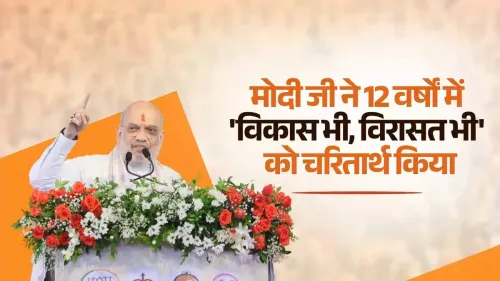
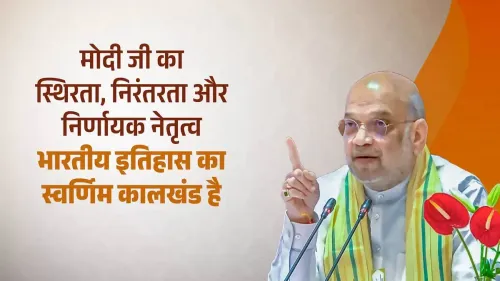
Union Home Minister Amit Shah on Sunday, 13 September 2026, declared that Prime Minister Narendra Modi's uninterrupted 25-year tenure — spanning his role as Gujarat Chief Minister and subsequently as Prime Minister of India from 2001 to 2026 — has fundamentally reshaped both the state and the nation, replacing what he described as decades of administrative decay with a clear 'politics of performance.'
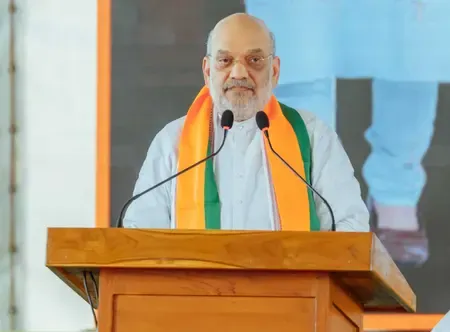
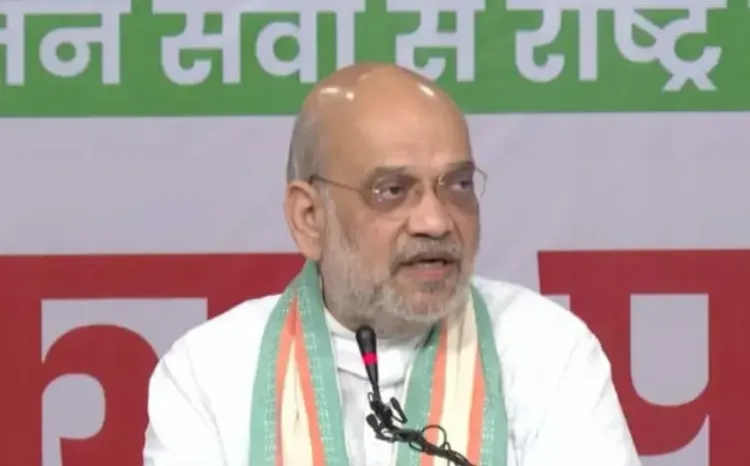
Shah made the remarks at a joint press conference in Mumbai, flanked by Maharashtra Chief Minister Devendra Fadnavis and Deputy Chief Minister Eknath Shinde, where he also announced a month-long nationwide 'Seva Sankalp Abhiyan' to mark Modi's silver jubilee in public office on 7 October 2026.
From 'Fragile Five' to Growth Engine
Drawing a sharp contrast between the UPA era and the post-2014 period, Shah argued that India has shed its former status as one of the so-called 'Fragile Five' economies — a grouping of emerging markets deemed vulnerable by global investors — to emerge as a leading global growth engine. Critics and opposition leaders have historically contested such characterisations, noting that structural challenges including unemployment and inequality persist.
'Before 2014, the nation's path was crippled by three systemic evils — casteism, corruption, and nepotism,' Shah said. 'Over the last 12 years, these afflictions have been systematically eliminated. The public has, for the first time since Independence, witnessed a decisive and firm foreign policy.'
Internal Security and Constitutional Milestones
Shah highlighted what he called landmark achievements in internal security, citing the abrogation of Article 370 in Jammu and Kashmir, the near-elimination of Left-Wing Extremism (Naxalism), and the winding down of insurgency in the Northeast as defining outcomes of the Modi government's tenure. He also reaffirmed the Centre's zero-tolerance policy on cross-border infiltration and illegal migration, stating that undocumented migrants across the country would be identified and deported.
On national security doctrine, Shah asserted that any attack resulting in casualties among Indian citizens or armed forces now draws an immediate and publicly visible retaliatory response — a reference widely interpreted as alluding to recent military actions along India's borders.
Uniform Civil Code Push Across NDA States
On the legal reform front, Shah confirmed that implementation of the Uniform Civil Code (UCC) is expanding across states, expressing confidence that all 21 states currently governed by the Bharatiya Janata Party (BJP)-National Democratic Alliance (NDA) coalition will fully enact the UCC before 2029. The UCC remains among the most contested political and legal proposals in the country, with opposition parties and minority groups raising concerns over its scope and implications.
Seva Sankalp Abhiyan: Scale and Timing
To mark PM Modi's birthday on 17 September and his completion of 25 continuous years as head of government on 7 October 2026, the NDA family alongside civil society organisations will execute a month-long public service drive. Shah noted that while Modi's birthday was traditionally observed as 'Seva Saptah' (Service Week) from 17 September to 2 October, the scale has been expanded this year to a full month.
'In a democratic system, very few leaders in history hold a record of continuous, uninterrupted public service as a state's Chief Minister and the nation's Prime Minister,' Shah said, adding that the campaign aims to align the nation toward making India a world leader in every sphere by 2047.
Shah also noted that Indian regional languages received unprecedented national priority under Modi's tenure — the first such emphasis, he claimed, since 1947. As the Seva Sankalp Abhiyan gets underway, all eyes will be on whether the NDA can translate the political messaging of Modi's silver jubilee into tangible outreach across swing states ahead of the next electoral cycle.
Point of View
And the BJP is clearly road-testing a 'continuity and performance' narrative against a resurgent opposition. The 'Fragile Five' framing is potent but selective: India's macro credentials have strengthened, yet joblessness, rural distress, and income inequality remain live vulnerabilities the speech glosses over. The UCC pledge — all 21 NDA states by 2029 — is the sharpest political signal buried in the statement, signalling the party intends to use legal reform as a mobilising wedge heading into the next cycle. What is missing from the narrative is accountability data: which specific benchmarks moved, by how much, and verified by whom.
NationPress
13 Sept 2026
Frequently Asked Questions
What is the 'Seva Sankalp Abhiyan' announced by Amit Shah?
It is a month-long nationwide public service drive announced by Home Minister Amit Shah to mark PM Modi's 25th continuous year in public office, observed from 17 September through 7 October 2026. The campaign is organised by the NDA family alongside civil society organisations and expands on the earlier 'Seva Saptah' format that ran annually from 17 September to 2 October.
What did Amit Shah mean by India moving from 'Fragile Five' to a global powerhouse?
The 'Fragile Five' was a label coined by global investors around 2013 for emerging economies — including India — seen as vulnerable due to high current account deficits and inflation. Shah argued that post-2014 economic and governance reforms have reversed that vulnerability, positioning India as a leading global growth engine, though critics note that structural challenges persist.
Which states are expected to implement the Uniform Civil Code before 2029?
Amit Shah stated that all 21 states currently governed by the BJP-NDA coalition are expected to fully enact the Uniform Civil Code (UCC) before 2029. Implementation is already under way in some states, but the UCC remains contested, with opposition parties and minority groups raising concerns over its scope.
What internal security achievements did Amit Shah highlight?
Shah cited three major milestones: the abrogation of Article 370 in Jammu and Kashmir, the near-elimination of Left-Wing Extremism (Naxalism), and a significant reduction in insurgency in the Northeast. He also reaffirmed a zero-tolerance policy on cross-border infiltration and illegal migration.
When does PM Modi complete 25 years in continuous public office?
PM Modi completes 25 uninterrupted years as head of government — first as Gujarat Chief Minister from 2001 and then as Prime Minister from 2014 — on 7 October 2026. His birthday falls on 17 September, around which the Seva Sankalp Abhiyan is centred.