Amit Shah announces Modus Operandi Bureau for data-driven crime prevention
Synopsis
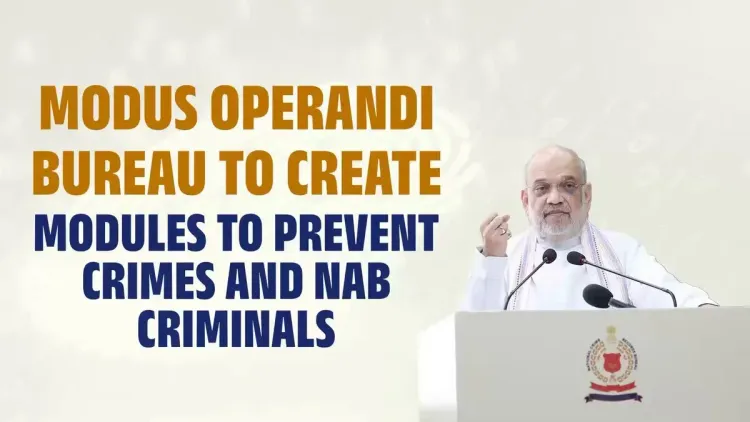
Union Home Minister Amit Shah on June 19, 2026, announced a Modus Operandi Bureau that will develop analytical modules to prevent crimes and catch criminals by drawing on a centralised data repository, extending India's decade-long push toward technology-enabled, data-centric policing.
Key Takeaways
Amit Shah announced the Modus Operandi Bureau on June 19, 2026 , via an official post on X.
The bureau will 'create modules to prevent crimes and nab criminals by leveraging data repository,' according to Shah .
The initiative builds on infrastructure established by the Crime and Criminal Tracking Network and Systems (CCTNS) , launched in 2009 .
The National Crime Records Bureau (NCRB) under the Ministry of Home Affairs currently anchors India's centralised crime data ecosystem.
State police forces and central agencies are the primary beneficiaries; data-sharing agreements with states will be key to implementation.
Formal mandate, budget, and rollout timelines for the bureau have not yet been publicly disclosed.
Union Home Minister Amit Shah on Friday, June 19, 2026, announced that a Modus Operandi Bureau will be established to prevent crimes and apprehend criminals by leveraging a centralised data repository, signalling a significant push toward technology-enabled policing in India.
Context
In his post, Shah stated that the Modus Operandi Bureau 'will create modules to prevent crimes and nab criminals by leveraging data repository.' The announcement positions the bureau as a dedicated analytical unit designed to identify patterns in criminal behaviour and use that intelligence to pre-empt offences and accelerate the apprehension of repeat offenders.
The Ministry of Home Affairs (MHA), which Shah heads, is the nodal body for internal security and police modernisation across India. The bureau, as described, would sit within this broader institutional framework and draw on centralised crime data to build actionable modules for state and central law enforcement agencies.
Policy Backdrop
India's move toward data-centric policing has been underway for over a decade. The Crime and Criminal Tracking Network and Systems (CCTNS), launched in 2009, created a nationwide networked database linking police stations across states to a common repository of crime and criminal records. The proposed Modus Operandi Bureau appears to build on this infrastructure by adding a dedicated analytical layer focused on behavioural and methodological patterns in criminal activity.
The National Crime Records Bureau (NCRB), operating under the MHA, has long maintained national crime statistics and supported data-driven policing initiatives. A specialised bureau focused on modus operandi — the characteristic methods criminals use — would complement the NCRB's existing mandate by shifting emphasis from record-keeping to predictive and preventive analytics.
This announcement fits a broader pattern under successive governments of integrating state-level police records with central repositories and deploying technology for organised and repeat crime investigations.
Stakeholders and Impact
State police forces and central investigation agencies are the primary stakeholders. If the bureau's modules are made accessible to ground-level investigators, they could assist in linking cases across jurisdictions — a persistent challenge in prosecuting organised crime, serial offenders, and inter-state criminal networks.
For citizens, the practical impact would depend on how effectively the bureau's intelligence translates into faster case resolution and crime deterrence. Data-sharing agreements between the Centre and individual states will be critical, given that policing is a state subject under India's constitutional framework.
What's Next
Key details — including the bureau's formal mandate, organisational structure, budgetary allocation, and rollout timeline — are yet to be made public. Parliamentary references or budgetary provisions in forthcoming sessions will offer the clearest indication of how quickly the initiative moves from announcement to operationalisation.
Observers will also watch whether the bureau's data architecture is designed to interoperate with existing systems like CCTNS and state-level crime databases, and whether data-privacy safeguards are built into its framework from the outset. The initiative reflects India's accelerating ambition to place analytical intelligence at the centre of its law-enforcement strategy.
Point of View
' Shah is signalling an intent to standardise investigative pattern-recognition across jurisdictions — a capability gap that has historically allowed organised and repeat offenders to exploit the seams between state police forces. The move also reflects a wider global trend of law-enforcement agencies investing in behavioural analytics, though India's federal policing structure means Centre-state data-sharing arrangements will determine whether the bureau delivers operational value or remains a coordination aspiration. The absence of specifics on budget and legal framework suggests the announcement is at a policy-direction stage, with institutional architecture still to be formalised.
NationPress
18 Sept 2026
Frequently Asked Questions
What is the Modus Operandi Bureau announced by Amit Shah?
The Modus Operandi Bureau is a proposed unit announced by Union Home Minister Amit Shah on June 19, 2026 , that will create analytical modules to prevent crimes and help catch criminals by drawing on a centralised data repository.
How does the Modus Operandi Bureau relate to CCTNS?
The Crime and Criminal Tracking Network and Systems (CCTNS) , launched in 2009 , built a nationwide networked crime database. The Modus Operandi Bureau is expected to build on this infrastructure by adding a dedicated layer of pattern-based and predictive analytics.
Which ministry oversees the Modus Operandi Bureau?
The bureau falls under the Ministry of Home Affairs (MHA) , headed by Amit Shah , which is responsible for internal security and police modernisation in India.
Who will benefit from the Modus Operandi Bureau?
State police forces and central investigation agencies are the primary beneficiaries, as the bureau's modules are intended to help link cases across jurisdictions and identify repeat or organised criminal activity.
When will the Modus Operandi Bureau become operational?
No formal rollout timeline has been announced yet. Details on the bureau's mandate, budget, and operational framework are expected to emerge through parliamentary proceedings or official government notifications.