Shekhawat marks 75 years of BJP's ideological journey from Jana Sangh
Synopsis
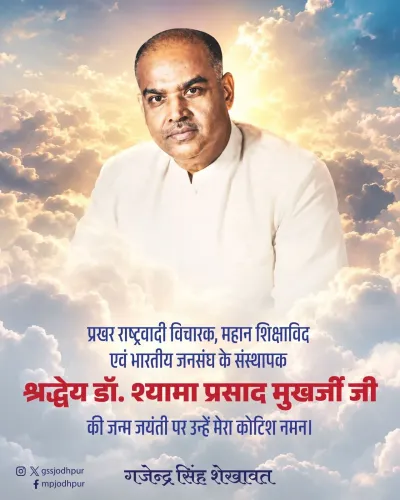
Union Culture Minister Gajendra Singh Shekhawat marks 75 years since the founding of the Bharatiya Jana Sangh on 21 October 1951, connecting Dr. Shyama Prasad Mukherjee's original vision to the BJP's present-day governance and the 2019 abrogation of Article 370.
Key Takeaways
Bharatiya Jana Sangh was founded on 21 October 1951 by Dr.
Shyama Prasad Mukherjee , making this its 75th founding anniversary .
Mukherjee launched an agitation against the Kashmir permit system, was arrested crossing into the state in 1953 , and died in detention.
Pandit Deendayal Upadhyaya developed Integral Humanism as the Jana Sangh's and later BJP's philosophical cornerstone.
The Bharatiya Janata Party was established in April 1980 after the Janata Party coalition dissolved.
The abrogation of Article 370 in August 2019 is described in the post as fulfilling Mukherjee's founding demand for one nation, one law.
Shekhawat links welfare schemes — Ayushman Bharat , PM Awas Yojana , and Har Ghar Jal — to the party's founding principles of Antyodaya and Rashtra Pratham .
Seventy-five years ago today, amid the wounds of Partition and the chaos of displacement, Dr. Shyama Prasad Mukherjee stood up a political movement on a single, uncompromising principle: one nation, one law, one flag. On 21 October 2026, Union Culture and Tourism Minister Gajendra Singh Shekhawat marked the founding anniversary of the Bharatiya Jana Sangh — the organisational precursor to the BJP — with a sweeping post on X that traced 75 years of what he called an unbroken ideological journey.
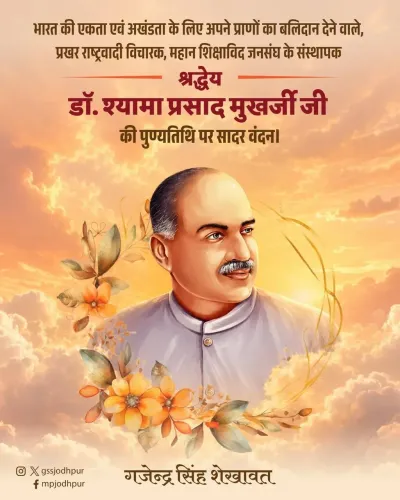
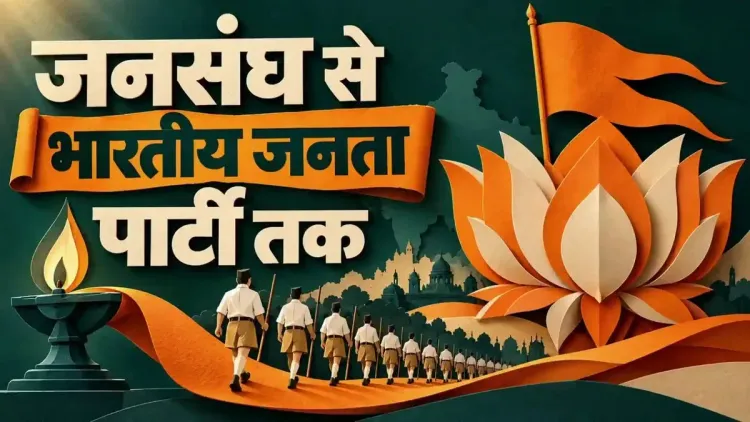
Shekhawat's post, written in Hindi, opens with the founding moment: 'जनसंघ से भारतीय जनता पार्टी तक: एक अनवरत वैचारिक यात्रा!' — 'From Jana Sangh to BJP: an unbroken ideological journey!' — before anchoring the anniversary in Dr. Mukherjee's most defiant declaration against the permit system in Jammu and Kashmir: 'One country cannot have two constitutions, two flags, and two heads of government.'
The man who started it all — and paid with his life
The Bharatiya Jana Sangh was founded on 21 October 1951 by Dr. Shyama Prasad Mukherjee, a former minister in Jawaharlal Nehru's cabinet who broke with the Congress over what he saw as the appeasement of separatist sentiment in Kashmir. Mukherjee launched a historic agitation against the permit system that required Indians to seek special permission to enter Jammu and Kashmir — a provision he viewed as a direct affront to national unity. He crossed into Kashmir in 1953 without a permit as an act of protest, was arrested, and died in detention. The movement he left behind became the party's founding martyr-narrative.
Shekhawat's post invokes that sacrifice explicitly, calling it a 'balidam' — a consecrated giving of one's life — for the country's unity. It is a framing the BJP has returned to consistently across its organisational history.
From Upadhyay's philosophy to Vajpayee's prime ministership
The post then traces the ideological lineage through a roster of towering figures. Pandit Deendayal Upadhyaya gave the Jana Sangh its philosophical spine with the doctrine of Integral Humanism (Ekatma Manavavad) — a framework that sought a distinctly Indian alternative to both Western capitalism and Soviet socialism, centred on the welfare of the last person in society (Antyodaya). Atal Bihari Vajpayee and L.K. Advani carried the organisation through the turbulent years of the 1975 Emergency, when Jana Sangh leaders joined the broader opposition resistance to what the post calls the 'difficult days' of authoritarian rule.
When the Janata Party coalition collapsed in 1980, the Jana Sangh's core reconstituted itself as the Bharatiya Janata Party — the direct institutional successor Shekhawat is celebrating today. Nana Ji Deshmukh, also cited in the post, was among the leaders who bridged grassroots social work with political organisation across this transition.
Article 370's abrogation: the anniversary centrepiece
The post's most politically charged moment arrives when Shekhawat describes the August 2019 abrogation of Article 370 — which removed Jammu and Kashmir's special constitutional status — as the fulfilment of Dr. Mukherjee's original dream. Under Prime Minister Narendra Modi and Home Minister Amit Shah, the post says, the seven-decade-old demand that had defined the Jana Sangh's founding agitation was finally answered.
The constitutional change, executed by presidential order in August 2019, had been a BJP manifesto commitment since the party's formation and a Jana Sangh demand even before that. For the BJP's base, the framing Shekhawat deploys — Mukherjee's sacrifice in 1953 redeemed in 2019 — is a story of historical closure spanning 66 years.
Welfare programmes as ideological proof of concept
Shekhawat closes the arc in the present, arguing that the principles of 'Rashtra Pratham' (Nation First), 'Antyodaya', and 'Ekatma Manavavad' are now expressed through flagship welfare schemes: Ayushman Bharat (national health insurance), Pradhan Mantri Awas Yojana (housing), and Har Ghar Jal (piped water to every home). The rhetorical move is deliberate — connecting a 1951 philosophical origin to 21st-century governance deliverables to argue continuity of purpose, not just continuity of organisation.
As the party marks 75 years of unbroken ideological lineage, the anniversary is as much a declaration of direction as it is a moment of remembrance. The journey, as Shekhawat puts it, 'anwarat jaari hai' — continues uninterrupted.
Point of View
The post frames 66 years of waiting as patient resolve rather than delayed governance. The inclusion of welfare schemes alongside nationalist milestones is also deliberate, reflecting the BJP's sustained effort to marry its 'Rashtra Pratham' identity with a credible 'Antyodaya' social-welfare pitch — two constituencies, one ideological umbrella. As the party approaches its own 46th year as the BJP, such anniversary messaging calibrates internal cadre pride while projecting a long-arc legitimacy to undecided voters.
NationPress
21 Oct 2026
Frequently Asked Questions
When was the Bharatiya Jana Sangh founded and by whom?
The Bharatiya Jana Sangh was founded on 21 October 1951 by Dr. Shyama Prasad Mukherjee , who sought to build a nationalist political alternative in post-Partition India.
How is the BJP related to the Bharatiya Jana Sangh?
The BJP is the direct successor to the Jana Sangh. After the Janata Party coalition dissolved, Jana Sangh leaders re-formed under the name Bharatiya Janata Party in April 1980 , carrying forward the same organisational and ideological core.
What was Dr. Shyama Prasad Mukherjee's demand regarding Kashmir?
Dr. Mukherjee demanded abolition of the special permit system that required Indian citizens to seek permission to enter Jammu and Kashmir. His famous slogan was that one country could not have two constitutions, two flags, and two heads of government. He died in detention in 1953 after crossing into Kashmir in protest.
What is Integral Humanism in the context of the BJP?
Integral Humanism ( Ekatma Manavavad ) is a philosophical doctrine developed by Pandit Deendayal Upadhyaya that became the Jana Sangh's and later BJP's ideological foundation, proposing a distinctly Indian model of development centred on holistic human welfare rather than Western capitalism or Soviet socialism.
Why does the BJP link Article 370's abrogation to its founding history?
Removing Article 370's special status for Jammu and Kashmir was a founding demand of the Jana Sangh, rooted in Dr. Mukherjee's agitation. When it was abrogated in August 2019 under PM Narendra Modi , the BJP described it as the fulfilment of a 66-year-old promise — directly completing the original mission for which Mukherjee had sacrificed his life.